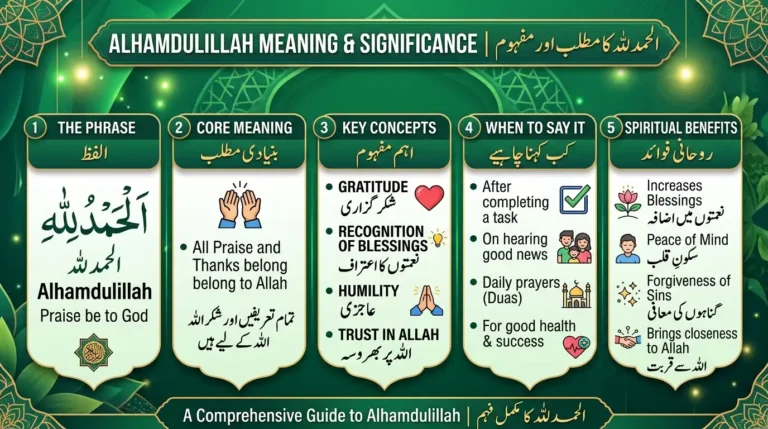
When to Say Alhamdulillah: Situations, Meaning & Examples
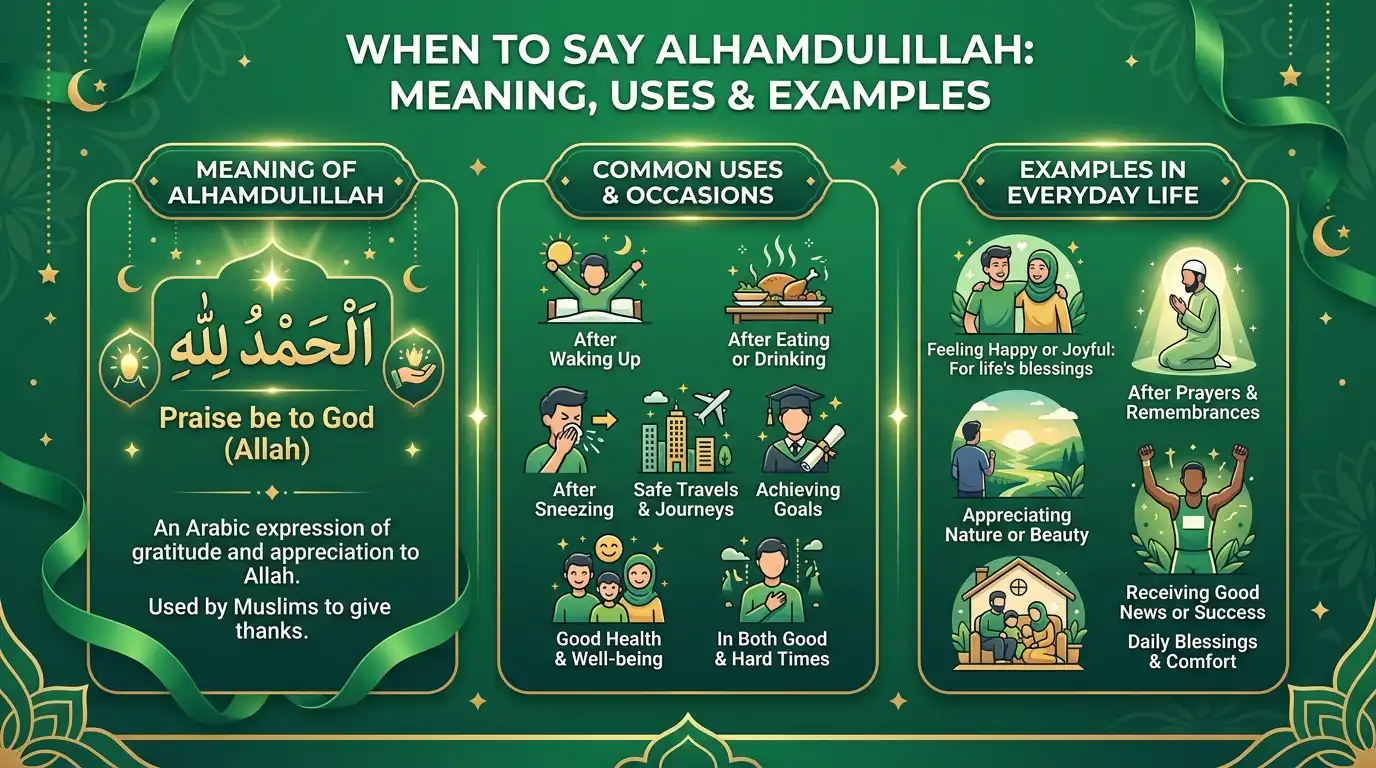
Knowing when to say Alhamdulillah is about more than using a familiar Islamic phrase. Muslims commonly say Alhamdulillah to praise and thank Allah for blessings, good news, ordinary moments, and even while facing difficulties. The expression can acknowledge gratitude without pretending that every situation is easy or painless.
This guide explains the meaning of Alhamdulillah, when it is appropriate to say it, how Muslims may use it after good news or success, and why gratitude can remain meaningful during hardship. It also gives practical examples for everyday situations, including health, family, studies, work, recovery, and the simple gift of another day of life.

What Does Alhamdulillah Mean?
Alhamdulillah is written in Arabic as الحمد لله. It is commonly translated as “praise be to Allah” or “all praise is due to Allah.” The expression combines praise of Allah with an attitude of gratitude and recognition of His blessings.
The phrase appears at the beginning of the Quran in Surah Al-Fatihah: Alhamdu lillahi Rabbil-‘Alamin, meaning “All praise is due to Allah, Lord of the worlds.” Because of its central place in Islamic worship, Alhamdulillah is familiar to Muslims around the world.
Saying Alhamdulillah does not necessarily mean that a person believes everything that happens is pleasant. Rather, it can express recognition of Allah’s goodness, dependence on Him, and gratitude for what has been given.
When Should You Say Alhamdulillah?
There is no single everyday situation in which Muslims are restricted to saying Alhamdulillah. It can be used naturally whenever a person wants to praise Allah or acknowledge a blessing. The context determines the meaning and emotional emphasis.
| Situation | Example | Why Say Alhamdulillah? |
|---|---|---|
| Good news | Receiving a job offer | To express gratitude for the blessing |
| Health | Feeling well after illness | To acknowledge the blessing of health |
| Success | Passing an exam | To recognize Allah’s favor and be thankful |
| Daily life | Eating, resting, spending time with family | To appreciate ordinary blessings |
| Hardship | Facing a difficult period | To maintain praise and trust in Allah |
Should You Say Alhamdulillah During Hardship?
Yes. A Muslim may say Alhamdulillah during hardship, although this should not be confused with denying pain, sadness, fear, or the seriousness of a problem. Islamic gratitude does not require someone to pretend that suffering is enjoyable.
During a difficult period, saying Alhamdulillah can express gratitude for the blessings that remain, such as faith, family, another day of life, opportunities for patience, or the hope of relief. A person can also ask Allah for help, healing, protection, and an end to the difficulty.
You can acknowledge the hardship honestly while still being grateful. Saying Alhamdulillah does not mean you cannot ask for help or admit that something hurts.
Saying Alhamdulillah After Good News
One of the most natural times to say Alhamdulillah is after receiving good news. For example, someone may say it after hearing that a family member has recovered, receiving a new job, completing an important project, or receiving an academic result they hoped for.
“Alhamdulillah, I passed my exam.”
Here the phrase expresses gratitude for the successful result rather than presenting success as something achieved entirely through personal ability.

Saying Alhamdulillah for Everyday Blessings
Gratitude does not have to be reserved for major events. Muslims may say Alhamdulillah for everyday blessings that are easy to overlook: waking up, having food, spending time with loved ones, being able to work, learning something useful, enjoying a peaceful moment, or simply having another opportunity to do something beneficial.
Alhamdulillah for Today
Saying “Alhamdulillah for today” can be a simple personal expression of gratitude. It may be especially meaningful when someone has gone through a difficult period and wants to recognize the value of another day.
Alhamdulillah for the Gift of Life
The phrase can also be used when reflecting on life itself. Gratitude for life may include appreciation for health, family, opportunities, knowledge, faith, and the ability to make positive choices.
Alhamdulillah for Success
Success can take many forms: passing an exam, completing a degree, getting a promotion, starting a business, finishing a difficult project, or reaching a personal goal. Saying Alhamdulillah after success places that achievement within a wider attitude of gratitude.
- “Alhamdulillah, I passed my exam.”
- “Alhamdulillah, I completed my degree.”
- “Alhamdulillah, I received the job I was hoping for.”
- “Alhamdulillah, my family is safe.”
- “Alhamdulillah, I have completed this difficult project.”
Gratitude after success can also help prevent arrogance. Achievement still requires effort, preparation, discipline, and responsibility, but a believer may recognize that opportunities, abilities, and favorable circumstances are blessings as well.
What Do You Say After Alhamdulillah?
There is no universal response that must be said every time another person says Alhamdulillah in ordinary conversation. The appropriate response depends on the context.
For example, if someone says, “Alhamdulillah, I passed my exam,” you could respond with a congratulatory statement such as “MashaAllah” or simply congratulate them. If Alhamdulillah is said as part of a specific Islamic supplication, prayer, or established religious expression, the appropriate wording may depend on that particular context.
Examples of Saying Alhamdulillah
After Passing an Exam
“Alhamdulillah, I passed my exam.” This is a natural expression of gratitude after an academic achievement.
After Recovery
“Alhamdulillah, I am feeling better now.” The phrase can acknowledge improvement while recognizing the blessing of health.
After Receiving a Job
“Alhamdulillah, I got the job.” This combines the announcement of good news with gratitude.
For Family
“Alhamdulillah for my family.” This can express appreciation for family relationships and the blessings associated with them.
During a Difficult Time
“Alhamdulillah in every situation.” Such wording can reflect patience and continued praise while the person still seeks relief and support.
Alhamdulillah for the Gift of Life
Life contains both ease and difficulty. Reflecting on the gift of life can encourage a person to notice blessings that are often treated as ordinary. Breathing, seeing, hearing, learning, loving others, and having opportunities to improve are examples of experiences that may inspire gratitude.
Saying Alhamdulillah for the gift of life is therefore not limited to a particular event. It can become a regular reminder to appreciate what a person has while continuing to work toward what they hope to achieve.

Alhamdulillah for Islam
Muslims may also say Alhamdulillah when expressing gratitude for faith and Islam. In this context, the phrase is not simply about material success. It can express thankfulness for guidance, worship, knowledge, community, and the opportunity to live according to one’s faith.
Always Say Alhamdulillah: What Does It Really Mean?
The advice to “always say Alhamdulillah” is best understood as an encouragement toward continual gratitude, rather than as a requirement to use the exact phrase mechanically after every event.
Genuine gratitude includes recognizing blessings, using them responsibly, remembering Allah, and responding to difficulties with patience. A person can be grateful and still take practical action to solve a problem. For example, someone who is sick can say Alhamdulillah while also seeking appropriate medical care.
When Not to Misunderstand Alhamdulillah
Alhamdulillah should not be used to dismiss another person’s suffering. Telling someone who is grieving or struggling that they should simply “be grateful” can be insensitive if it ignores their circumstances. Islamic gratitude and compassion should work together.
Similarly, saying Alhamdulillah does not replace practical effort. A student can be grateful and study hard. A person looking for employment can be grateful and continue applying for jobs. Someone facing illness can maintain faith while seeking professional medical advice.
Simple Ways to Make Gratitude Part of Daily Life
- Notice one blessing each day that you normally overlook.
- Say Alhamdulillah sincerely when you receive good news.
- Remember blessings such as health, family, food, safety, and faith.
- During hardship, acknowledge what remains good without denying the difficulty.
- Combine gratitude with responsible action rather than treating gratitude as a substitute for effort.
Frequently Asked Questions
When should you say Alhamdulillah?
You can say Alhamdulillah whenever you want to praise or thank Allah. Common situations include receiving good news, experiencing a blessing, finishing a task, recovering from illness, succeeding in studies or work, and reflecting on everyday blessings.
Can I say Alhamdulillah during hardship?
Yes. Saying Alhamdulillah during hardship can express continued praise and gratitude for the blessings that remain. It does not mean that you must deny sadness or pain. A person can acknowledge difficulty, ask Allah for relief, and remain grateful at the same time.
What does Alhamdulillah mean in English?
Alhamdulillah is commonly translated as “praise be to Allah” or “all praise is due to Allah.” Depending on context, it can also communicate gratitude to Allah for a blessing or favorable situation.
Can I say Alhamdulillah for everyday things?
Yes. Muslims commonly use Alhamdulillah to express gratitude for ordinary blessings as well as major events. Food, health, family, safety, work, knowledge, and another day of life can all prompt feelings of gratitude.
What do you say after someone says Alhamdulillah?
There is not one response that applies to every ordinary conversation. The suitable response depends on why the person said Alhamdulillah. If they are sharing good news, you can congratulate them or respond appropriately to the situation.
Can Alhamdulillah be used after passing an exam?
Yes. A Muslim may say “Alhamdulillah, I passed my exam” to express gratitude after academic success. The phrase recognizes the blessing while the student’s preparation, study, and effort remain important parts of the achievement.
Can I say Alhamdulillah for the gift of life?
Yes. Saying Alhamdulillah for the gift of life is a meaningful way to express gratitude for existence, health, relationships, opportunities, and other blessings. It can be used as a personal reflection rather than a fixed formula that must be repeated in a particular way.
Does saying Alhamdulillah mean everything is good?
Not necessarily. A person can say Alhamdulillah while going through something painful or difficult. Gratitude does not require calling suffering pleasant. It can mean recognizing Allah’s blessings while asking for help, patience, healing, or relief from the difficulty.
Final Thoughts
Understanding when to say Alhamdulillah becomes easier when the phrase is viewed in its proper context. It is an expression of praise and gratitude to Allah that can accompany good news, success, everyday blessings, recovery, family life, and periods of difficulty.
The most meaningful use is sincere rather than mechanical. Saying Alhamdulillah can remind a person to recognize blessings without ignoring problems, and to combine gratitude with patience, prayer, compassion, and practical effort.
Islamic Sources & Further Reading
The opening of Surah Al-Fatihah contains the phrase “Alhamdu lillahi Rabbil-‘Alamin.” You can read the Quranic text and translation through reputable Quran resources such as:

Asrar Ahmad is the founder of PrayersGuide.com and a professional SEO expert based in Pakistan. As a practicing Muslim with years of experience in digital content, He is dedicated to making authentic Quranic prayers/duas and Islamic prayers accessible to English-speaking Muslims worldwide. All content is carefully researched and sourced from the Quran and authentic Hadith only.