Alhamdulillah Meaning in Different Languages: Best Guide
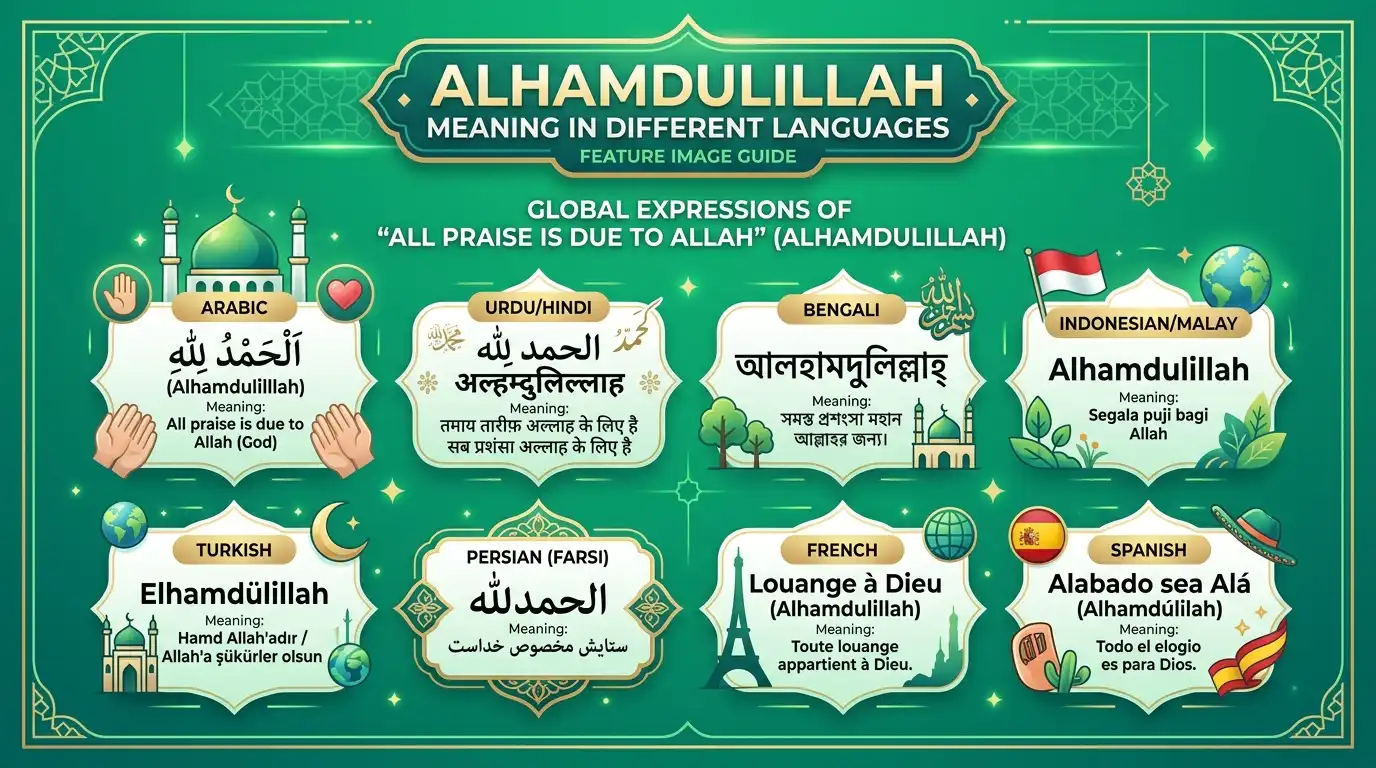
Alhamdulillah Meaning in Different Languages
Alhamdulillah meaning in different languages is a useful topic for anyone who sees this Arabic expression in Islamic posts, prayers, conversations, social media captions, or religious texts. Although the phrase comes from Arabic, Muslims around the world use it while speaking many different languages.
The most common English translation is “Praise be to Allah” or “All praise is due to Allah.” Depending on the language and context, translators may use slightly different wording to communicate the same basic meaning. This article explains Alhamdulillah in English, Urdu, Hindi, Marathi, Kannada, Malayalam, Jawi, and French without treating transliterations as if they were separate Arabic phrases.

What Does Alhamdulillah Mean?
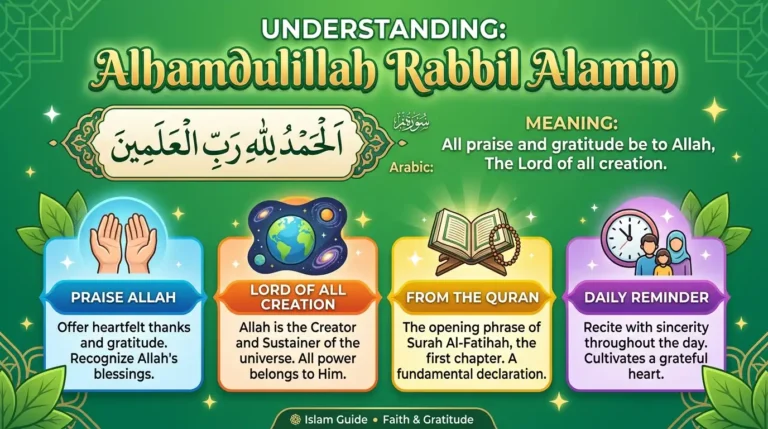
Alhamdulillah appears in Arabic as الحمد لله. The phrase combines Arabic words linked to praise and Allah. People commonly translate it as “Praise be to Allah,” “All praise belongs to Allah,” or “All praise is due to Allah.”
The phrase can express praise, gratitude, appreciation, and acknowledgment of Allah’s blessings. Its exact English rendering can vary because translation is not always a word-for-word process.
This is particularly important when comparing languages. A translation may use the word “thanks,” while another may emphasize “praise.” These translations can communicate related ideas, but Alhamdulillah specifically contains the concept of hamd, or praise, directed toward Allah.
Alhamdulillah Meaning in English
In English, people commonly translate Alhamdulillah as “Praise be to Allah.” Another natural translation is “All praise is due to Allah.”
Arabic: الحمد لله
English-speaking Muslims frequently keep the original Arabic expression rather than translating it. For example, someone might say, “Alhamdulillah, I am doing well,” meaning that they are well and praise Allah for that condition.
People can also say the phrase after good news, when they recognize a blessing, after they complete something successfully, or when they simply want to praise Allah.
Alhamdulillah for Everything in English
The expression “Alhamdulillah for everything” communicates gratitude and praise to Allah in every circumstance. It does not necessarily mean that every event is pleasant or easy. Rather, it can express a believer’s continuing recognition of Allah and gratitude for His blessings even when life contains difficulties.
Alhamdulillah Meaning in Urdu
اردو میں الحمدللہ کا عام مطلب ہے: تمام تعریفیں اللہ ہی کے لیے ہیں یا اللہ کا شکر اور حمد ہے۔
یہ لفظ اللہ تعالیٰ کی حمد، تعریف اور نعمتوں کے اعتراف کے لیے استعمال کیا جاتا ہے۔
اردو بولنے والے لوگ روزمرہ گفتگو میں بھی الحمدللہ استعمال کرتے ہیں۔ مثال کے طور پر اگر کوئی پوچھے کہ آپ کیسے ہیں تو جواب دیا جا سکتا ہے: “الحمدللہ، میں ٹھیک ہوں۔”
اسی طرح کسی خوشی، کامیابی، صحت، نعمت یا اچھی خبر پر بھی الحمدللہ کہا جاتا ہے۔ اس کا مفہوم صرف عام شکریہ تک محدود نہیں بلکہ اللہ تعالیٰ کی حمد و تعریف کو بھی شامل کرتا ہے۔

Alhamdulillah Meaning in Hindi
In Hindi, people can explain Alhamdulillah as “अल्लाह की प्रशंसा है” or “सारी प्रशंसा अल्लाह के लिए है।” The wording may change for everyday readers or for a more literal religious explanation.
Another common explanation: सारी प्रशंसा अल्लाह के लिए है।
Hindi-speaking Muslims may use the original Arabic word Alhamdulillah in conversation rather than replacing it with a Hindi translation. This is common with many Islamic expressions because the Arabic wording has religious and cultural significance.
Alhamdulillah Quotes in Hindi
If you are looking for Alhamdulillah quotes in Hindi, simple gratitude-focused lines can communicate the idea clearly without changing the meaning of the Arabic expression.
Alhamdulillah Meaning in Marathi
People can explain the Alhamdulillah meaning in Marathi as “अल्लाहची स्तुती असो” or, in a fuller form, “सर्व स्तुती अल्लाहसाठी आहे.”
Meaning: All praise belongs to Allah.
Marathi explanations can use different words while keeping the central idea of praising Allah. Judge a translation by its meaning and context, not by whether every Arabic word has one Marathi equivalent.
For Marathi-speaking readers, the original Arabic expression الحمد لله remains the same even though its explanation changes according to the language.

Alhamdulillah Meaning in Kannada
People can explain the Alhamdulillah for everything meaning in Kannada as praise and gratitude to Allah. A natural Kannada version is “ಅಲ್ಲಾಹನಿಗೆ ಸರ್ವ ಸ್ತುತಿಯೂ ಸಲ್ಲುತ್ತದೆ”.
ಅಲ್ಲಾಹನಿಗೆ ಸರ್ವ ಸ್ತುತಿಯೂ ಸಲ್ಲುತ್ತದೆ.
When people use “Alhamdulillah for everything,” they express praise and thanks to Allah while recognizing the blessings in life.
The Kannada translation explains the Arabic expression rather than replacing the original Arabic wording. Muslims may continue to use Alhamdulillah even when the rest of their conversation is in Kannada.
Alhamdulillah Meaning in Malayalam
People can express the Alhamdulillah Malayalam meaning as “അല്ലാഹുവിന് സ്തുതി” or, more fully, “എല്ലാ സ്തുതിയും അല്ലാഹുവിനാണ്”.
എല്ലാ സ്തുതിയും അല്ലാഹുവിനാണ്.
Malayalam-speaking Muslims commonly retain the Arabic expression Alhamdulillah in everyday speech. The Malayalam explanation helps readers understand the meaning, while the Arabic phrase retains its original religious wording.
Context matters here too. After good news, Alhamdulillah can express praise and gratitude. In a Qur’anic context, readers should also consider the surrounding verse when they explain its meaning.

Alhamdulillah in Jawi
Alhamdulillah dalam Jawi is another search intent associated with this Arabic expression. Jawi is an Arabic-derived writing system historically used for Malay and other languages of Southeast Asia.
The original Arabic phrase is:
Jawi uses an Arabic-based script, so readers may see Islamic expressions that look similar to Arabic. However, the original Arabic wording of Alhamdulillah remains الحمد لله.
For users searching for alhamdulillah dalam jawi, the key point is to distinguish the Arabic religious phrase from a Jawi version of its Malay explanation. These two forms do not always mean the same thing.
Alhamdulillah Ala Kulli Haal in Jawi
People commonly transliterate Alhamdulillah Ala Kulli Haal as Alhamdulillah ‘ala kulli haal. The phrase generally means “Praise be to Allah in every situation” or “All praise is due to Allah in every circumstance.”
For people searching for alhamdulillah ala kulli haal jawi or alhamdulillah ala kulli hal jawi, the important point is that spelling conventions in Latin transliteration can differ. “Haal,” “hal,” and similar spellings are attempts to represent Arabic pronunciation using another writing system.
When publishing a Jawi version, it is better to preserve the intended meaning and verify the exact Jawi orthography with a reliable Malay-language or Jawi reference rather than creating a spelling based only on transliteration.

Alhamdulillah Ala Kulli Haal Meaning Across Languages
The phrase Alhamdulillah Ala Kulli Haal contains the idea of praising Allah in every condition or circumstance. Different languages may express this naturally in slightly different ways.
| Language | Simple Meaning |
|---|---|
| English | Praise be to Allah in every situation. |
| Urdu | ہر حال میں اللہ ہی کی حمد ہے۔ |
| Hindi | हर हाल में अल्लाह की प्रशंसा है। |
| Malay | Segala puji bagi Allah dalam setiap keadaan. |
| French | Louange à Allah en toute circonstance. |
These are explanatory translations rather than claims that there is only one officially fixed translation in each language. Religious expressions often have several natural translations depending on the audience and context.
Alhamdulillah Ala Kulli Haal Traduction Français
For readers searching Alhamdulillah Ala Kulli Haal traduction français, a concise French rendering is “Louange à Allah en toute circonstance.”
Another translation is “Toute louange appartient à Allah en toute situation.” The first version is shorter and more natural for many readers. The second makes the idea of “all praise” clearer.
French: Louange à Allah en toute circonstance.
English: Praise be to Allah in every situation.
Why Does Alhamdulillah Stay the Same in Every Language?
One reason Alhamdulillah appears in many languages without translation is that Arabic remains the original language of the phrase. Muslims in different countries may speak English, Urdu, Hindi, Marathi, Kannada, Malayalam, Malay, French, or another language and still use the Arabic expression.
Translation helps people understand the phrase, but it does not need to replace the original wording. Muslims also keep many other well-known Islamic expressions in Arabic while they explain them in the local language.
Alhamdulillah and Gratitude
People often connect Alhamdulillah with gratitude, but its meaning is broader than simply saying “thank you.” The word hamd is associated with praise, while Islamic gratitude is also connected with shukr.
Therefore, saying Alhamdulillah can express a person’s recognition of Allah’s blessings while also praising Allah. This is why the expression appears naturally in conversations about health, family, success, food, faith, safety, and other blessings.

Common Translation Mistakes to Avoid
1. Treating Alhamdulillah as Only “Thank You”
“Thank you” can communicate gratitude, but it does not completely represent the concept of hamd. “Praise be to Allah” is closer to the central meaning of Alhamdulillah.
2. Confusing Transliteration With Translation
Writing “Alhamdulillah,” “Alhamdulillah,” or another Latin spelling counts as transliteration. It does not translate the phrase into another language. Translation explains the meaning using the vocabulary of the target language.
3. Assuming Every Language Has One Fixed Translation
Translations can differ while still communicating the same core concept. A good translation should preserve the meaning rather than forcing every Arabic word into a rigid word-for-word equivalent.
Frequently Asked Questions
What is the meaning of Alhamdulillah in English?
People commonly translate Alhamdulillah into English as “Praise be to Allah” or “All praise is due to Allah.” Muslims use this Arabic expression to praise Allah and acknowledge His blessings.
What is Alhamdulillah meaning in Urdu?
الحمدللہ کا عام اردو مطلب ہے “تمام تعریفیں اللہ ہی کے لیے ہیں”۔ یہ اللہ تعالیٰ کی حمد و تعریف اور اس کی نعمتوں کے اعتراف کے لیے استعمال ہوتا ہے۔
What does Alhamdulillah mean in Hindi?
In Hindi, people can explain Alhamdulillah as “अल्लाह की प्रशंसा है” or “सारी प्रशंसा अल्लाह के लिए है.” The original Arabic expression remains الحمد لله.
What is the Alhamdulillah meaning in Marathi?
A common Marathi explanation is “अल्लाहची स्तुती असो,” meaning “Praise be to Allah.” A fuller explanation can communicate that all praise belongs to Allah.
What is Alhamdulillah for everything meaning in Kannada?
In Kannada, people can explain the expression as an acknowledgment that praise and gratitude belong to Allah in every circumstance. A natural version is “ಅಲ್ಲಾಹನಿಗೆ ಸರ್ವ ಸ್ತುತಿಯೂ ಸಲ್ಲುತ್ತದೆ.”
What is the Alhamdulillah Malayalam meaning?
In Malayalam, people can explain Alhamdulillah as “അല്ലാഹുവിന് സ്തുതി” or “എല്ലാ സ്തുതിയും അല്ലാഹുവിനാണ്,” which means that praise belongs to Allah.
What does Alhamdulillah dalam Jawi mean?
“Alhamdulillah dalam Jawi” refers to finding or explaining the expression in the Jawi writing tradition. The original Arabic phrase is الحمد لله. Jawi is an Arabic-derived script historically used for Malay and related languages.
What does Alhamdulillah Ala Kulli Haal mean?
People commonly understand Alhamdulillah Ala Kulli Haal as “Praise be to Allah in every situation” or “All praise is due to Allah in every circumstance.” Latin spellings can vary, so English-language searches may show both “hal” and “haal.”
Final Thoughts
The meaning of Alhamdulillah crosses linguistic boundaries even though the phrase itself is Arabic. English speakers may say “Praise be to Allah,” Urdu speakers may explain it as “تمام تعریفیں اللہ ہی کے لیے ہیں,” while Hindi, Marathi, Kannada, Malayalam, Malay, and French speakers can express the same core concept using their own vocabulary.
For anyone searching Alhamdulillah meaning in different languages, the key distinction is between the original Arabic phrase, transliteration, and translation. The Arabic expression remains الحمد لله; only the way people explain its meaning changes from one language to another.
Alhamdulillah — Praise be to Allah.

Asrar Ahmad is the founder of PrayersGuide.com and a professional SEO expert based in Pakistan. As a practicing Muslim with years of experience in digital content, He is dedicated to making authentic Quranic prayers/duas and Islamic prayers accessible to English-speaking Muslims worldwide. All content is carefully researched and sourced from the Quran and authentic Hadith only.