Subhanallah, Alhamdulillah & Allahu Akbar: Meaning
Subhanallah Alhamdulillah Allahu Akbar: Meaning & Arabic
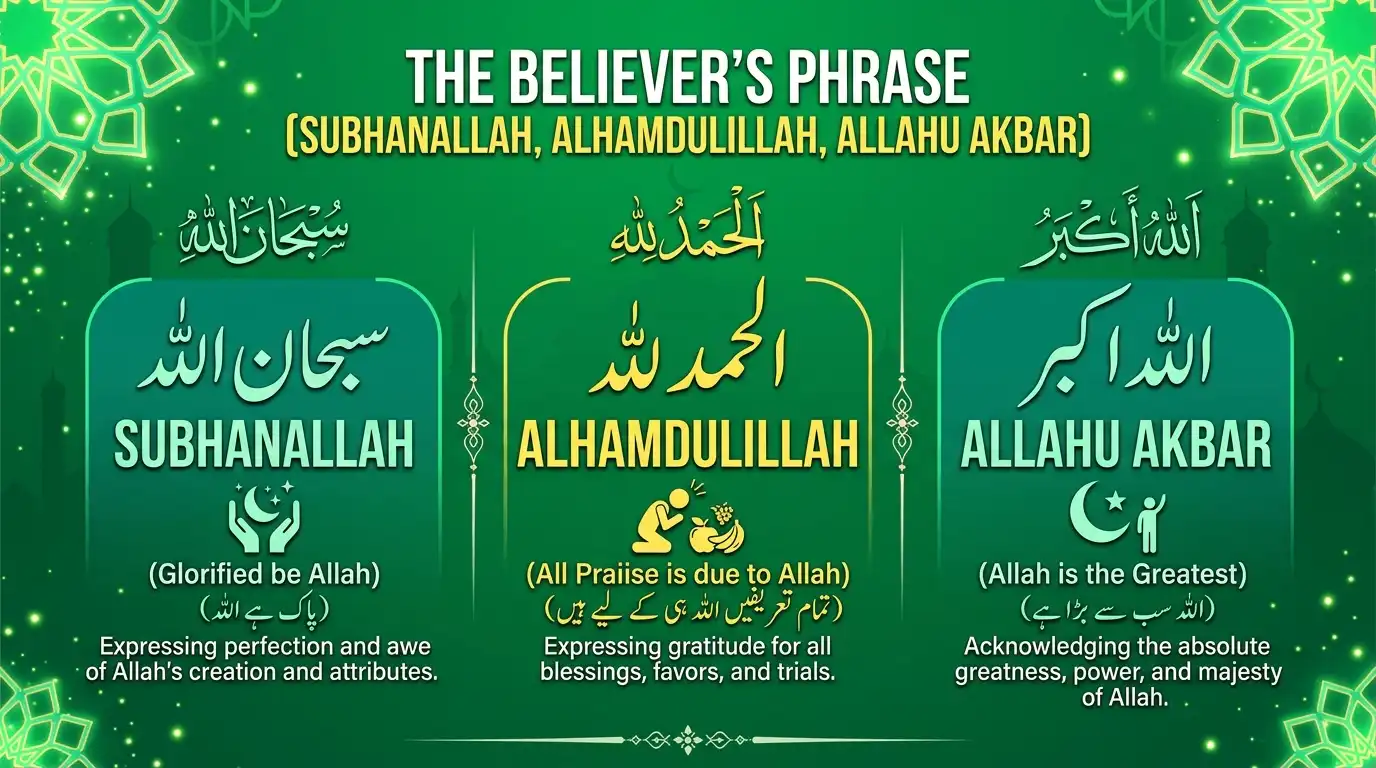
Subhanallah Alhamdulillah Allahu Akbar are three of the most familiar expressions of dhikr in Islam. Each phrase has its own meaning and spiritual emphasis: Subhanallah declares Allah’s perfection, Alhamdulillah expresses praise and gratitude to Allah, and Allahu Akbar declares that Allah is greater than everything.
Together, these words help a Muslim remember Allah, recognize His greatness, praise Him, and maintain gratitude throughout everyday life. This guide explains the Arabic text, English meanings, pronunciation, appropriate uses, Jawi writing, and how the three phrases relate to one another.

Subhanallah Alhamdulillah Allahu Akbar in Arabic
The three phrases can be written in Arabic as follows:
الْحَمْدُ لِلَّهِ
اللَّهُ أَكْبَرُ
Without vowel marks, they are commonly written:
الحمد لله
الله أكبر
Quick meaning:
- Subhanallah — Glory be to Allah / Allah is free from all imperfection.
- Alhamdulillah — All praise belongs to Allah.
- Allahu Akbar — Allah is the Greatest.
Subhanallah Meaning
Subhanallah (سُبْحَانَ اللَّهِ) is an expression used to declare Allah’s perfection and transcendence. The word Subhan conveys the idea of declaring Allah free from anything that is inconsistent with His perfection.
In everyday Muslim speech, Subhanallah may be said when someone notices something remarkable, beautiful, surprising, or extraordinary. Its use should not be reduced to simply meaning “wow”; its deeper meaning is connected with recognizing Allah’s perfection and greatness.
What does Subhanallah mean in English?
A common English rendering is “Glory be to Allah”. Another explanatory rendering is that Allah is perfect and free from all imperfection. The exact English wording can vary because a short Arabic expression can carry a broader meaning than a single English phrase.
Alhamdulillah Meaning
Alhamdulillah (الْحَمْدُ لِلَّهِ) means that all praise belongs to Allah. It combines the concept of praising Allah with acknowledging His goodness and blessings.
Muslims commonly say Alhamdulillah when expressing gratitude for health, family, food, success, safety, or other blessings. It can also be used in difficult circumstances as an expression of continued praise, patience, and trust in Allah.
Alhamdulillah and gratitude
The phrase is closely associated with shukr, or thankfulness. However, Alhamdulillah should not be understood as merely the equivalent of saying “thank you.” It specifically directs praise toward Allah and recognizes Him as the source of blessings.

Allahu Akbar Meaning
Allahu Akbar (اللَّهُ أَكْبَرُ) is commonly translated as “Allah is the Greatest.” It expresses the greatness and supremacy of Allah.
Allahu Akbar is especially familiar from the Adhan, the Islamic call to prayer, and from the prayer itself. It is also used in various forms of dhikr and remembrance.
Why does Allahu Akbar matter?
The phrase reminds Muslims that Allah is greater than worldly concerns, fears, difficulties, achievements, and distractions. Its meaning can therefore help a person put everyday problems into a broader spiritual perspective.
What Do These Three Phrases Mean Together?
The three phrases are closely related but should not be treated as three identical translations. Each highlights a different aspect of remembering Allah.
| Phrase | Arabic | Main idea |
|---|---|---|
| Subhanallah | سبحان الله | Declaring Allah’s perfection and transcendence |
| Alhamdulillah | الحمد لله | Praising and thanking Allah |
| Allahu Akbar | الله أكبر | Declaring Allah’s supreme greatness |
When said together, they form a powerful reminder of three important attitudes: recognizing Allah’s perfection, praising Him for His blessings, and remembering His greatness. This is why the phrases appear frequently in Islamic remembrance and devotional practice.
Alhamdulillah — praise Him and be grateful.
Allahu Akbar — remember His greatness.
When Should You Say Subhanallah, Alhamdulillah and Allahu Akbar?
There are established contexts in Islamic worship where these phrases are used, and Muslims also use them as general expressions of dhikr. Their use should be understood according to the Sunnah rather than treating every phrase as interchangeable.
When to say Subhanallah
Subhanallah may be used in remembrance of Allah and when observing something that reminds a person of His perfection and power. It is also part of prescribed forms of dhikr.
When to say Alhamdulillah
Alhamdulillah is commonly said when acknowledging Allah’s blessings or praising Him. For example, someone may say it after receiving good news, when asked about their wellbeing, or when reflecting on a blessing.
When to say Allahu Akbar
Allahu Akbar is used prominently during salah and the Adhan and is also part of various forms of Islamic remembrance. It emphasizes that Allah is greater than everything else.

Subhanallah Alhamdulillah Allahu Akbar Jawi
The three phrases can also be written in Jawi, a traditional Arabic-based writing system used for Malay. The exact spelling conventions can vary depending on the Jawi orthography being followed.
الحمد لله
الله أكبر
For users searching for Subhanallah Alhamdulillah Allahu Akbar Jawi, the Arabic script above is readable in Jawi contexts because Jawi uses Arabic-derived characters. However, the pronunciation and meaning remain the same.
Subhanallah Alhamdulillah Allahu Akbar Jawi meaning
The meaning does not change simply because the phrases are written in Jawi. They continue to express Allah’s perfection, praise and gratitude, and His supreme greatness.
Subhanallah Alhamdulillah Allahu Akbar in Arabic Copy and Paste
If you need the phrases for a message, study note, social media caption, or personal reminder, you can copy the Arabic text below.
الحمد لله
الله أكبر
For a combined line:
This combined wording should not be confused with a claim that the three expressions always constitute one fixed phrase in every Islamic context. The individual phrases have their own established uses in dhikr and worship.
Subhanallah Alhamdulillah Allahu Akbar and Dhikr
Dhikr means remembering Allah. These phrases are among the well-known words used in Islamic remembrance. The Prophet Muhammad ﷺ taught forms of dhikr containing these expressions, including remembrance after prayer and other occasions.
One well-known authentic hadith describes saying Subhanallah, Alhamdulillah, and Allahu Akbar as part of remembrance after the obligatory prayers, with specific counts and wording reported in hadith. Because different authentic narrations contain different forms of post-prayer dhikr, it is better to learn the established forms rather than inventing a single mandatory formula.
Subhanallah vs Alhamdulillah vs Allahu Akbar
| Expression | Focus | Simple explanation |
|---|---|---|
| Subhanallah | Allah’s perfection | Allah is free from imperfection. |
| Alhamdulillah | Praise and gratitude | All praise belongs to Allah. |
| Allahu Akbar | Allah’s greatness | Allah is greater than everything. |
Why Muslims Repeat These Phrases
Dhikr is not simply about repeating Arabic words mechanically. The deeper purpose is remembrance of Allah with awareness and sincerity. Understanding the meaning can help a person connect the words with their heart and actions.
For example, saying Alhamdulillah can encourage gratitude, while saying Allahu Akbar can remind a person that worldly worries do not outweigh Allah’s greatness. Subhanallah can direct attention toward Allah’s perfection and away from attributing imperfections to Him.

Pronunciation Guide
| Arabic | Common transliteration | Simple pronunciation |
|---|---|---|
| سبحان الله | Subhanallah | Sub-haa-nal-laah |
| الحمد لله | Alhamdulillah | Al-ham-du-lil-laah |
| الله أكبر | Allahu Akbar | Al-laa-hu Ak-bar |
Transliterations are only approximate because English letters cannot reproduce every Arabic sound perfectly. For accurate pronunciation, learning directly from a qualified Arabic or Islamic teacher is preferable.
Common Questions About Subhanallah Alhamdulillah Allahu Akbar
What does Subhanallah Alhamdulillah Allahu Akbar mean?
Together, the three phrases express recognition of Allah’s perfection, praise and gratitude toward Him, and recognition of His supreme greatness. They are individual expressions with distinct meanings, and they are commonly found in Islamic remembrance and worship.
How do you write Subhanallah Alhamdulillah Allahu Akbar in Arabic?
The three phrases are written as: سبحان الله، الحمد لله، الله أكبر. They can also be written separately as سبحان الله, الحمد لله, and الله أكبر.
What is Subhanallah in English?
Subhanallah is commonly translated as “Glory be to Allah.” It expresses the belief that Allah is perfect and free from all imperfection.
What is Alhamdulillah in English?
Alhamdulillah is commonly translated as “All praise is due to Allah” or “Praise be to Allah.” It expresses praise and gratitude directed toward Allah.
What does Allahu Akbar mean?
Allahu Akbar means “Allah is the Greatest.” The phrase declares Allah’s supreme greatness and is an important part of the Adhan and salah, as well as other forms of Islamic remembrance.
Can I say Subhanallah, Alhamdulillah and Allahu Akbar every day?
Yes. Muslims commonly engage in daily dhikr that includes these phrases. There are also specific forms of dhikr taught in authentic Islamic sources. When following a particular Sunnah practice, it is best to use the wording and number reported in reliable sources rather than assuming every combination has the same prescribed status.
Are Subhanallah and Alhamdulillah the same?
No. They are related but have different meanings. Subhanallah emphasizes Allah’s perfection and transcendence, while Alhamdulillah expresses praise and gratitude toward Allah. Both are important forms of dhikr, but they should not be treated as exact synonyms.
What is Subhanallah Alhamdulillah Allahu Akbar Jawi?
In Jawi, these Arabic-origin Islamic expressions are written using the Arabic-derived Jawi script. The words can be presented as: سبحان الله، الحمد لله، الله أكبر. The meanings remain the same: Allah’s perfection, praise and gratitude, and Allah’s supreme greatness.
Final Thoughts
Subhanallah Alhamdulillah Allahu Akbar brings together three powerful concepts of Islamic remembrance. Subhanallah reminds the believer of Allah’s perfection, Alhamdulillah expresses praise and gratitude, and Allahu Akbar affirms Allah’s supreme greatness.
Learning the meanings behind these phrases can make dhikr more meaningful. Rather than simply repeating words, a Muslim can reflect on what each expression teaches: to recognize Allah’s perfection, appreciate His blessings, and remember that His greatness is above everything in creation.
الْحَمْدُ لِلَّهِ
اللَّهُ أَكْبَرُ
Subhanallah • Alhamdulillah • Allahu Akbar

Asrar Ahmad is the founder of PrayersGuide.com and a professional SEO expert based in Pakistan. As a practicing Muslim with years of experience in digital content, He is dedicated to making authentic Quranic prayers/duas and Islamic prayers accessible to English-speaking Muslims worldwide. All content is carefully researched and sourced from the Quran and authentic Hadith only.