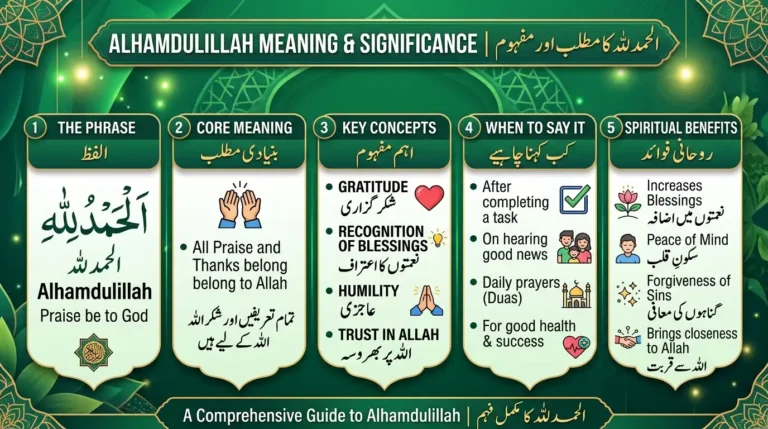
Alhamdulillah Rabbil Alamin: Arabic, Meaning & Quran
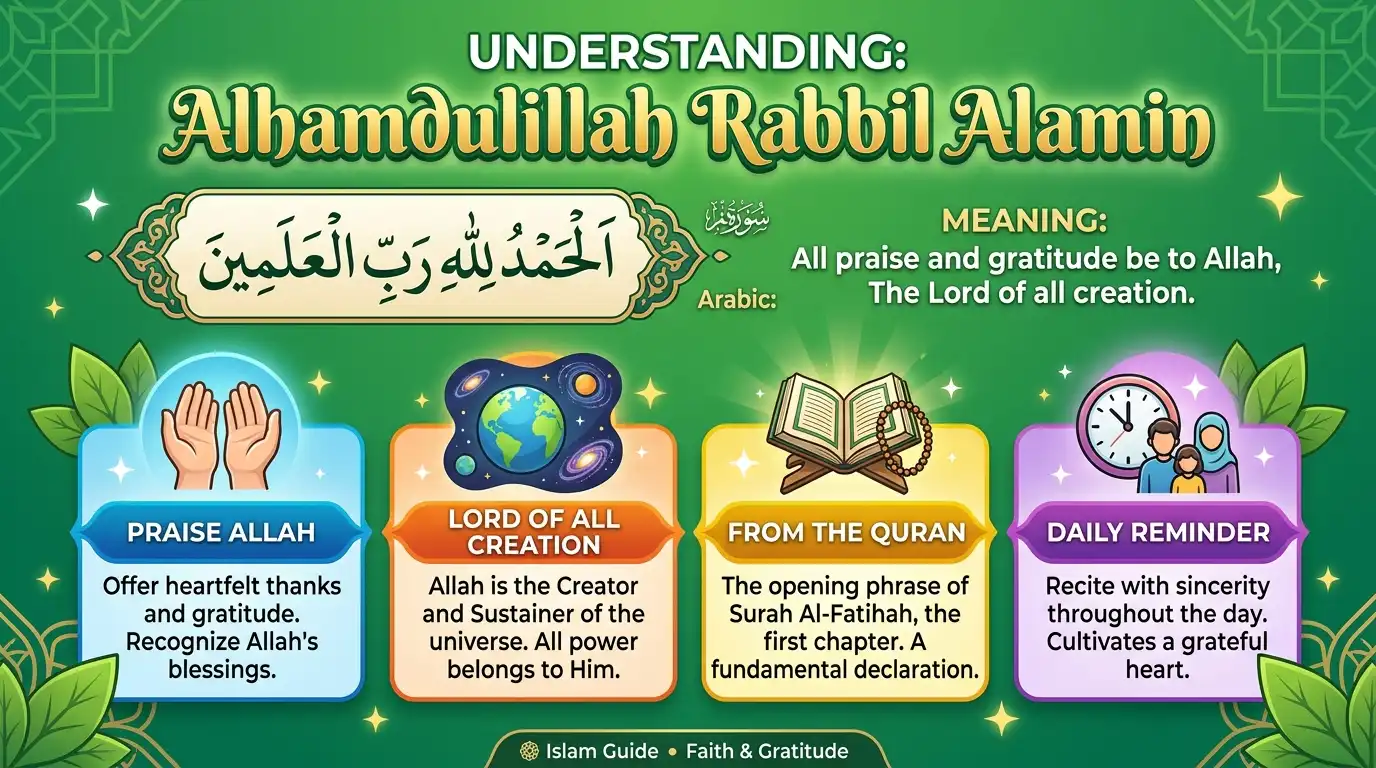
Alhamdulillah Rabbil Alamin is one of the most familiar and meaningful phrases in Islam. Muslims hear and recite these words every day, especially during Salah because they appear at the beginning of Surah Al-Fatihah. The phrase expresses praise and gratitude to Allah, while also recognizing Him as the Lord and Sustainer of all worlds.
For someone searching for the meaning of Alhamdulillah Rabbil Alamin, the phrase can be understood at several levels: its Arabic wording, English translation, Urdu meaning, Quranic context, pronunciation, and spiritual significance. This guide explains each part clearly without treating the phrase as merely a literal translation.
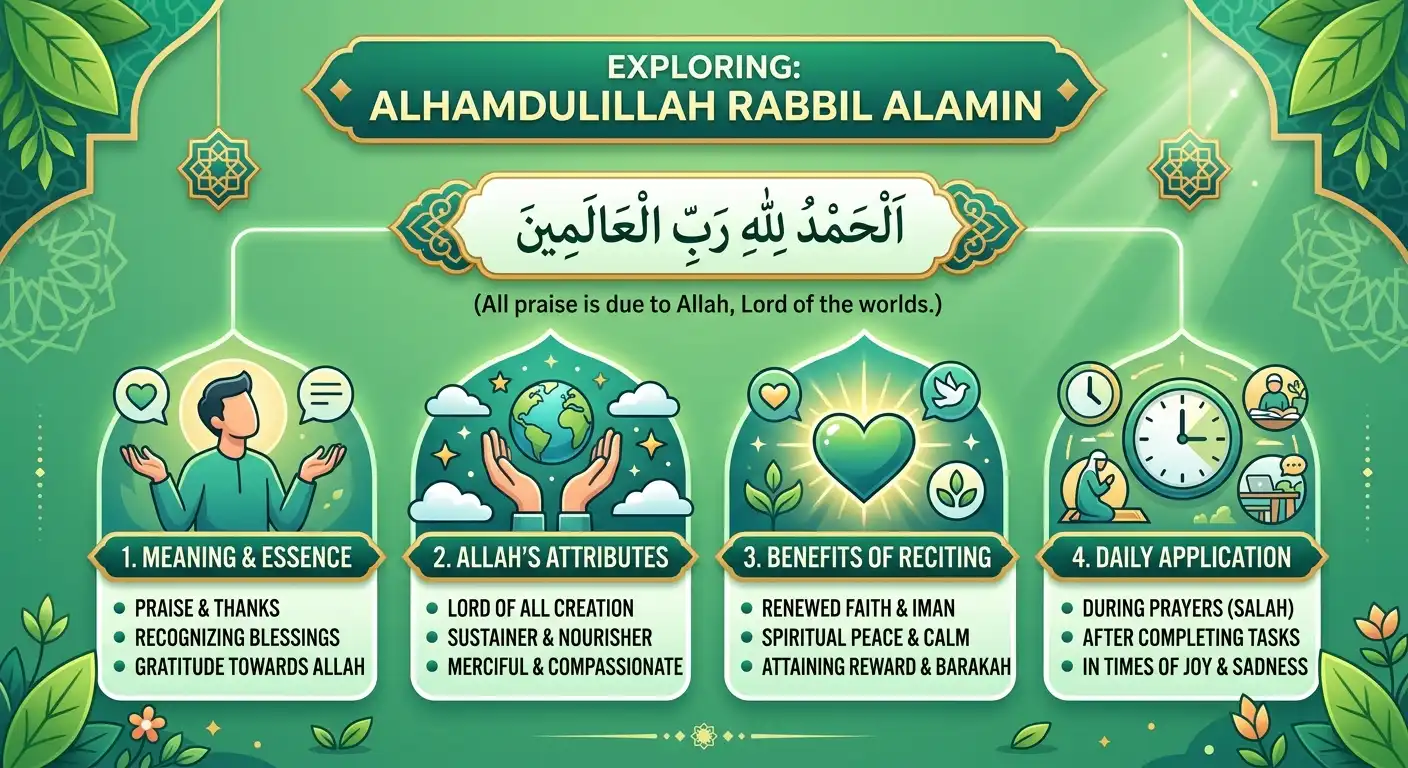
Alhamdulillah Rabbil Alamin in Arabic
The Arabic text of the phrase is:
Transliteration: Alhamdulillahi Rabbil Alamin
The phrase is found in Surah Al-Fatihah, verse 2. In Arabic, each word carries meaning, and together the words form a declaration of praise directed to Allah, who is described as the Lord of the worlds.
The commonly used transliteration is Alhamdulillahi Rabbil Alamin. You may also see spellings such as Alhamdulillah Rabbil Alamin, Alhamdulillah Rabb Al Alamin, or Alhamdulillah Hirrabbil Alamin in English searches. These variations generally reflect different ways of transliterating Arabic rather than different phrases.
Alhamdulillah Rabbil Alamin Meaning in English
“All praise is for Allah, Lord of the worlds.”
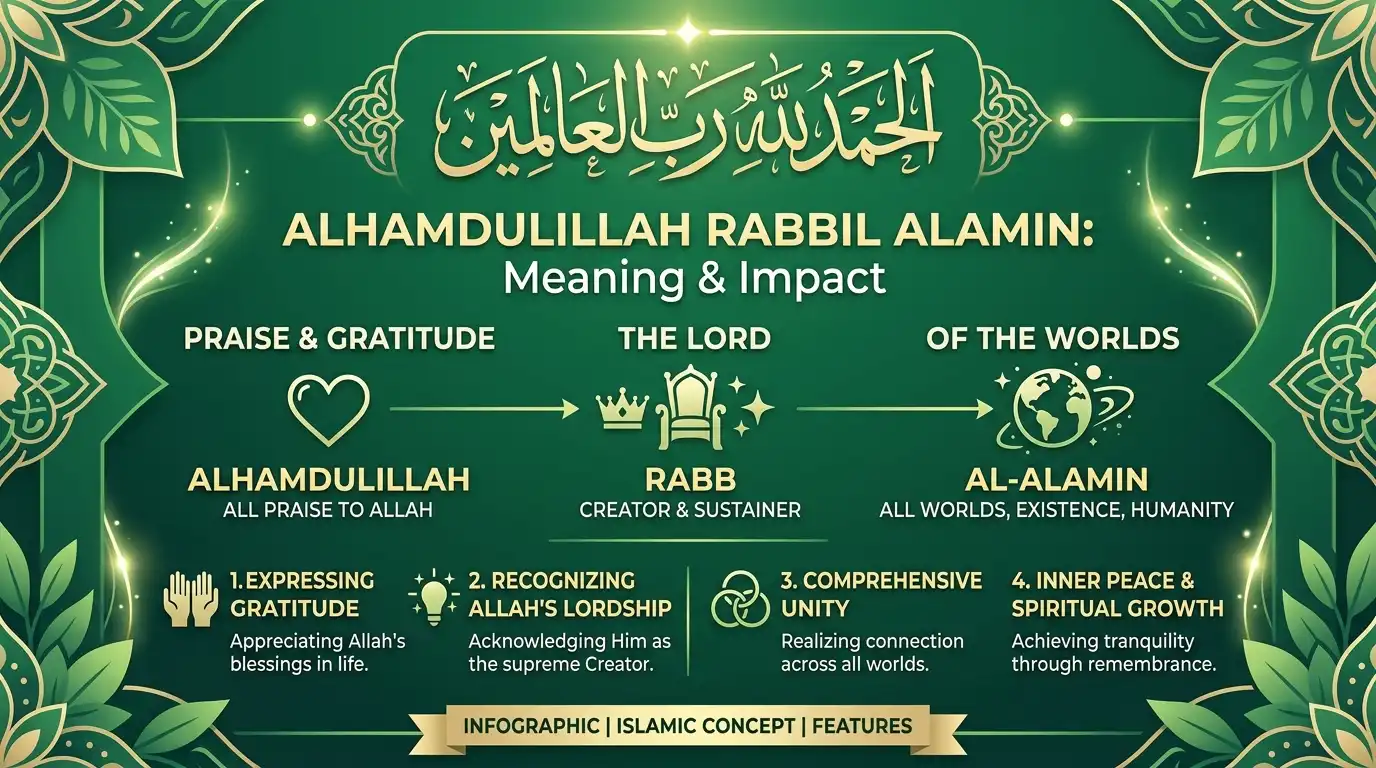
The phrase contains two major ideas: Alhamdulillah, which expresses praise belonging to Allah, and Rabbil Alamin, which identifies Allah as the Lord of the worlds.
A simple translation is “All praise is due to Allah, Lord of the worlds.” The wording emphasizes praise rather than gratitude alone. Muslims may say Alhamdulillah when receiving a blessing, after completing something successfully, when expressing gratitude, or even during hardship while maintaining trust in Allah.
The expression therefore has a wider meaning than simply saying “thank God.” It recognizes Allah as worthy of praise and acknowledges His authority, care, and lordship over creation.
Alhamdulillah Rabbil Alamin Meaning in Urdu
تمام تعریفیں اللہ کے لیے ہیں جو تمام جہانوں کا رب ہے۔
In Urdu, Alhamdulillah Rabbil Alamin is commonly understood as a declaration that all praise belongs to Allah, the Lord of all the worlds. The word “رب” carries a broader meaning than simply “creator”; it also conveys lordship, care, authority, and sustenance.
This is why the phrase has deep significance in Islamic belief. It reminds Muslims that everything ultimately exists under Allah’s lordship and that praise belongs to Him.
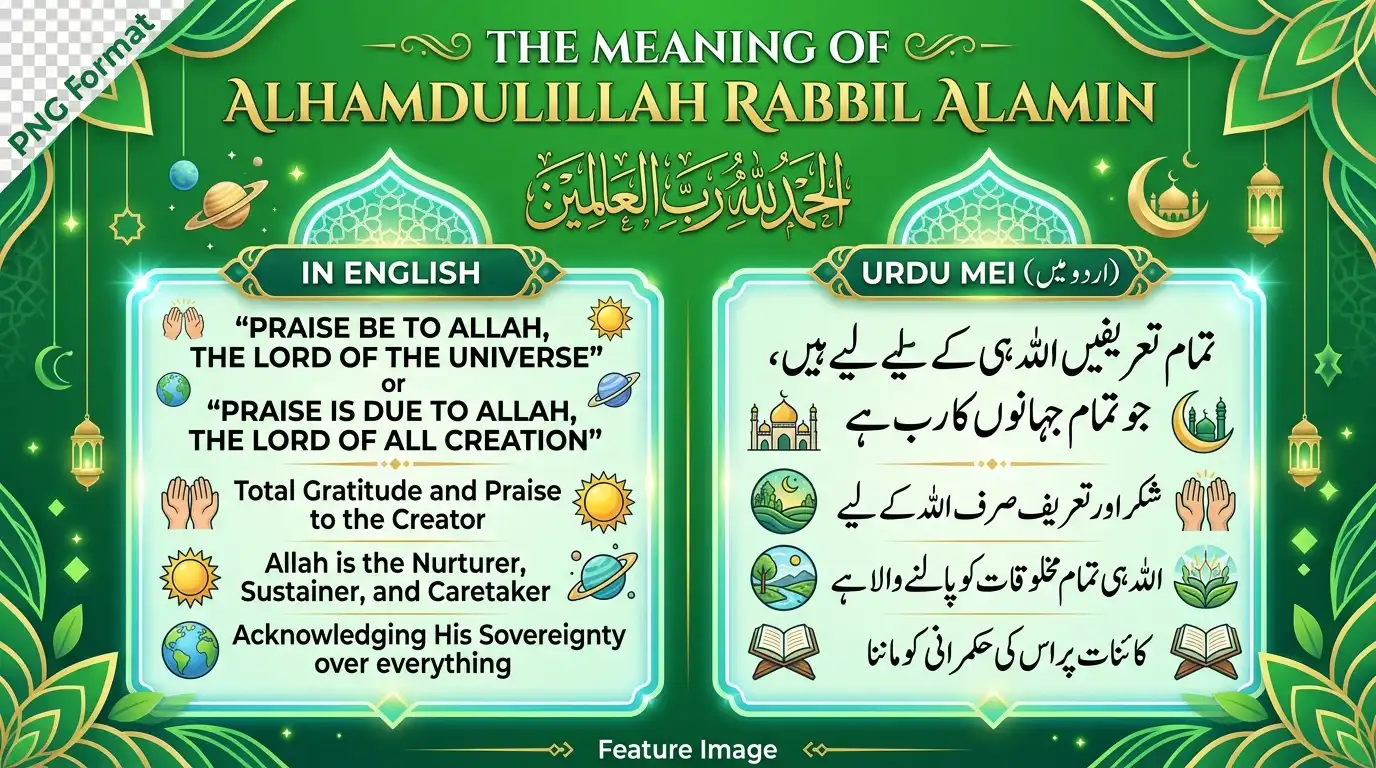
What Does Rabbil Alamin Mean?
The expression Rabbil Alamin consists of two important Arabic terms.
| Arabic | Transliteration | Meaning |
|---|---|---|
| رَبِّ | Rabb | Lord, Master, Sustainer |
| الْعَالَمِينَ | Al-Alamin | The worlds / all creation |
Rabb refers to Allah as the Lord, Master, Sustainer, and One who has authority over creation. Al-Alamin refers broadly to the worlds or realms of creation.
Consequently, Rabbil Alamin communicates the idea of Allah being the Lord and Sustainer of all creation, not merely one particular group of people or one particular place.
Alhamdulillah Rabbil Alamin in Surah Al-Fatihah
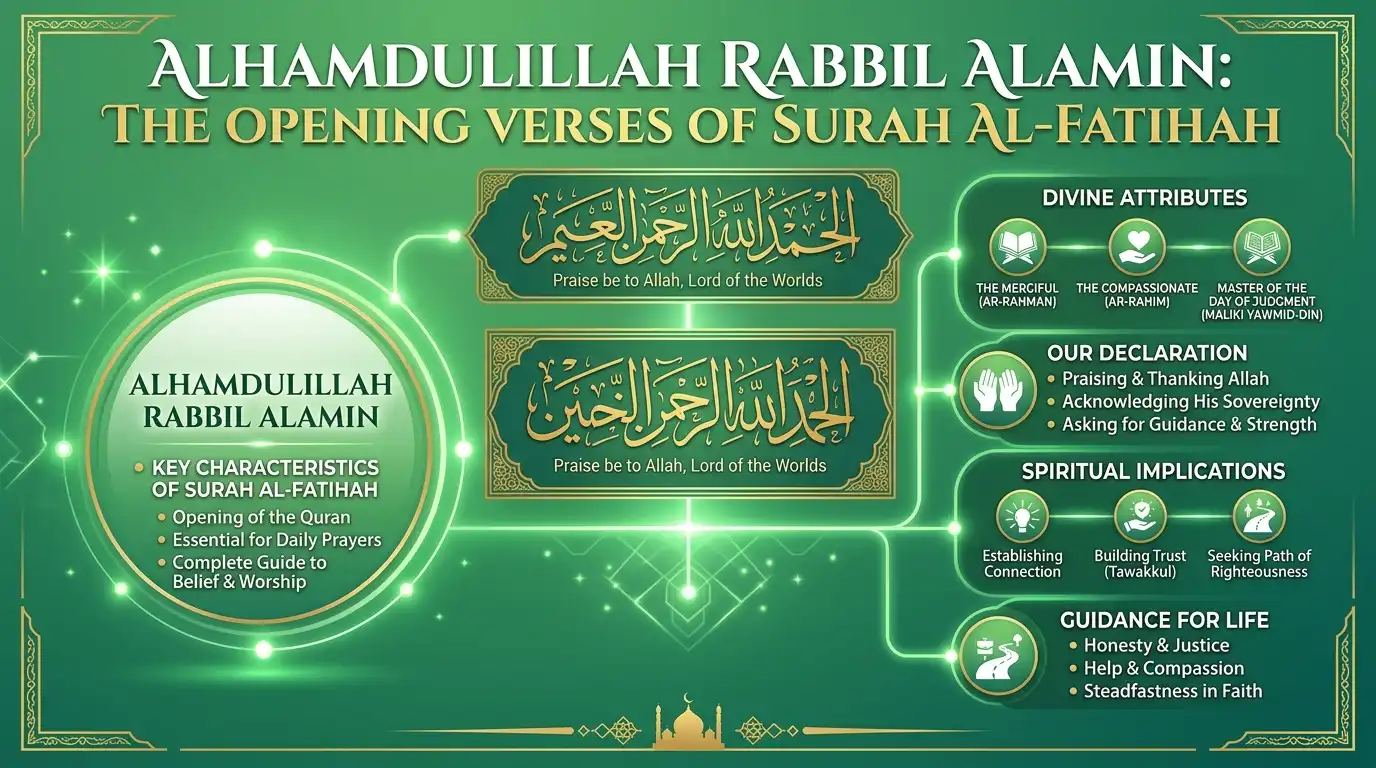
The phrase appears in the second verse of Surah Al-Fatihah, immediately after the opening declaration of praise. The verse is:
In widely used English translations, this is rendered along the lines of “All praise is for Allah, Lord of the worlds.”
Surah Al-Fatihah is recited repeatedly in Muslim prayer, which means this declaration of praise has a central place in daily Islamic worship. Rather than being an isolated expression of gratitude, it introduces a central theme of the Surah: recognizing Allah’s greatness, mercy, authority, and right to be worshipped.
The Quranic context is particularly important because it shows why the phrase should not be reduced to a social-media caption or a simple equivalent of “thank you.”
Why Is This Phrase Important in Islam?
Alhamdulillah Rabbil Alamin is important because it combines praise of Allah with recognition of His universal lordship. It teaches a believer to look beyond individual circumstances and remember the One who sustains all creation.
This attitude can influence how Muslims respond to both success and difficulty. When something good happens, saying Alhamdulillah expresses gratitude and praise. During difficult circumstances, the phrase can serve as a reminder that Allah remains the Lord of all creation even when a person does not understand the wisdom behind an event.
However, saying Alhamdulillah during hardship does not mean that a Muslim is forbidden from feeling sadness, seeking help, or taking practical action. Patience and gratitude can coexist with legitimate human emotions.
How to Pronounce Alhamdulillah Rabbil Alamin
A simple English transliteration is:
A more careful transliteration is Alhamdulillahi Rabbil Alamin. English spelling cannot perfectly reproduce Arabic pronunciation, so anyone learning the phrase should ideally listen to a qualified Arabic or Quran teacher rather than relying exclusively on Roman letters.
Common English Spellings
- Alhamdulillah Rabbil Alamin
- Alhamdulillahi Rabbil Alamin
- Alhamdulillah Rabb Al Alamin
- Alhamdulillah Hirrabbil Alamin
- Alhamdulillah Hirobbil Alamin
Search engines may show all of these spellings because Arabic transliteration does not have one universally standardized spelling in English. The Arabic text is the clearest way to identify the original phrase.
Alhamdulillah Rabbil Alamin and Gratitude
Gratitude is an important part of Islamic spirituality, but Alhamdulillah is more comprehensive than gratitude alone. The word “hamd” involves praise and appreciation, while “shukr” is commonly associated with thankfulness for a blessing or favor.
This distinction helps explain why Muslims can say Alhamdulillah in many different situations. It can be used after receiving something good, when acknowledging Allah’s blessings, during ordinary daily life, and in circumstances where a believer seeks patience and trust.
Alhamdulillah Rabbil Alamin in Daily Life
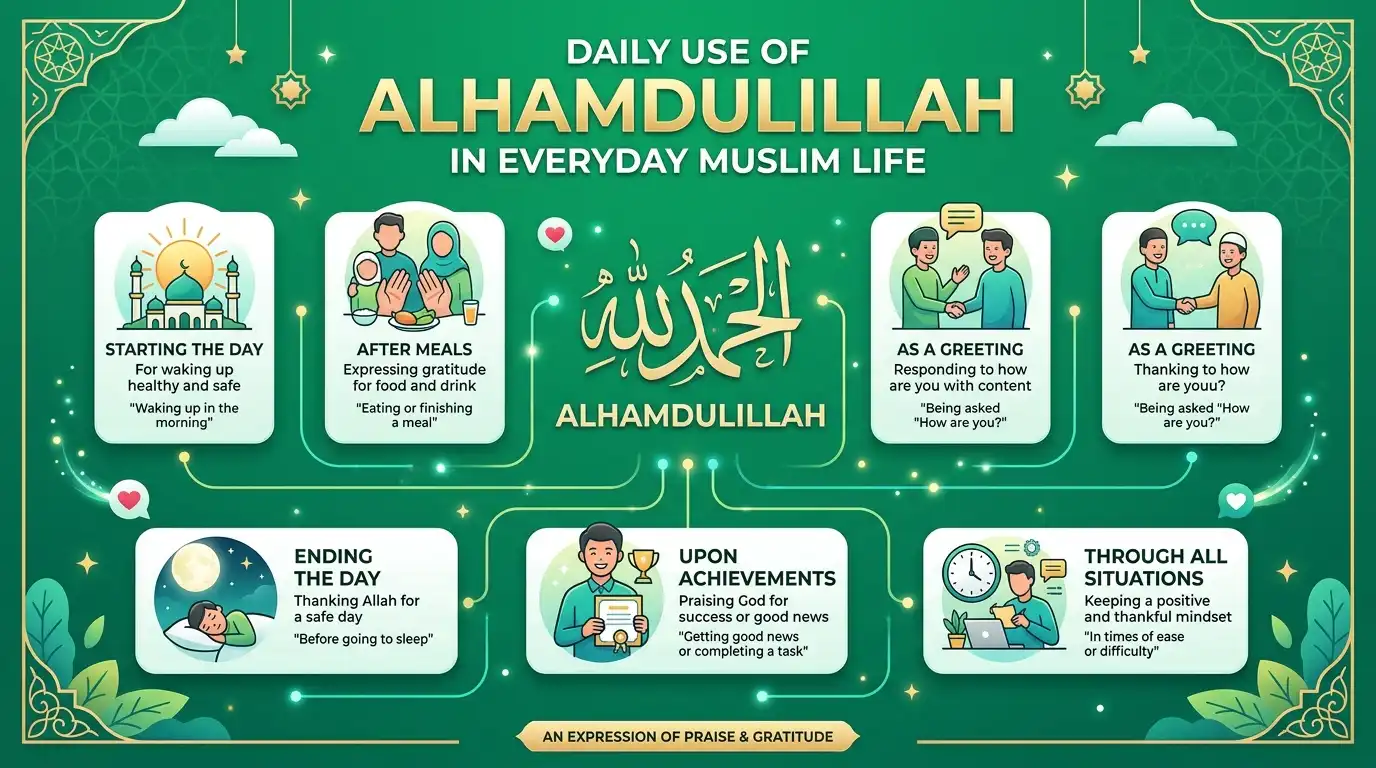
Muslims commonly use Alhamdulillah as part of everyday speech. Someone may say it after eating, after recovering from an illness, after receiving good news, or when describing a blessing in their life.
It can also appear in written communication, social media captions, personal reflections, and Islamic reminders. When used thoughtfully, the phrase directs attention toward Allah rather than making gratitude purely self-focused.
For English-speaking Muslims in the United States, United Kingdom, and other English-speaking communities, the phrase is often used alongside an English explanation so that people unfamiliar with Arabic can understand its significance.
Is Alhamdulillah Rabbil Alamin in the Quran?
Yes. The Arabic phrase الْحَمْدُ لِلَّهِ رَبِّ الْعَالَمِينَ appears in Surah Al-Fatihah, which is the first Surah of the Quran. It is one of the best-known Quranic expressions of praise to Allah.
The Quran also contains other occurrences of the expression Alhamdulillah in different contexts. For example, the Quran opens with the declaration of praise in Al-Fatihah, and several other Surahs contain praise of Allah.
For accurate Quranic study, readers should consult a reliable Quran translation alongside the Arabic text because translations are interpretations of the original Arabic rather than replacements for it.
Alhamdulillah Rabbil Alamin vs Alhamdulillah
| Phrase | General Meaning | Context |
|---|---|---|
| Alhamdulillah | All praise belongs to Allah | Common everyday expression |
| Alhamdulillah Rabbil Alamin | All praise belongs to Allah, Lord of the worlds | Quranic phrase from Surah Al-Fatihah |
The longer expression provides additional context by identifying Allah as Rabbil Alamin, the Lord of the worlds. The shorter Alhamdulillah is broader and is frequently used in everyday Muslim conversation.
Common Questions About Alhamdulillah Rabbil Alamin
What does Alhamdulillah Rabbil Alamin mean?
Alhamdulillah Rabbil Alamin means “All praise is for Allah, Lord of the worlds.” It is the second verse of Surah Al-Fatihah and expresses praise of Allah while recognizing His universal lordship and sustaining authority over creation.
What is Alhamdulillah Rabbil Alamin in Arabic?
The Arabic text is الْحَمْدُ لِلَّهِ رَبِّ الْعَالَمِينَ. A common transliteration is “Alhamdulillahi Rabbil Alamin.” English transliteration can vary because Arabic sounds do not always have exact equivalents in the Latin alphabet.
What does Rabbil Alamin mean?
Rabbil Alamin means “Lord of the worlds” or “Lord of all creation.” Rabb refers to Allah as Lord, Master, and Sustainer, while Alamin refers broadly to the worlds or realms of creation.
Is Alhamdulillah Rabbil Alamin from the Quran?
Yes. The phrase appears in Surah Al-Fatihah 1:2: الْحَمْدُ لِلَّهِ رَبِّ الْعَالَمِينَ. It is recited regularly by Muslims as part of Salah because Surah Al-Fatihah has a central role in Islamic prayer.
What is Alhamdulillah Rabbil Alamin in Urdu?
In Urdu, it is commonly translated as “تمام تعریفیں اللہ کے لیے ہیں جو تمام جہانوں کا رب ہے۔” The phrase recognizes Allah as worthy of all praise and as the Lord and Sustainer of all worlds.
How do you pronounce Alhamdulillah Rabbil Alamin?
A basic English transliteration is “Alhamdulillahi Rabbil Alamin.” Because Roman spelling cannot perfectly represent Arabic pronunciation, listening to a qualified Quran teacher is preferable for learning the exact sounds.
Can Alhamdulillah be said during difficult times?
Yes. Muslims may praise Allah during difficult circumstances while also acknowledging sadness, asking for help, making dua, and taking practical steps. Saying Alhamdulillah does not mean denying hardship; it can express continued faith and recognition of Allah’s lordship.
Is Alhamdulillah the same as saying thank you?
Not exactly. Alhamdulillah includes gratitude but carries the broader idea of praise belonging to Allah. It can therefore be used when recognizing Allah’s greatness and blessings, rather than functioning only as a direct equivalent of the English phrase “thank you.”
Final Thoughts
Alhamdulillah Rabbil Alamin is much more than a phrase translated as “thank God.” Its Quranic wording combines praise of Allah with recognition of Him as the Lord and Sustainer of all worlds. This is why the expression occupies such an important position in Surah Al-Fatihah and in Muslim daily worship.
Understanding the Arabic words, their Quranic context, and their broader Islamic meaning gives the phrase greater depth. Whether you encounter it in Salah, a conversation, an Islamic book, or an English-language Muslim community, its central message remains one of recognizing Allah’s praise, authority, and lordship.
Related Islamic Articles
- Alhamdulillah for Everything: Meaning, Arabic & Quotes
- Alhamdulillah Ala Kulli Haal: Meaning, Arabic & Usage
- What Does Alhamdulillah Mean?
- Alhamdulillah in Arabic: Text, Meaning & Copy Paste
Sources & Further Reading
For the Quranic Arabic and translation, readers can consult the Quran text and translation for Surah Al-Fatihah .
For additional Quranic study, the Quranic Arabic Corpus provides linguistic information about Quranic words and grammatical structures.

Asrar Ahmad is the founder of PrayersGuide.com and a professional SEO expert based in Pakistan. As a practicing Muslim with years of experience in digital content, He is dedicated to making authentic Quranic prayers/duas and Islamic prayers accessible to English-speaking Muslims worldwide. All content is carefully researched and sourced from the Quran and authentic Hadith only.