
Allahumma Barik Lahu — Meaning, Usage, and How to Reply (Complete Guide)
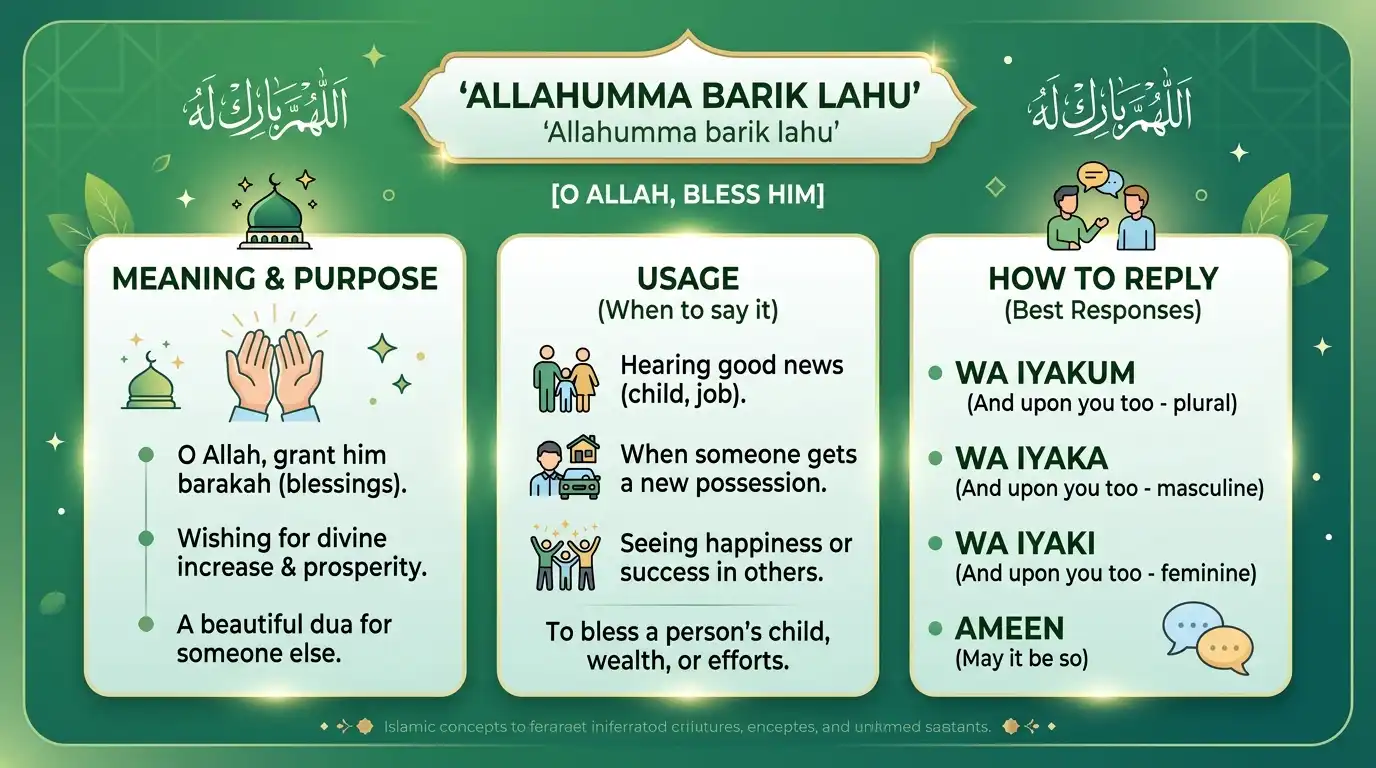

When you see a boy or a man achieve something admirable, the Sunnah way to react is to say Allahumma Barik Lahu. It means “O Allah, bless him,” and it turns a simple compliment into a real dua.
Many Muslims know the phrase but are unsure when exactly to use it, how to write it correctly, or how to reply when someone says it to them. This guide covers all of that in one place.
What Does “Allahumma Barik Lahu” Mean?
Word-by-Word Breakdown
The phrase has three parts. “Allahumma” means “O Allah,” a direct address used only in dua. “Barik” is the command form of “bless.” “Lahu” means “for him.”

Is It a Dua or Just a Compliment?
It is a genuine dua, not a casual compliment. Saying it means you are asking Allah directly to protect and increase a blessing you noticed in someone.
Allahumma Barik Lahu in Arabic — Text & Pronunciation
Arabic Text (Copy-Paste)
اللَّهُمَّ بَارِكْ لَهُ
Transliteration: Al-laa-hum-ma Baa-rik la-hu. Tap and hold on mobile, or use Ctrl+C on desktop, to copy the Arabic text above.
How to Pronounce It Correctly
Break it into three parts: Al-laa-HUM-ma, pause, then BAA-rik la-hu. Hold the double “m” slightly longer for correct Tajweed.

Allahumma Barik Lahu vs Laha vs Lahum — Gender & Number Variations
Arabic changes the ending of the dua depending on who you are blessing. Below is the complete set of variations in one table.
| Phrase | Arabic | Meaning | Use For |
|---|---|---|---|
| Allahumma Barik Lahu | اللَّهُمَّ بَارِكْ لَهُ | Bless him | One male |
| Allahumma Barik Laha | اللَّهُمَّ بَارِكْ لَهَا | Bless her | One female |
| Allahumma Barik Lahum | اللَّهُمَّ بَارِكْ لَهُمْ | Bless them | Group / mixed |
| Allahumma Barik Lahunna | اللَّهُمَّ بَارِكْ لَهُنَّ | Bless them | Females only |
| Allahumma Barik Lana | اللَّهُمَّ بَارِكْ لَنَا | Bless us | Self and others |
| Allahumma Barik Fihi / Fiha | فِيهِ / فِيهَا | Bless it | An object |

When to Say Allahumma Barik Lahu — Real-Life Situations
When a Baby Boy Is Born
Saying Allahumma Barik Lahu for a newborn boy is a Sunnah greeting, asking Allah to bless the child from his very first days.
At Weddings and Engagements
The Prophet Hazarat MUHAMMAD ﷺ taught a specific wedding dua that includes this phrase, asked for a newly married man and his household.
💍Dua for Getting Married
Read the full Sunnah dua Muslims say for a couple starting married life.
When Praising a Boy’s or Man’s Achievement
Graduating, getting a new job, or reciting Quran well are all moments where Allahumma Barik Lahu fits naturally.
When Fearing the Evil Eye
If your admiration feels intense, saying this dua protects the person from the evil eye, which the Prophet Hazarat MUHAMMAD ﷺ confirmed is real.
🧿Dua for Protection from Evil Eye
Learn the full protective duas Muslims recite against the evil eye.
Before Eating
A related form of “Barik” is also said before meals, asking Allah to bless the food that has been provided.
🍽️Dua Before Eating and Drinking
See the exact Sunnah wording to say before every meal.

Hadith Evidence — Why Allahumma Barik Lahu Is Sunnah
The Hadith of Sahl ibn Hunayf
A companion once admired Sahl’s skin without saying this dua, and Sahl became ill soon after from the evil eye. The Prophet Hazarat MUHAMMAD ﷺ asked why blessing was not prayed for him.
“If he sees something that he likes, let him pray for blessing for him.” — Sunan Ibn Majah 3509
The Wedding Dua Hadith
Aqil bin Abi Talib was taught by the Prophet Hazarat MUHAMMAD ﷺ to say this dua for a newly married couple instead of common cultural phrases.
“Allahumma barik lahum wa barik alaihim.” — Sunan Ibn Majah 1906
Ibn al-Qayyim’s Ruling — Is It Obligatory?
Ibn al-Qayyim explained that saying this dua becomes obligatory whenever a person fears their admiring gaze could genuinely harm someone.
Allahumma Barik Lahu vs MashaAllah — What’s the Difference?
| Feature | Allahumma Barik Lahu | MashaAllah |
|---|---|---|
| Type | Active dua | Acknowledgement |
| Source | Hadith | Quran 18:39 |
| Use | Bless someone else | Anything admired |
| Combined? | Yes, recommended together | Yes |
When to Say Alhamdulillah
Compare with another common dhikr phrase and when Muslims say it.
Allahumma Barik Lahu vs Tabarakallah — Are They the Same?
They are related but not identical. Tabarakallah is a statement praising Allah as the source of blessing, while Allahumma Barik Lahu is an active request asking Allah to bless a specific person.
In short, Tabarakallah declares that blessing belongs to Allah, while Allahumma Barik Lahu asks Allah to give more of it to someone you admire.
How to Reply to Allahumma Barik Lahu
Ameen
The simplest reply is Ameen, which accepts the dua that has just been made for you.
Wa Feeka Barakallah (Recommended)
This returns the blessing directly, meaning “and may Allah bless you too.” Scholars consider it the most complete reply.
Barakallahu Feek / Feeki / Feekum
Use Feek for a male, Feeki for a female, and Feekum when replying to a group.

Can You Say Allahumma Barik Lahu for Yourself?
This exact form is meant for a male other than yourself. For your own blessings, say Allahumma Barik Li or Allahumma Barik Lana instead.
Cultural Variations Around the World
South Asian Usage
Urdu-speaking Muslims often pair it with MashaAllah, saying both together as a single compliment and dua.
🇵🇰Alhamdulillah Meaning in Urdu
Explore how similar phrases of gratitude are understood in Urdu.
Arab and Middle Eastern Usage
Native Arabic speakers are more precise with Tajweed and gendered endings, switching easily between Lahu, Laha, and Lahum.
Western Muslim Usage
English-speaking Muslims often use it casually in conversation and on social media, still keeping its sincere, protective intent.
Common Mistakes to Avoid
Mispronouncing the phrase changes its Tajweed and should be practiced slowly and correctly.
Saying it without sincerity turns a dua into an empty habit, so intention matters every time.
Forgetting to reply when someone says it to you is considered impolite in Islamic etiquette.
Benefits of Saying Allahumma Barik Lahu
It protects the admired person from the harm of the evil eye, as taught directly by the Prophet Hazarat MUHAMMAD ﷺ.
It counts as an act of worship and earns spiritual reward for following the Sunnah sincerely.
It strengthens bonds between Muslims by turning ordinary praise into a shared prayer.
Frequently Asked Questions
What does Allahumma Barik Lahu mean?
It means “O Allah, bless him.” It is a dua said when admiring or praising a male, asking Allah to protect and increase that blessing.
What is the difference between Lahu and Laha?
Lahu is used for a single male, and Laha is used for a single female, following standard Arabic gender rules.
How do I reply to Allahumma Barik Lahu?
Reply with Ameen, Wa Feeka Barakallah, or Barakallahu Feek, adjusting the ending for gender or a group.
Is Allahumma Barik Lahu mentioned in the Quran?
The exact wording comes from hadith, not the Quran, though the Quran repeatedly mentions the concept of barakah.
Can I say it for myself?
It is meant for others. For yourself, say Allahumma Barik Li or Allahumma Barik Lana instead.
Is it obligatory or just recommended?
It is Sunnah generally, but becomes obligatory if you fear your gaze could genuinely cause harm.
What is the difference between Allahumma Barik and Tabarakallah?
Allahumma Barik is a request asking Allah to bless someone. Tabarakallah is a statement praising Allah as the source of blessing.

Conclusion — Make Allahumma Barik Lahu a Daily Habit
Allahumma Barik Lahu is more than a phrase. It is a small, powerful habit that turns everyday admiration into a genuine act of worship.
Practice saying it sincerely, reply to it correctly, and let it become a natural part of how you speak about the blessings around you.
🤲Meaning of Dua
New to dua? Start with this simple explanation of what dua really means in Islam.

Asrar Ahmad is the founder of PrayersGuide.com and a professional SEO expert based in Pakistan. As a practicing Muslim with years of experience in digital content, He is dedicated to making authentic Quranic prayers/duas and Islamic prayers accessible to English-speaking Muslims worldwide. All content is carefully researched and sourced from the Quran and authentic Hadith only.

