
Meaning of Dua: The Sacred Conversation Between You and Allah
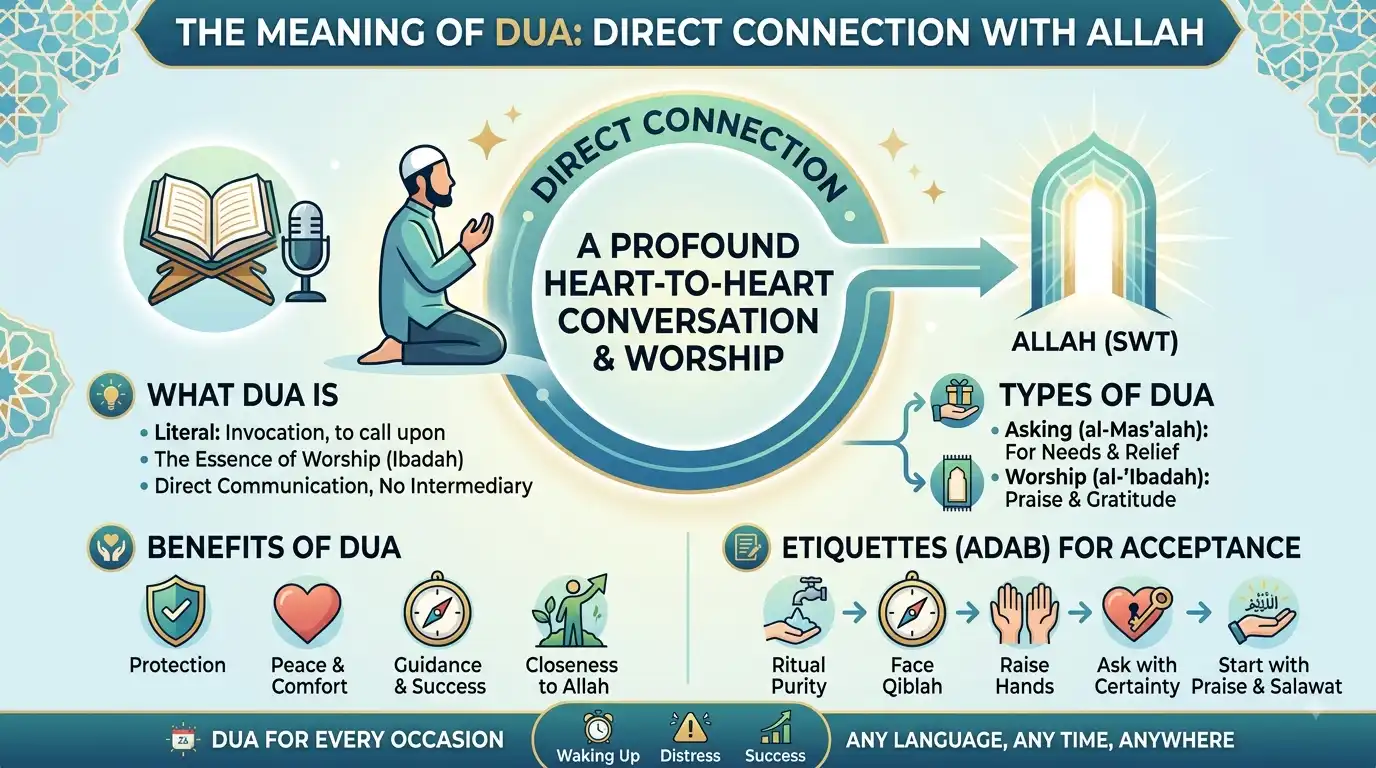
Dua is not just a ritual posture; it is the quiet, unbreakable whisper of a human heart speaking directly to its Creator.
Introduction to the Meaning of Dua
There are nights when the weight of the world feels heavier than your strength to carry it. You lie awake, staring at the ceiling, overwhelmed by feelings you cannot quite explain to anyone else. In that quiet room, when words fail and your chest feels tight, turning your palms upward becomes your ultimate sanctuary.
Understanding the meaning of dua begins in these exact moments of human vulnerability. It is the realization that no matter how isolated you feel, you are never without a direct line to the One who fashioned your heart.
Allah explicitly invites us into this personal dialogue in the Holy Quran:
وَإِذَا سَأَلَكَ عِبَادِي عَنِّي فَإِنِّي قَرِيبٌ ۖ أُجِيبُ دَعْوَةَ الدَّاعِ إِذَا دَعَانِ
Wa idha sa’alaka ‘ibadi ‘anni fa-inni qareeb, ujeebu da’watad-da’i idha da’an
“And when My servants ask you concerning Me, indeed I am near. I respond to the call of the caller when he calls upon Me.” — (Surah Al-Baqarah, 2:186)
This verse reminds us that divine assistance is never distant. Prayer is your turning point, and understanding its deeper layers unlocks endless spiritual peace.
Understanding What Is Dua in Islam
To understand what is dua, we must look at both its language and its spirit. Linguistically, the word originates from the Arabic root Da’a ($د-ع-و$), which literally translates to calling out, summoning, or requesting help. When asking about the dua meaning in english, it is best translated as personal supplication or heartfelt prayer.
However, the dua definition goes far beyond a simple translation. While Salah represents the structured, obligatory ritual prayer performed five times a day, supplication is the unstructured, boundaryless conversation you have with Allah at any moment, in any language, and in any emotional state.
[Related: Understanding the Differences Between Salah and Supplication]
In Islamic theology, this informal calling upon God is considered the very core of worship. It signifies a profound admission: that we are inherently needy (faqir) and that Allah is the All-Powerful (Al-Qadir). When you raise your hands, you step out of self-reliance and step into divine care.
Meaning of Dua: 12 Sacred Prayers for Every Human Need
Supplication transforms depending on what your heart is enduring. Here are heartfelt prayers tailored to specific emotional states, each reflecting the true dua meaning in islam.
Seeking Hope and Emotional Renewal
- Prayer 1 (Emotion: Desperation)O Allah, my heart feels completely broken, and my strength is entirely spent. I have nowhere else to run except to Your mercy. Please repair what is shattered inside me and pull me out of this darkness.
- Prayer 2 (Emotion: Gratitude)Ya Rabb, thank You for the blessings I notice and the thousands You protect me from that I never see. My heart overflows with gratitude for Your endless patience with my shortcomings.
- Prayer 3 (Emotion: Surrender)Lord, I release my anxiety over what tomorrow holds into Your perfect plans. I trust that Your decisions for my life are far better than my own desperate desires.
Finding Courage and Strength
- Prayer 4 (Emotion: Boldness)Allahumma, grant me the courage to stand firm upon the truth even when my hands shake. Fill my spirit with unshakeable conviction whenever fear tries to make me shrink.
- Prayer 5 (Emotion: Grief)Ya Allah, the ache of loss in my chest feels suffocating today. Comfort my hurting heart, blanket my soul with Your tranquility, and reunite me with those I love in Your eternal Paradise.
- Prayer 6 (Emotion: Hope)My Creator, even when every door seems closed, I know Your grace remains wide open. Let my heart anchor itself in the bright hope of Your upcoming relief.
Restoring Peace and Trust
- Prayer 7 (Emotion: Intercession)O Most Merciful, heal my loved ones who are suffering in silence today. Light up their darkness, ease their physical and emotional pain, and grant them total restoration.
- Prayer 8 (Emotion: Awe)Ya Allah, when I look up at the vast sky and consider Your majestic universe, I am humbled that You still listen to my quietest whisper. Glorified are You beyond all measure.
- Prayer 9 (Emotion: Confession)Lord, I have wronged my own soul through my mistakes and lapses in judgment. I come to You humbled, seeking Your vast forgiveness, for no one forgives sins except You.
Cultivating Patience and Guidance
- Prayer 10 (Emotion: Trust)O God, I do not understand why this hardship has come my way, but I trust Your wisdom implicitly. Hold my heart steady while I wait for Your wisdom to unfold.
- Prayer 11 (Emotion: Longing)Ya Rabb, my soul longs for closeness to You above all worldly achievements. Draw me nearer to Your love, and let my ultimate joy be found in Your remembrance.
- Prayer 12 (Emotion: Peace)Allahumma, calm the restless storm inside my mind today. Replace my racing thoughts with Your divine stillness, and let my heart rest firmly in Your presence.
Why Spiritual Supplication Transforms Your Heart
When you make calling upon God a constant practice, something subtle yet profound begins to shift inside you. Hardships do not magically disappear overnight, but your internal capacity to bear them expands drastically.
[Related: How Daily Remembrance Builds Emotional Resilience]
You stop feeling like a helpless leaf blown around by life’s uncertain winds. Instead, you become anchored in the knowledge that the Sovereign Controller of the universe is actively listening to your voice.
This deep spiritual connection is highlighted beautifully in the Noble Quran:
أَلَا بِذِكْرِ اللَّهِ تَطْمَئِنُّ الْقُلُوبُ
Ala bidhikril-laahi tatma’innul-quloob
“Unquestionably, by the remembrance of Allah do hearts find rest.” — (Surah Ar-Ra’d, 13:28)
This verse reveals that true emotional tranquility is not found in controlling our circumstances, but in surrendering our worries to Allah through constant remembrance.
15 Short Arabic Dua Phrases for Daily Strength and Faith
Integrating an arabic dua into your daily routine keeps your tongue moist with remembrance. Here are 15 powerful phrases, each serving a unique situation:
- When facing overwhelming distress: Recite Yaa Hayyu Yaa Qayyoomu bi-rahmatika astagheeth (O Ever-Living, Sustainer, by Your mercy I seek help).
- For guidance in decision making: Ask Allah with Allahumma khir lee wakhtar lee (O Allah, choose for me and select what is best for me).
- When seeking forgiveness: Repeat Astaghfirullahal-‘Atheem (I seek forgiveness from Allah, the Magnificent).
- For relief from anxiety: Say Rabbi ishrah lee sadree (My Lord, expand for me my chest).
- When seeking protection from harm: Recite Bismillahil-ladhi la yadurru ma’as-mihi shay’un fil-ardi wa la fis-sama’i (In the name of Allah, with whose name nothing can cause harm).
- For increase in beneficial knowledge: Pray Rabbi zidnee ‘ilmaa (My Lord, increase me in knowledge).
- When feeling helpless: Say Hasbunallahu wa ni’mal wakeel (Sufficient for us is Allah, and He is the best Disposer of affairs).
- For healing from illness: Recite Allahumma Rabban-naas, adh-hibil-ba’s, ishfi Antash-Shaafee (O Allah, Lord of mankind, remove the suffering, heal, for You are the Healer).
- When starting any task: Begin with Bismillahir-Rahmanir-Rahim (In the name of Allah, the Most Gracious, the Most Merciful).
- When experiencing joy: Express Alhamdulillah illadhi bi-ni’matihi tatimmus-salihaat (Praise be to Allah, by Whose favor good things are accomplished).
- For spiritual steadfastness: Pray Yaa Muqallibal-quloobi thabbit qalbee ‘alaa deenik (O Turner of hearts, keep my heart firm upon Your religion).
- When entering your home: Say Allahumma innee as’aluka khayral-mowliji wa khayral-makhraj (O Allah, I ask You for the best entry and best exit).
- For relief from debts: Recite Allahummak-finee bi-halalika ‘an haramika (O Allah, suffice me with Your lawful against Your unlawful).
- When seeking patience: Say Rabbanaa afrigh ‘alaynaa sabran (Our Lord, pour upon us patience).
- For good in both worlds: Pray Rabbanaa aatinaa fid-dunyaa hasanatan wa fil-aakhirati hasanatan (Our Lord, give us in this world good and in the Hereafter good).
Seeking Divine Protection and Inner Peace
Living in an unpredictable world naturally brings moments of vulnerability. Turning to God for protection is not a sign of weakness; it is the ultimate expression of trust.
Protection Duas
- Prayer 13 (Emotion: Courage)Ya Hafiz, shield my family and home from all seen and unseen harms, envy, and evil intentions. Place a fortress of light around our daily movements.
- Prayer 14 (Emotion: Healing)O Healer of all pain, touch every aching cell in my body with Your restorative grace. Wash away illness and grant me renewed vitality to serve You.
- Prayer 15 (Emotion: Wonder)Lord of the heavens, as I observe Your vast power across creation, protect my mind from doubts and preserve the light of faith within my soul.
- Prayer 16 (Emotion: Relief)Allahumma, remove the heavy burdens pressing down upon my shoulders today. Grant me a way out from every difficulty I am currently struggling through.
Peace Duas
- Prayer 17 (Emotion: Humility)O Creator, keep my heart humble in times of ease and patient during trials. Remind me that every breath I take depends entirely on Your generosity.
- Prayer 18 (Emotion: Patience)Ya Rabb, soften my impatience when Your answers do not align with my desired timeline. Help me gracefully endure the waiting periods of my life.
- Prayer 19 (Emotion: Devotion)My Lord, make my worship sincere and free from ostentation. Let my quiet moments spent calling upon You be the sweetest highlights of my day.
Heartfelt Prayers for Specific Life Situations
Life brings diverse challenges—financial stress, heartbreak, health scares, family tensions, and spiritual exhaustion. Here is a tailored dua for each key moment.
💼 For Career & Financial Distress
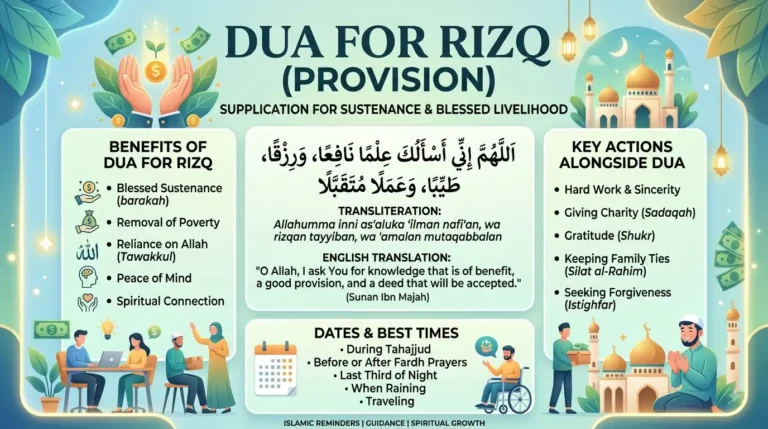
- Prayer 20 (Emotion: Serenity)Ya Razzaq (The Provider), unlock doors of clean, blessed sustenance for my family. Ease my anxiety regarding bills and career hurdles, and grant me contentment with Your divine distribution.
💔 For Healing a Broken Heart
- Prayer 21 (Emotion: Guidance)O Turner of Hearts, heal the deep pain caused by human disappointments. Rebuild my self-worth in Your love and guide my steps toward healthy, uplifting relationships.
🏥 For Health & Physical Recovery
- Prayer 22 (Emotion: Contentment)Ya Allah, grant strength to my body while it recovers. Give me patience through discomfort, and let this physical hardship cleanse my past mistakes and elevate my spiritual status.
👨👩👧 For Family Harmony & Peace
- Prayer 23 (Emotion: Comfort)Lord of Mercy, place love, soft speech, and mutual understanding inside our home. Remove arguments, heal grudges, and make our household a peaceful haven of Your remembrance.
What Changes When the Meaning of Dua Becomes a Habit
When calling upon Allah shifts from a sporadic emergency reaction to a quiet daily habit, your whole outlook on life changes. You no longer view trials as punishments, but as gentle invitations from your Creator to draw near to Him.
Your heart develops a steady quietness. Even when storms rage externally, you carry an internal sanctuary because you know you have laid every fear at the feet of the Almighty.
How to Make Daily Supplication a Habit — 10 Practical Steps
- Tie your prayers to daily routines: Spend two minutes making supplication right after every obligatory Salah.
- Utilize sacred times: Pray during the last third of the night (Tahajjud) or between the Athan and Iqamah.
- Speak in your mother tongue: While learning traditional Arabic phrases is rewarding, speak to Allah in the language your heart naturally thinks in.
- Keep a personal prayer journal: Write down specific requests so you can track how Allah answers them over time.
- Capitalize on moments of rain: Make heartfelt requests whenever rain falls, as this is a known time of divine acceptance.
- Pray during travel: Take advantage of your journeys, as the supplication of a traveler carries special weight.
- Raise your hands physically: Lifting your palms creates an physical posture of humility and expectation.
- Begin with praise and blessings: Start your prayer by praising Allah’s attributes and sending peace upon Prophet Muhammad (ﷺ).
- Pray for others in secret: Ask for your friends and family; angels will respond by saying, “And to you the same.”
- Maintain certainty (Yaqeen): Pray with total confidence that Allah hears you and will answer in the way that is best for you.
Faith Declarations to Strengthen Your Spiritual Connection
Repeat these daily statements to realign your heart with your faith:
- God is my protector, and I will not let fear dictate my choices.
- I am never alone because my Creator hears my every whisper.
- God is the Ultimate Provider, and my sustenance is completely secure in His hands.
- I have full confidence that my prayers are being answered in the best possible way.
- God is closer to me than my own jugular vein.
- I am worthy of divine mercy despite my human mistakes.
- God is able to change any impossible situation into a blessing overnight.
- I have peace knowing that my life’s story is written by the Best of Planners.
- God is my Healer, restoring my mind, body, and spirit daily.
- I am anchored in hope because my faith rests in an Eternal Creator.
Quotes to Inspire Your Daily Supplication
- “Supplication is not asking God to change His mind; it is aligning your heart with His infinite wisdom.”
- “The quietest whisper raised in faith echoes louder in the heavens than thunder across the earth.”
- “Do not lose heart over delayed answers; Allah is simply preparing your heart for the weight of the blessing.”
- “When you lift your hands to the sky, you drop every heavy burden resting on your shoulders.”
- “The distance between your greatest problem and its solution is as short as the distance between your forehead and the ground.”
- “Prayer is the only bridge that connects human weakness directly to divine omnipotence.”
- “Allah never inspires your heart to make a supplication without intending to respond to it.”
- “Your tearful silence in prayer speaks a language that heaven understands perfectly.”
- “True wealth is not measured by what you store in your bank account, but by how often you call upon your Lord.”
- “When human help fails you, remember that divine intervention was waiting for your call all along.”
Common Questions About the Meaning of Dua Answered
What is the precise dua meaning in Islam?
In Islamic tradition, the dua meaning in islam centers on personal, direct supplication to Allah. It represents an act of devotion where a believer expresses their humility, need, and trust in God outside the formal structure of daily ritual prayers.
How is Dua different from Salah?
While Salah is an obligatory ritual prayer performed five times daily with specific physical postures and Arabic recitations, supplication is informal, voluntary, and can be done anytime, anywhere, in any language.
Why do some prayers feel unanswered?
Allah answers every sincere request in one of three ways: by granting what you asked for immediately, by withholding it to protect you from unseen harm, or by saving a far greater reward for you in the Hereafter.
The Prophet Muhammad (ﷺ) emphasized the power of persistence in prayer:
ادْعُوا اللَّهَ وَأَنْتُمْ مُوقِنُونَ بِالإِجَابَةِ
Ud’ullah wa antum mooqinoona bil-ijaabah
“Call upon Allah while you are certain of an answer.” — (Sunan At-Tirmidhi, 3479)
This Hadith teaches us that confidence in God’s mercy is essential when turning to Him in supplication.
Can I make supplication in English or my native language?
Yes, absolutely. While traditional Arabic recitations from the Quran and Sunnah carry profound spiritual weight, Allah understands every language and the unspoken feelings of your heart.
What is the best time to make supplication?
While you can pray at any moment, particularly blessed times include the last third of the night, while in prostration (Sujood), between the call to prayer (Athan) and its commencement (Iqamah), and on Friday afternoons.
Final Thoughts on the Meaning of Dua
Understanding the true meaning of dua shifts your life from anxious self-reliance into serene divine trust. It reminds you that no matter how overwhelming your life circumstances become, you possess an immediate, boundaryless connection to the Almighty. You do not need an intermediary, a perfect setting, or flawless words—you only need an honest, sincere heart.
May your hands always find comfort in rising, and may your heart forever find rest in knowing that Allah is listening to your every word.
When your voice quivers in prayer, remember: the Sovereign Lord of the heavens and earth is leaning in to listen to you.

Asrar Ahmad is the founder of PrayersGuide.com and a professional SEO expert based in Pakistan. As a practicing Muslim with years of experience in digital content, He is dedicated to making authentic Quranic prayers/duas and Islamic prayers accessible to English-speaking Muslims worldwide. All content is carefully researched and sourced from the Quran and authentic Hadith only.


One Comment