
Zakat Calculator 2026: Free Tool + Step-by-Step Guide for US Muslims
Use this free Zakat calculator to estimate Zakat on cash, savings, gold, silver, investments, business assets, cryptocurrency and other potentially zakatable wealth. This guide is designed for Muslims in the United States and explains Nisab, the lunar year, debts, retirement accounts and common calculation questions.
Important: This is an educational calculator, not a fatwa. Rules can differ between Islamic schools and scholars, especially for jewelry, retirement accounts, investments, debts and other disputed assets.
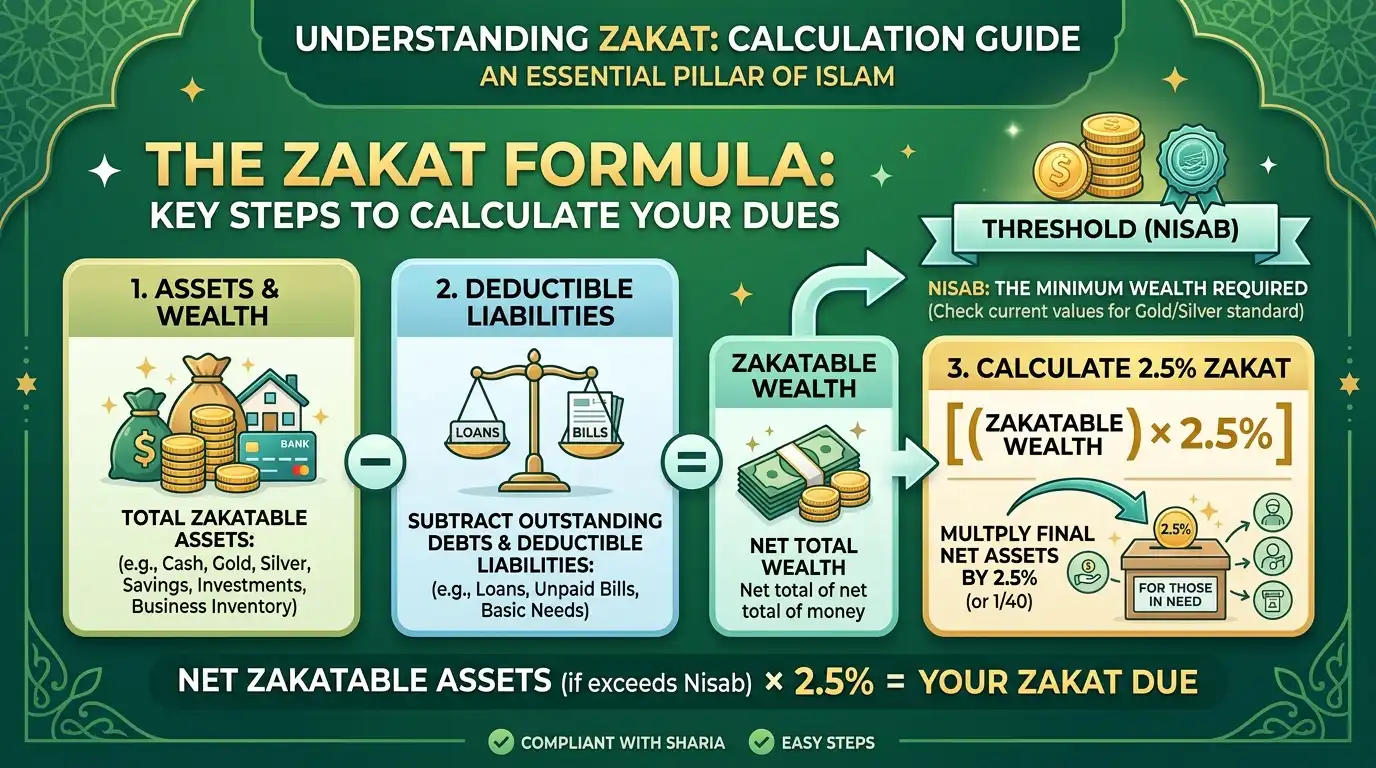
How to Calculate Zakat
- Add your potentially zakatable assets.
- Subtract only liabilities that your chosen fiqh method permits.
- Compare the resulting wealth with your selected Nisab.
- If it meets the Nisab, multiply the applicable amount by 2.5% for the standard Zakat-al-Mal calculation.
- Pay according to your Zakat date and the guidance you follow.
Zakat Calculator 2026 (USD)
The calculator below performs the arithmetic locally in your browser. It does not send the amounts you enter to PrayersGuide.
Potentially Zakatable Assets
Liabilities
Estimated Zakat
$0.00Before You Start
Gather bank and brokerage statements, gold or silver weight and purity information, retirement balances, crypto holdings, business inventory, recoverable loans and debts that may be deductible under your chosen method.
Today’s Nisab: Gold vs Silver
Nisab is the minimum threshold associated with Zakat liability. Its dollar value changes with precious-metal prices. Current reputable calculators do not all use the same modern conversion of the classical weights, so a dated source matters.
| Standard | Common reference | Example dated value |
|---|---|---|
| Gold | About 85 g or 87.48 g depending on conversion | About $11,710 at the Zaytuna September 26, 2026 reference |
| Silver | About 595 g or 612.36 g depending on conversion | About $1,230 at the Zaytuna September 26, 2026 reference |
Islamic Relief currently publishes 87.48 g gold and 612.36 g silver and shows changing dollar values. Human Appeal’s published Zakat policy also gives 87.48 g gold and 612.36 g silver as classical reference levels. These differences are why this calculator lets you edit the Nisab instead of hard-coding one permanent number.
Gold or Silver?
There is scholarly discussion over which standard to use. Some guidance favors silver because its threshold is lower, while other scholars use gold or a context-specific method. Use the standard that corresponds to the fiqh guidance you follow and record the date and source.
Nisab in Tola
South Asian readers commonly encounter 7.5 tola gold and 52.5 tola silver. If your assets are held in Pakistan or another country, convert their market value consistently into the currency used for your calculation.
How Zakat Is Calculated: Formula and Worked Example
Net Zakatable Wealth × 2.5% = Estimated Zakat
Worked Example
Suppose Ahmed has $8,000 in cash and savings, $4,000 in investments that he is treating as fully zakatable for this example, and $2,000 in gold. His assets total $14,000. If his chosen method permits a $1,000 deduction, his net figure is $13,000. At 2.5%, the illustrative amount is $325.
This is an arithmetic example, not a ruling about Ahmed’s individual assets. Retirement accounts, jewelry, stocks and debts may require a different treatment.
The Lunar Year (Hawl)
Zakat on qualifying wealth is commonly connected with completion of a lunar year after reaching Nisab. The treatment of wealth dipping below Nisab can differ by madhab. Zaytuna’s current calculator, for example, describes a specific Hanafi beginning-and-end-of-year approach while noting different conditions for its other school options.
What Counts as Zakatable Wealth?
| Asset | Common treatment | Check |
|---|---|---|
| Cash and bank balances | Generally included | Use the balance required by your method. |
| Money owed to you | May be included | Consider recoverability and fiqh method. |
| Gold and silver | Potentially included | Weight, purity, value and jewelry ruling. |
| Stocks and funds | Potentially included | Trading vs long-term investment and underlying assets. |
| Business inventory | Generally included for trade | Current value and business-specific rules. |
| Primary home | Generally not treated like trade wealth | Rental/trade property can differ. |
| Personal car | Generally not included | Trade vehicles are different. |
Cash and Payment Apps
For US households, liquid wealth can be spread across checking, savings, PayPal, Venmo, Cash App and similar services. Consolidate balances so the same money is not counted twice.
Business Inventory and Receivables
Goods held for sale differ from equipment used to operate a business. Recoverable receivables can also matter. Keep doubtful debts separate for scholarly review.
Zakat on Gold: Jewelry, Coins, Bars and ETFs
Gold may be jewelry, coins, bars or an investment product. Start with ownership, purity, weight and market value, then apply the ruling relevant to your school.
| Purity | Approx. pure-gold content |
|---|---|
| 24K | About 100% |
| 22K | About 91.7% |
| 18K | About 75% |
For example, 50 g of 22K gold contains about 45.84 g of pure gold. Do not value 22K jewelry as though all 50 g were pure gold.
Worn Jewelry
There is recognized scholarly disagreement over qualifying personal-use gold and silver jewelry. Some Hanafi guidance includes it, while many other scholars distinguish personal-use jewelry from investment wealth. Follow your madhab or scholar.
Wife’s Jewelry and Mahr
Ownership matters. Jewelry belonging to a wife is not automatically entered into the husband’s calculation. Mahr and jewelry can require separate analysis.
Zakat on Silver
Silver can be held as jewelry, coins, bars or an investment. Value it according to purity and the market price relevant to the calculation date. Sterling silver is commonly marked 925, meaning about 92.5% silver by weight.
Zakat on Salary and Monthly Income
Zakat is generally not calculated by simply applying 2.5% to every paycheck. The practical question is which qualifying wealth remains in your possession and how your chosen method treats newly acquired savings.
Bonuses, Commissions, RSUs and ESPP
Identify when money or shares become yours and whether they remain in your possession on the Zakat date. RSUs and employee stock plans can involve vesting and restrictions, so generic salary rules may not answer every case.
Taxes Withheld From Pay
Do not automatically subtract every tax line from your wealth. Deductibility depends on the liability and the scholarly method you follow.
Zakat on Savings, Stocks, Crypto and Retirement Accounts
Stocks and ETFs
Trading stock and long-term investment are not necessarily treated identically. Some contemporary methods look at the underlying zakatable assets or a proportion of an investment, while others use a different approach. Document your investment purpose and follow a consistent scholarly method.
401(k), Traditional IRA and Roth IRA
Retirement accounts require special attention because access, taxes, penalties, employer contributions and the underlying investments can matter. Zaytuna’s current calculator, for example, allows retirement funds and says estimated taxes and, where relevant, withdrawal penalties may be subtracted. That is a methodology, not a universal ruling.
Cryptocurrency
Crypto is a contemporary area with differing scholarly approaches. Record your holdings and value on the Zakat date, and confirm the treatment if you hold complex tokens or protocols.
HSA and 529
Consider ownership, accessibility, restrictions and underlying assets instead of forcing every account into a retirement category.
Debts and Liabilities: What Can You Deduct?
Debt treatment can materially change the answer. Some contemporary calculators focus on debts currently due or the coming year’s installments, while fiqh approaches differ.
Mortgage, Car Loan and Student Loan
Do not automatically subtract the entire future balance of a long-term loan. Enter only the amount your chosen method permits.
Credit Cards and Bills
Separate amounts currently due from future spending. Interest should not simply be treated as a permissible Zakat deduction because it appears on a statement.
Money Owed to You
Recoverable loans and receivables can be relevant. Doubtful debts may be treated differently.
Zakat Calculator: Hanafi and Other Madhabs
A calculator can perform arithmetic but cannot settle a disputed fiqh question. Keep the legal assumptions separate from the math.
| Question | Why it matters | Action |
|---|---|---|
| Hawl | Rules can differ if wealth falls below Nisab. | Use your madhab’s rule. |
| Jewelry | Personal-use jewelry has disagreement. | Confirm the ruling. |
| Debts | Deductibility can differ. | Separate current from long-term obligations. |
| Stocks | Trading and investing can differ. | Identify investment purpose. |
| Retirement | Access and penalties matter. | Use account-specific guidance. |
Zakat Calculator App vs Online Tool
Compare tools by methodology, privacy, update date, Nisab source, madhab options and explanations of disputed assets. Do not choose a calculator merely because it produces a lower or higher result; its assumptions matter.
Zakat for Pakistan, Rupees and Overseas Assets
US Muslims may hold cash, gold or other assets in Pakistan or elsewhere. First establish ownership, then value the asset consistently in your calculation currency on the relevant date. Pakistan gold is often quoted in tola, while US tools use dollars, so convert carefully. Cross-border distribution and recipient questions are separate fiqh issues.
When and How to Pay Zakat
Your Zakat date is commonly connected to your personal lunar-year cycle rather than automatically January 1 or Ramadan 1. Islamic Relief describes a seed date based on first possessing wealth above Nisab and recommends calculating on the corresponding Islamic date each year. Other schools and circumstances can affect details.
If you have missed previous years, reconstruct the amounts as accurately as possible and seek qualified advice if records are incomplete.
Who Can Receive Zakat? The Eight Categories
Qur’an 9:60 identifies eight categories. Application of categories such as administrators and “in the cause of Allah” can involve scholarly interpretation.
| Category | Plain-English description |
|---|---|
| Poor | People whose resources are insufficient for their needs. |
| Needy | People experiencing financial hardship. |
| Zakat administrators | Those appointed to administer Zakat, subject to applicable rules. |
| Those whose hearts are reconciled | A Qur’anic category interpreted within legal conditions. |
| Those in bondage | A classical category connected with emancipation. |
| Those in debt | People with qualifying debts they cannot reasonably meet. |
| In the cause of Allah | A category with differing scholarly interpretations. |
| Stranded traveler | A traveler lacking sufficient access to funds. |
How to Check a Zakat-Eligible Charity in the US
- Look for a written Zakat policy.
- Check whether Zakat is separated from unrestricted donations.
- Look for named scholarly review when claimed.
- Check how administrative costs are handled.
- Verify nonprofit and tax information.
- Keep your receipt and calculation worksheet.
7 Common Zakat Calculation Mistakes
- Using an old Nisab value.
- Counting a primary home or ordinary personal car automatically.
- Subtracting an entire long-term mortgage.
- Forgetting recoverable money owed to you.
- Double-counting salary and the savings created from it.
- Ignoring gold purity.
- Assuming one investment or retirement rule applies to every Muslim.
Printable Zakat Worksheet
Record your Zakat date, Nisab standard, Nisab value, cash, gold, silver, investments, retirement accounts, receivables, business assets, deductible liabilities and final amount. Keeping last year’s worksheet can make future calculations much easier.
Frequently Asked Questions
What is the Zakat Nisab in the US today?
There is no permanent dollar amount because metal prices change. A September 26, 2026 Zaytuna reference displayed about $11,710 for 85 g gold and $1,230 for 595 g silver. Other reputable organizations use 87.48 g gold and 612.36 g silver. Use a dated source.
Should I use gold or silver Nisab?
There is scholarly discussion. Some guidance recommends silver, while other scholars use gold or another contextual approach. Follow the method you trust.
Do I pay Zakat on a 401(k) or IRA?
Treatment varies according to accessibility, taxes, penalties, contributions and underlying investments. Confirm the method for your account with a qualified scholar.
Do I pay Zakat on monthly salary?
Zakat is generally calculated on qualifying wealth rather than simply 2.5% of every paycheck. Savings that remain can become part of your zakatable wealth.
Is Zakat due on gold jewelry I wear?
This is a recognized area of scholarly disagreement. Follow your madhab or ask a qualified scholar.
Can I deduct my mortgage or student loan?
Do not automatically deduct the entire future balance. Debt rules vary; enter only the amount permitted by your method.
Is Zakat due on stocks, ETFs and crypto?
These assets can be relevant, but treatment may depend on investment purpose and the nature of the asset. Contemporary scholarly views differ.
What if my wealth dropped below Nisab during the year?
The answer can differ by madhab. Check the rule of the school or scholar you follow.
Can I pay Zakat in installments or in advance?
Advance payment and installments have specific fiqh conditions. Confirm the arrangement with a qualified scholar.
Sources and Scholarly Review
This guide is educational. Current Nisab examples and methodological comparisons were checked against published guidance from Islamic Relief, Zaytuna College and Human Appeal. Their figures and approaches are not identical, so this page deliberately shows the assumptions rather than presenting one dollar figure or one disputed ruling as universally binding.
Update practice: Refresh the precious-metal values whenever the page is materially updated. A “2026” title does not make a dollar Nisab value permanently current.
What Does Alhamdulillah Mean?
Explore the meaning and Islamic context of Alhamdulillah.
Read the guide →Conclusion
A useful Zakat calculator needs more than a 2.5% button. Record the Nisab source and date, classify assets carefully, apply a consistent debt method and identify disputed areas before relying on the final figure. Use the calculator above for the arithmetic, keep a worksheet for future years and seek qualified scholarly advice for complex cases.

Asrar Ahmad is the founder of PrayersGuide.com and a professional SEO expert based in Pakistan. As a practicing Muslim with years of experience in digital content, He is dedicated to making authentic Quranic prayers/duas and Islamic prayers accessible to English-speaking Muslims worldwide. All content is carefully researched and sourced from the Quran and authentic Hadith only.
