Dua for Exiting Bathroom: Arabic, Meaning & Sunnah
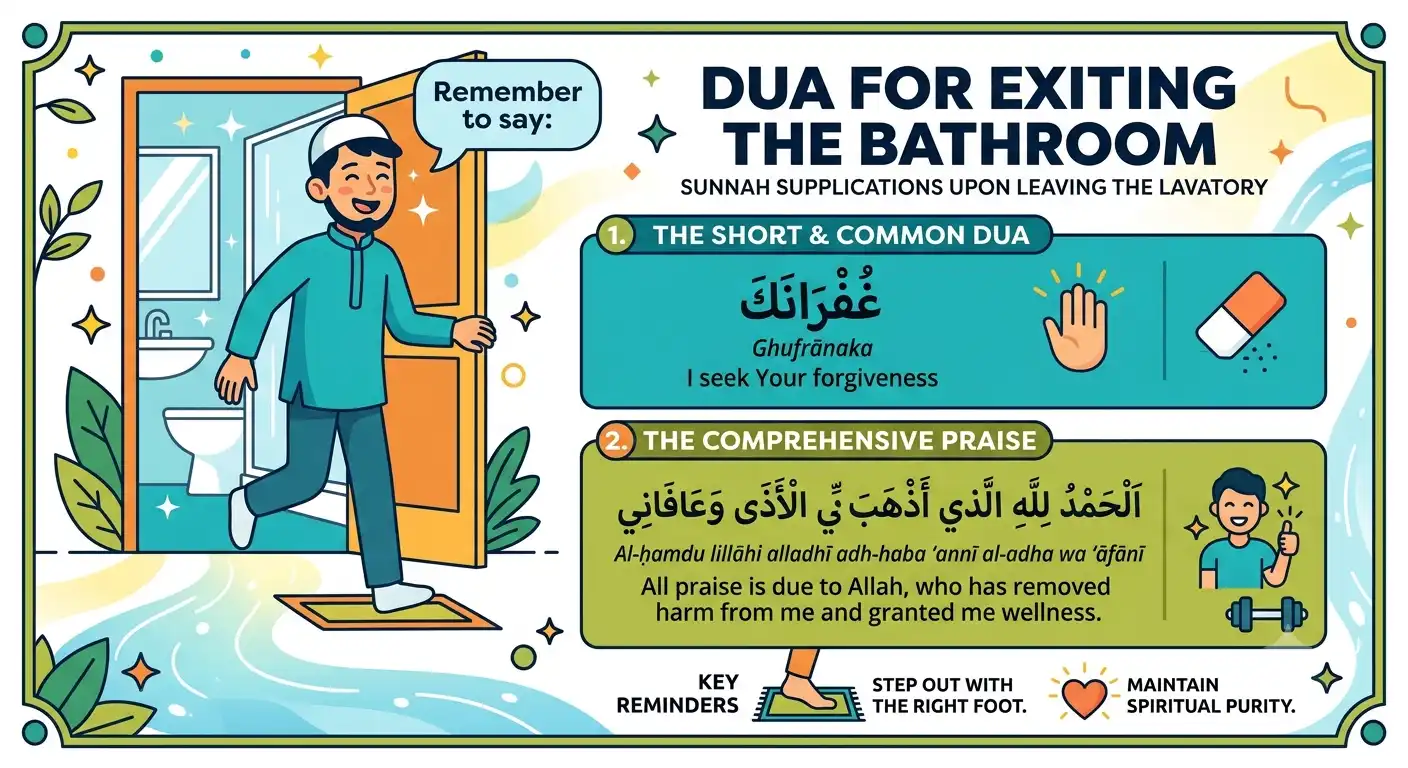
One word. Said in one second. And yet the PROPHET HAZRAT MUHAMMAD ﷺ never left the bathroom without it — not once.
Introduction: The Smallest Sunnah That Changes Everything
A young man was once asked by his teacher: “When do you remember Allah the most?”
He listed the obvious answers — in salah, during Ramadan, when making dua before sleep.
His teacher smiled and said: “The PROPHET HAZRAT MUHAMMAD ﷺ remembered Allah even when leaving the bathroom. If you can do that — if you can say one word of forgiveness in that most ordinary, private moment — then you will remember Allah everywhere, always.”
That one word is Ghufranak. That one act is the dua for exiting the bathroom — a Sunnah so simple it takes less than two seconds, yet so profound that scholars have written entire chapters about what it means.
This article will give you the complete dua, its Arabic text, transliteration, authentic hadith source, and the deep spiritual wisdom behind why the PROPHET HAZRAT MUHAMMAD ﷺ chose a word of forgiveness — of all things — to say when stepping out of the toilet.
What Is the Dua for Exiting the Bathroom — and Why Forgiveness?
The dua for exiting the bathroom is a single word — Ghufranak — that the PROPHET HAZRAT MUHAMMAD ﷺ recited every single time he stepped out of the toilet.
It narrated by Aisha (رضي الله عنها), the most observant witness to the Prophet’s private habits, which makes this narration uniquely reliable. She saw him say it. Every time.
But here is what stops most people when they think about it: Why forgiveness?
You just used the bathroom. You cleaned yourself, You are about to return to your day. Why, of all the possible words of praise or gratitude, did the PROPHET HAZRAT MUHAMMAD ﷺ choose to ask for forgiveness?
Scholars have offered a beautiful answer. Inside the bathroom, you cannot mention Allah’s name. You cannot say Bismillah, you cannot recite Quran, you cannot make dhikr. For a believer whose tongue is usually in constant remembrance of Allah, that moment of silence — of disconnection — felt like a lapse. The first words upon exiting were therefore an acknowledgment of that gap: “I could not praise You while I was in there. Forgive me for that absence.”
It also understood as gratitude expressed through humility. The body just functioned as Allah designed it to function. Waste removed. Relief granted. Health preserved. And the believing heart, upon realizing this, does not say “Well done, me” — it says “Thank You, Allah. Forgive me for not thanking You enough.”
That is Ghufranak. One word. An entire theology.
The Dua for Exiting the Bathroom — Full Arabic, Transliteration & Translation
The Primary Authentic Dua (Hasan Hadith — Tirmidhi)
Arabic: غُفْرَانَكَ
Transliteration: Ghufrānaka.
Translation: “I seek Your forgiveness.” (Literally: “Your forgiveness [I seek].”)
📖 Source: Jami’ al-Tirmidhi 7, Sunan Abu Dawud 30, Sunan Ibn Majah 300, Musnad Ahmad 25220 — narrated by Aisha (رضي الله عنها).
Imam al-Tirmidhi graded this hadith Hasan. Imam al-Nawawi verified its authenticity in his book al-Adhkar. This is the one word that is unambiguously, soundly established from the PROPHET HAZRAT MUHAMMAD ﷺ — and it is enough.
The Extended Dua (Reported from Anas ibn Malik and Abu Dharr — Weak but Permitted)
Some scholars and many Muslims also recite this longer version, which combines Ghufranak with a phrase of praise:
Arabic: غُفْرَانَكَ ، الْحَمْدُ لِلَّهِ الَّذِي أَذْهَبَ عَنِّي الْأَذَى وَعَافَانِي
Transliteration: Ghufrānaka. Alḥamdulillāhil-ladhī adh-haba ‘annil-adhā wa ‘āfānī.
Translation: “I seek Your forgiveness. All praise is due to Allah Who removed harm from me and granted me well-being.”
📖 Source: Sunan Ibn Majah 301, Sunan al-Nasa’i 9825 — narrated by Anas ibn Malik (رضي الله عنه) and Abu Dharr (رضي الله عنه). Imam al-Nawawi and Imam al-Tirmidhi both noted that the chains for this longer addition are weak. However, scholars including Imam al-Nawawi permit using weak hadith for recommended supplications — so reciting this extended dua is permissible and widely practiced.
Practical guidance: If you know only Ghufranak, that is complete and authentic. If you know the longer dua, recite it — there is no harm and possible added reward.
The Dua for Entering the Bathroom — The Companion Supplication
The exit dua does not exist alone. It is the second half of a complete pair. Before entering the bathroom, the PROPHET HAZRAT MUHAMMAD ﷺ taught:
Arabic: اللَّهُمَّ إِنِّي أَعُوذُ بِكَ مِنَ الْخُبْثِ وَالْخَبَائِثِ
Transliteration: Allāhumma innī a’ūdhu bika minal-khubthi wal-khabā’ith.
Translation: “O Allah, I seek refuge with You from male and female devils.”
📖 Source: Sahih al-Bukhari 142, Sahih Muslim 375 — narrated by Anas ibn Malik (رضي الله عنه). Muttafaqun ‘alayhi — agreed upon by both Bukhari and Muslim. This is the strongest possible grade of hadith authenticity.
Together, these two duas frame the entire experience of using the bathroom as a moment of spiritual awareness — entering with Allah’s protection, exiting with Allah’s forgiveness.
Why the PROPHET HAZRAT MUHAMMAD ﷺ Chose One Word Over a Long Prayer
There is wisdom in the brevity.
The bathroom is a place of minimal stay. You enter, you complete your need, you exit. The Sunnah does not ask you to stand at the door and recite a page. It asks you for one word — Ghufranak — said with your heart, as your right foot crosses the threshold back into the world.
The PROPHET HAZRAT MUHAMMAD ﷺ understood something about human nature: we will do what is easy, consistently. One word, said every time, builds a habit of forgiveness-seeking that eventually overflows into every moment of life.
The Quran says:
وَاسْتَغْفِرُوا۟ رَبَّكُمْ ثُمَّ تُوبُوٓا۟ إِلَيْهِ ۚ إِنَّ رَبِّى رَحِيمٌ وَدُودٌ
Wastaghfirū rabbakum thumma tūbū ilayh, inna Rabbī Raḥīmun Wadūd.
“Seek forgiveness from your Lord, then turn to Him in repentance. Indeed, my Lord is Merciful and Loving.” (Surah Hud 11:90)
Allah is Wadud — He is not just Merciful; He is loving. Every act of seeking forgiveness, even the briefest one-word Ghufranak, received by a God who loves the ones who return to Him.
What the Quran and Sunnah Say About Purity and the Believing Body
The dua for exiting the bathroom sits within a much larger Islamic framework of taharah — purity — that connects the physical and the spiritual in ways no other tradition does quite so completely.
The PROPHET HAZRAT MUHAMMAD ﷺ said:
“Purity half of faith.” (Sahih Muslim 223 — narrated by Abu Malik al-Ash’ari)
Half of faith. Not a side note. Not optional. The cleanliness of the body explicitly connected to the completeness of iman. This is why the bathroom dua matters — it does not stand alone. It is part of a theology of purity that the PROPHET HAZRAT MUHAMMAD ﷺ lived every day.
The Quran reinforces this:
إِنَّ اللَّهَ يُحِبُّ التَّوَّابِينَ وَيُحِبُّ الْمُتَطَهِّرِينَ
Innallāha yuḥibbut-tawwābīna wa yuḥibbul-mutaṭahhirīn.
“Indeed, Allah loves those who are constantly repentant and loves those who purify themselves.” (Surah Al-Baqarah 2:222)
Two loves in one verse: those who repent (tawwabeen) and those who purify themselves (mutatahhireen). The exit dua does both — Ghufranak is repentance, and leaving the bathroom clean is purification. Step out with your right foot, say one word, and you are fulfilling two things that Allah loves, simultaneously.
Complete Bathroom Etiquette From the Sunnah
The dua for exiting the bathroom the final act of a prophetically guided sequence. Competitors give the dua in isolation. Here is the complete picture:
Enter with your left foot. The PROPHET HAZRAT MUHAMMAD ﷺ preferred the right side for honorable acts and the left for impure ones. The bathroom entered with the left.
Recite the entry dua before stepping in. “Allāhumma innī a’ūdhu bika minal-khubthi wal-khabā’ith.” This established in Bukhari and Muslim.
Do not face or turn your back to the Qiblah while relieving yourself, if possible. (Sahih al-Bukhari 144)
Do not speak or respond to greetings. The PROPHET HAZRAT MUHAMMAD ﷺ did not reply to someone who greeted him while he was relieving himself. (Sunan Ibn Majah 352)
Do not use your right hand for cleansing. The PROPHET HAZRAT MUHAMMAD ﷺ said: “Do not touch your private parts with your right hand.” (Sahih al-Bukhari 154)
Clean thoroughly. Islam emphasizes istinja — cleansing with water — as part of physical and ritual purity. The PROPHET HAZRAT MUHAMMAD ﷺ said cleanliness is half of faith, and this expressed practically in how we use the bathroom.
Exit with your right foot and say Ghufranak immediately upon stepping out.
Each of these steps is not a ritual burden. It is the PROPHET HAZRAT MUHAMMAD ﷺ turning the most private, unglamorous moment of human life into a complete act of worship.
The Spiritual Depth of Ghufranak — A Word Scholars Wrote Books About
Why has one word generated so much scholarship?
Because Ghufranak — “Your forgiveness” — is not a full sentence. It is a fragment. A longing. In Arabic, when you say Ghufranak, you are leaving the verb implied: “I seek” or “Grant me” understood but unspoken. The word itself an outstretched hand toward Allah — not a full articulated request, just a reaching.
Imam Ibn al-Qayyim wrote that one of the signs of the truthful believer is that they seek Allah’s forgiveness not only for sins but for falling short in gratitude. You just received relief from your body. Your digestive system worked. Your kidneys functioned. Health flowed through you. And in that recognition, the heart cries Ghufranak — because no amount of thanks will ever be enough for what Allah has given the human body.
The Quran says:
وَإِن تَعُدُّوا۟ نِعْمَةَ ٱللَّهِ لَا تُحْصُوهَا
Wa in ta’uddū ni’matallāhi lā tuḥṣūhā.
“And if you were to count the blessings of Allah, you could never enumerate them.” (Surah Ibrahim 14:34)
A functioning body that relieves itself without pain, without illness, without complication — that is a blessing most of us never notice until it gone. Ghufranak is the believer noticing it, every single time.
What Changes When the Exit Dua Becomes a Habit
There is a man in his forties — a professional, a father — who once described himself as spiritually disconnected. He prayed Fajr sometimes. He felt guilty often, He wanted to do more but did not know where to start.
A scholar told him: Start with Ghufranak.
Just that. Every time you leave the bathroom, say it. Don’t add anything. Don’t pressure yourself to be spiritual everywhere else yet. Just that one word, that one moment.
He did it. Within a month, something shifted. Not dramatically. Quietly. He started noticing that he was thinking about Allah in other small moments too. The dua had become a hinge — a tiny hinge that opened a much larger door.
That is what consistent dhikr does. The PROPHET HAZRAT MUHAMMAD ﷺ told us:
“The most beloved deeds to Allah are the most consistent ones, even if they are small.” (Sahih al-Bukhari 6464, Sahih Muslim 783)
Ghufranak is small. Said ten times a day, every day, it is ten thousand times of seeking forgiveness in a year. Ten thousand moments of turning to Allah.
Dua for Entering and Exiting Bathroom — Side by Side Reference
Before Entering
Arabic: اللَّهُمَّ إِنِّي أَعُوذُ بِكَ مِنَ الْخُبْثِ وَالْخَبَائِثِ
Transliteration: Allāhumma innī a’ūdhu bika minal-khubthi wal-khabā’ith.
Translation: “O Allah, I seek refuge with You from male and female devils.”
Source: Sahih al-Bukhari 142, Sahih Muslim 375 ✅ Muttafaqun ‘alayhi
Foot: Enter with left foot.
After Exiting
Arabic: غُفْرَانَكَ
Transliteration: Ghufrānaka.
Translation: “I seek Your forgiveness.”
Source: Jami’ al-Tirmidhi 7, Sunan Abu Dawud 30, Sunan Ibn Majah 300 ✅ Hasan
Foot: Exit with right foot.
Common Mistakes People Make With the Bathroom Dua
This is what competitors miss entirely. People search for help because they are making mistakes — and they want to know what to do.
Saying Bismillah inside the bathroom. Many Muslims say Bismillah before everything — but the bathroom is an exception. Allah’s name should not mentioned in a place of impurity. The entry dua said before stepping in, at the door.
Forgetting to say the dua completely. The most common issue. The solution is to link the dua to the physical act of stepping out with your right foot. Right foot + Ghufranak. One movement, one word. They become inseparable.
Thinking the long dua is “better” because it is longer. The authenticated core is Ghufranak alone. The longer addition permitted but based on weak chains. Saying the short version with full heart and consistency is superior to reciting the long version without understanding.
Entering with the right foot. Many Muslims know the right foot rule for entering masjids and homes, but the bathroom is the exception — you enter with the left and exit with the right.
Saying the dua inside the bathroom before fully exiting. The dua said after stepping out — not while still inside. This is important both spiritually and practically.
Frequently Asked Questions About Dua for Exiting Bathroom
Q: What is the dua for exiting the bathroom in Islam?
The dua is Ghufranak — “I seek Your forgiveness.” It a single Arabic word narrated in Jami’ al-Tirmidhi 7, Sunan Abu Dawud 30, and Sunan Ibn Majah 300, through the narration of Aisha (رضي الله عنها). Imam al-Tirmidhi graded it Hasan and Imam al-Nawawi verified its authenticity.
Q: Why do we ask for forgiveness when leaving the bathroom?
Scholars explain it in two ways. First: inside the bathroom, you cannot mention Allah’s name — so exiting with Ghufranak acknowledges that momentary absence of dhikr. Second: the body just functioned as Allah designed, relief received, and health maintained .
Q: Which foot do you use to exit the bathroom?
You exit the bathroom with the right foot and say Ghufranak immediately. The right foot used for honorable exits (masjid, home) — the bathroom exit follows this same pattern. You enter the bathroom with the left foot.
Q: Can I say the bathroom dua in English?
You may make personal supplication in any language. However, Ghufranak a specific prophetic word taught by the PROPHET HAZRAT MUHAMMAD ﷺ himself. Learning this one word in Arabic is simple — it has five letters and said in one second — and carrying the prophetic word itself carries the barakah of following the Sunnah exactly.
Q: What if I forget to say the dua before entering — can I say it inside?
If you forgot the entry dua and are already inside, you may make the intention in your heart or say Bismillah very quietly without vocalizing it. However, the established practice is to say the entry dua before stepping in.
Q: Is the bathroom dua obligatory or Sunnah?
It is Sunnah — a recommended act, not obligatory. However, the PROPHET HAZRAT MUHAMMAD ﷺ never left it. Aisha (رضي الله عنها) narrated that he said it every single time. When the PROPHET HAZRAT MUHAMMAD ﷺ never abandoned something, scholars regard it as strongly recommended Sunnah (muakkadah), and abandoning it without reason considered disliked.
Conclusion: One Word That Follows You Everywhere
The dua for exiting the bathroom is not a big act of worship. It is not a long prayer, It is not something that requires preparation or a special state of heart.
It is one word. Said on the threshold. Said every day, multiple times, Said by the PROPHET HAZRAT MUHAMMAD ﷺ without exception.
And yet, in that one word, there is a complete posture of the believer: I received a blessing. I could not praise You while I was inside, I come out acknowledging my shortcoming. I seek Your forgiveness. Again. Always.
The Quran says:
وَتُوبُوٓا۟ إِلَى ٱللَّهِ جَمِيعًا أَيُّهَ ٱلْمُؤْمِنُونَ لَعَلَّكُمْ تُفْلِحُونَ
Wa tūbū ilallāhi jamī’an ayyuhal-mu’minūna la’allakum tufliḥūn.
“And turn to Allah in repentance, all of you, O believers, so that you may succeed.” (Surah Al-Nur 24:31)
All of you. Every believer. In every moment — even the smallest, most private, most ordinary one.
That is where Ghufranak lives. In the ordinar,. In the private, In the moment no one else sees but Allah.
Start today. Right foot. One word. Ghufranak.
The believer who remembers Allah in private is the one whose heart stays alive in public.
All duas and hadith in this article sourced and graded from primary collections: Sahih al-Bukhari, Sahih Muslim, Jami’ al-Tirmidhi, Sunan Abu Dawud, Sunan Ibn Majah, Musnad Ahmad, and verified through Imam al-Nawawi’s al-Adhkar and al-Majmu’.

Asrar Ahmad is the founder of PrayersGuide.com and a professional SEO expert based in Pakistan. As a practicing Muslim with years of experience in digital content, He is dedicated to making authentic Quranic prayers/duas and Islamic prayers accessible to English-speaking Muslims worldwide. All content is carefully researched and sourced from the Quran and authentic Hadith only.