Dua for Food: Before & After Eating
When you say bismillah before a meal, you are not just beginning to eat — you are turning a moment of hunger into an act of worship.
Introduction: The Grandmother Who Never Forgot
She was eighty-three years old, hands trembling, eyes still sharp.
Every single meal — whether it was a full plate of biryani or a piece of dry roti with tea — she would pause, lower her head, and whisper the dua for food before touching anything. Not out of habit. Out of love. Out of a deep, quiet certainty that the food on that plate was not hers by right. It was a gift.
As a child, you might have seen someone like her. Someone who taught you, without a lecture, that a meal begins with Allah’s name — not a fork.
That small act — reciting the dua before eating — is one of the most powerful sunnahs of daily life. It takes three seconds, It changes everything. It turns the most ordinary moment of your day into a direct conversation with your Creator.
And if you have ever forgotten it, rushed through it, or never properly learned it — this article is your gentle reminder that it is never too late to begin.
What Is the Dua for Food — and Why It Is More Than Manners
The dua for food is a prophetic supplication — or a set of supplications — that a Muslim recites before eating and after finishing a meal.
It is not table manners. It is theology.
When you say Bismillah before eating, you are declaring that the food in front of you exists because of Allah. Not because of the farmer who grew it, the cook who prepared it, or the money that bought it — though all of those are means. The Razzaq, the Provider, is Allah alone. The meal begins with His name because He is the reason the meal exists.
And when you praise Allah after eating, you are completing a circle of gratitude that the PROPHET HAZRAT MUHAMMAD ﷺ called deeply beloved to Allah. Anas ibn Malik narrated that the PROPHET HAZRAT MUHAMMAD ﷺ said:
“Allah is pleased with a servant who eats a meal and praises Him for it, and drinks a drink and praises Him for it.” (Sahih Muslim 2734, Sunan al-Tirmidhi 1816)
Notice what pleases Allah: not the length of the dua. Not the beauty of your voice. Just the act of acknowledging Him — before and after — in the smallest, most repeated ritual of your day.
This is the spiritual genius of the dua for food. Three billion Muslims eat multiple times a day. If every one of them pauses to say Allah’s name and then thanks Him after — that is a river of gratitude flowing to the heavens, all day, from every corner of the earth.
The Quran reminds us of this responsibility:
فَكُلُوا مِمَّا رَزَقَكُمُ اللَّهُ حَلَالًا طَيِّبًا وَاشْكُرُوا نِعْمَتَ اللَّهِ
Fakulū mimmā razaqakumullāhu ḥalālan ṭayyiban washkurū ni’matallāh.
“Then eat of what Allah has provided for you — lawful and good — and be grateful for the blessing of Allah.” (Surah Al-Nahl 16:114)
Halal. Tayyib. And thankful. That is the complete Islamic relationship with food.
Dua Before Eating — The Core Supplication
The Prophet ﷺ was direct and practical. He did not burden us with long memorizations before a meal. He gave us one word — and it is enough.
Arabic: بِسْمِ اللَّهِ
Transliteration: Bismillāh.
Translation: “In the name of Allah.”
📖 Source: Sahih al-Bukhari 5376, Sahih Muslim 2022 — narrated by ‘A’ishah (رضي الله عنها). The PROPHET HAZRAT MUHAMMAD ﷺ said: “When any one of you eats food, let him say Bismillah.”
This single word — Bismillah — drives away Shaytan from your food. The Prophet ﷺ described that when a person forgets to say it at the beginning, Shaytan enters and shares in the meal. When the person remembers and says Bismillah fi awwalihi wa akhirih, Shaytan is expelled even from what has already been eaten.
(Sunan Abu Dawud 3767, authenticated in Silsilah al-Ahadith al-Sahihah)
If You Forgot to Say Bismillah Before Starting
This is what people search for — and competitors rarely give a clear answer.
If you begin eating and forget to say the dua for food at the start, recite this the moment you remember — even mid-meal:
Arabic: بِسْمِ اللَّهِ أَوَّلَهُ وَآخِرَهُ
Transliteration: Bismillāhi awwalahu wa ākhirah.
Translation: “In the name of Allah, at its beginning and at its end.”
📖 Source: Sunan Abu Dawud 3767, Sunan al-Tirmidhi 1858 — narrated by ‘A’ishah (رضي الله عنها). Authenticated as sahih.
Do not feel shame for forgetting. Say it now. That is the Sunnah.
The Extended Dua Before Eating — For Barakah
This dua, narrated from the Tabi’in and traced back through Imam Malik, adds a beautiful request for protection:
Arabic: اللَّهُمَّ بَارِكْ لَنَا فِيمَا رَزَقْتَنَا وَقِنَا عَذَابَ النَّارِ
Transliteration: Allāhumma bārik lanā fīmā razaqtanā wa qinā ‘adhāban-nār.
Translation: “O Allah, bless us in what You have provided for us and protect us from the punishment of the Fire.”
📖 Source: Narrated by Urwah ibn al-Zubayr and recorded in al-Muwatta of Imam Malik.
This dua does two things at once: it asks for barakah in the food itself, and it asks for protection from the Fire — reminding the believer that even a meal is a moment to seek Allah’s mercy. It is particularly loved by scholars who teach that gratitude for food is itself a shield from heedlessness.
Dua After Eating — Complete Islamic Food Prayers
The Primary Dua After Eating (Hisnul Muslim — Most Authenticated)
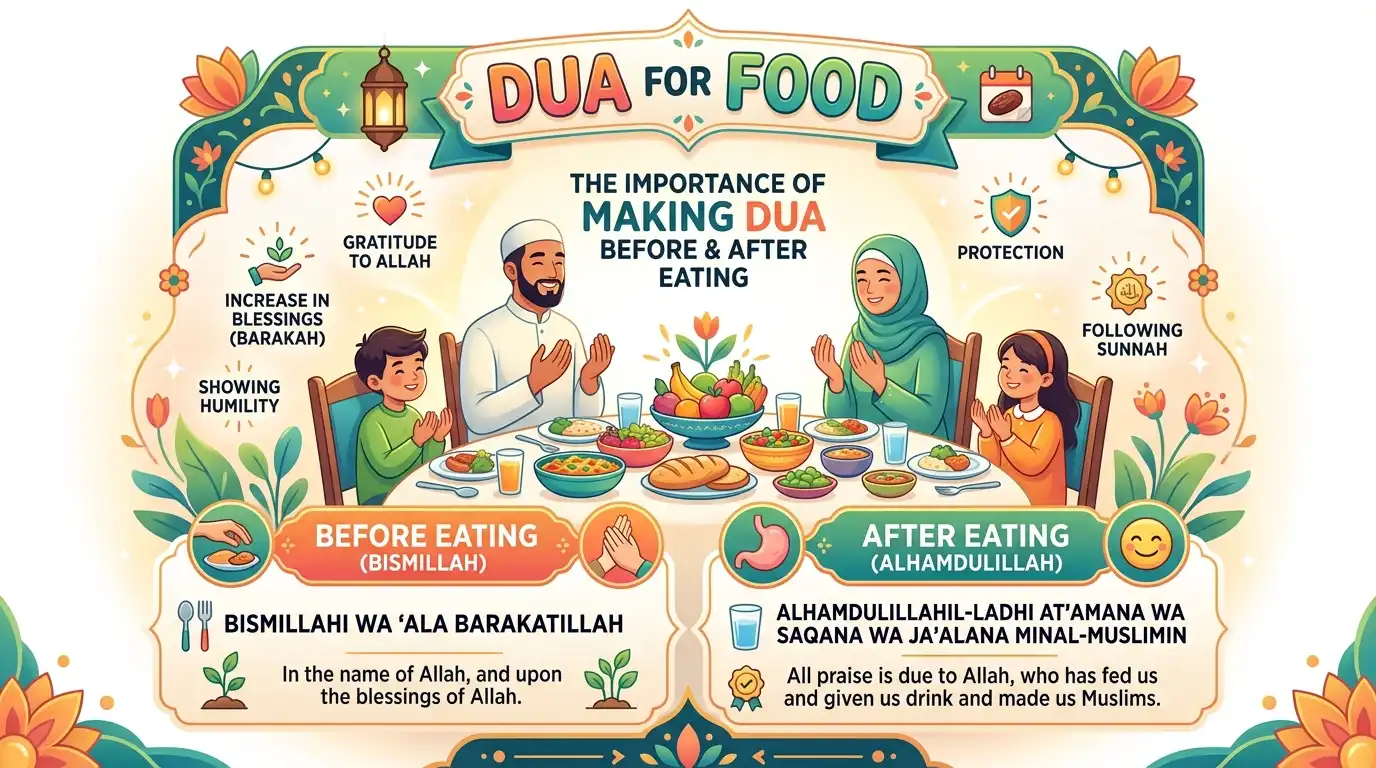
Arabic: الْحَمْدُ لِلَّهِ الَّذِي أَطْعَمَنَا وَسَقَانَا وَجَعَلَنَا مُسْلِمِينَ
Transliteration: Alḥamdulillāhil-ladhī aṭ’amanā wa saqānā wa ja’alanā muslimīn.
Translation: “All praise is due to Allah Who fed us and gave us drink and made us Muslims.”
📖 Source: Sunan Abu Dawud 3850, Sunan al-Tirmidhi 3457 — narrated by Abu Sa’id al-Khudri (رضي الله عنه). Classified as sahih.
Notice the third phrase: “and made us Muslims.” After eating, the PROPHET HAZRAT MUHAMMAD ﷺ did not just thank Allah for the food. He thanked Allah for Islam itself. Because the greatest provision is not the meal on your plate — it is the faith in your heart.
The Long Dua After Eating — Narrated from the PROPHET HAZRAT MUHAMMAD ﷺ Himself
Arabic: الْحَمْدُ لِلَّهِ حَمْدًا كَثِيرًا طَيِّبًا مُبَارَكًا فِيهِ، غَيْرَ مَكْفِيٍّ وَلَا مُوَدَّعٍ وَلَا مُسْتَغْنًى عَنْهُ رَبُّنَا
Transliteration: Alḥamdulillāhi ḥamdan kathīran ṭayyiban mubārakan fīh, ghayra makfiyyin wa lā muwadda’in wa lā mustaghnan ‘anhu Rabbunā.
Translation: “All praise is due to Allah — abundant, pure, and blessed praise; praise that is not enough, not forsaken, and not dispensed with, our Lord.”
📖 Source: Sahih al-Bukhari 5458 — narrated by Abu Umamah al-Bahili (رضي الله عنه). The PROPHET HAZRAT MUHAMMAD ﷺ recited this when his food was cleared away.
The phrase “ghayra makfiyyin” — “not enough” — is stunning in its honesty. The PROPHET HAZRAT MUHAMMAD ﷺ was saying: no matter how much I thank You, Allah, it is not enough for what You have given. This is the prophet of humility. This is the man who, after every meal, reminded himself that his gratitude could never match the gift.
Dua for Barakah When Eating with Others
The PROPHET HAZRAT MUHAMMAD ﷺ specifically taught a dua for when food is provided by a host, or when eating together:
Arabic: اللَّهُمَّ بَارِكْ لَهُمْ فِيمَا رَزَقْتَهُمْ وَاغْفِرْ لَهُمْ وَارْحَمْهُمْ
Transliteration: Allāhumma bārik lahum fīmā razaqtahum waghfir lahum warḥamhum.
Translation: “O Allah, bless them in what You have provided for them, forgive them, and have mercy on them.”
📖 Source: Sahih Muslim 2042 — narrated by Abdullah ibn Busr (رضي الله عنه). The PROPHET HAZRAT MUHAMMAD ﷺ made this dua when a family hosted him for a meal.
What the Quran Says About Food, Gratitude, and Provision
The Quran speaks about food and rizq repeatedly — not as a side topic, but as one of the central proofs of Allah’s existence and mercy.
Surah Al-Baqarah 2:172:
يَـٰٓأَيُّهَا ٱلَّذِينَ ءَامَنُوا۟ كُلُوا۟ مِن طَيِّبَـٰتِ مَا رَزَقْنَـٰكُمْ وَٱشْكُرُوا۟ لِلَّهِ
Yā ayyuhal-ladhīna āmanū kulū min ṭayyibāti mā razaqnākum wash-kurū lillāh.
“O you who have believed, eat from the good things which We have provided for you and be grateful to Allah.”
Allah is not commanding you to enjoy food reluctantly. He is commanding you to eat from the tayyibat — the good, the wholesome, the lawful — and to be grateful. Enjoyment with consciousness. Pleasure with gratitude. That is the Islamic way of eating.
Eating Etiquettes From the Sunnah — The Complete Prophetic Way
The dua for food does not exist in isolation. It is part of a comprehensive Sunnah of eating that the PROPHET HAZRAT MUHAMMAD ﷺ lived and taught. These are not suggestions. They are acts of worship woven into the most ordinary moment of your day.
Eat with your right hand. The PROPHET HAZRAT MUHAMMAD ﷺ said: “Do not eat with your left hand, for Shaytan eats with his left hand.” (Sahih Muslim 2020)
Eat from what is in front of you. When young Umar ibn Abi Salama ate with the PROPHET HAZRAT MUHAMMAD ﷺ and his hand wandered all over the dish, the PROPHET HAZRAT MUHAMMAD ﷺ gently said: “O boy, mention Allah’s name, eat with your right hand, and eat from what is in front of you.” (Sahih al-Bukhari 5376)
Do not eat while reclining. The PROPHET HAZRAT MUHAMMAD ﷺ said: “I do not eat while reclining.” (Sahih al-Bukhari 5398)
Do not waste. The Quran says:
وَلَا تُسْرِفُوا ۚ إِنَّهُ لَا يُحِبُّ الْمُسْرِفِينَ
Wa lā tusrifū, innahu lā yuḥibbul-musrifīn.
“And do not be excessive. Indeed, He does not like those who commit excess.” (Surah Al-An’am 6:141)
Food thrown away in the modern world is a spiritual failure. Every morsel that reaches our stomach is a mercy. Every morsel thrown is a test we did not pass with gratitude.
Share your food. The PROPHET HAZRAT MUHAMMAD ﷺ said: “The food of one person is sufficient for two, and the food of two is sufficient for four, and the food of four is sufficient for eight.” (Sahih Muslim 2059)
Do not criticize food. Abu Hurayrah narrated: “The PROPHET HAZRAT MUHAMMAD ﷺ never criticized any food. If he liked it, he ate it; if he did not like it, he left it.” (Sahih al-Bukhari 5409, Sahih Muslim 2064)
Why the Dua for Food Transforms the Way You Live
There is something that happens to a person who consistently recites the dua for food.
They become harder to take for granted.
Gratitude — real, daily gratitude, built into the fabric of every meal — restructures how you see the world. The family that used to feel ordinary around the dinner table starts to feel like a gift. The simple plate of dal and roti starts to carry weight. You begin to notice when others go without. You begin to give more.
A woman once shared that she had been deeply anxious — about money, about the future, about whether she was doing enough. She made one change: she started saying the dua before and after every meal, slowly, with meaning. Within weeks, something shifted. Not her circumstances. Her heart. She said: “I stopped eating like someone who deserved the food, and started eating like someone who was given it. That changed everything.”
The PROPHET HAZRAT MUHAMMAD ﷺ understood this. He never ate without remembering Allah before and praising Him after. That consistency was not just ritual — it was the daily calibration of a heart that stayed grounded in gratitude even as the world around him was constantly in turmoil.
Dua for Food in Specific Situations
🍱 When Eating Alone and Feeling Lonely
Emotion: peace
Ya Allah, this plate is just for me today, and still You have filled it with Your mercy. Let this food nourish not just my body but my certainty that You are with me — especially in the quiet moments when no one else is here. Let me never eat without remembering You, and never forget that Your company is enough.
🏥 When Eating During Illness — Asking for Healing Through Provision
Emotion: hope
Ya Shafi, what I eat today, let it carry Your healing into my body. You created the food and You created this body — and You know exactly what this body needs. Whatever nourishment reaches me, make it medicine. Make it strength. Make it the beginning of my recovery.
👨👩👧 When Eating as a Family — Dua for Barakah at the Table
Emotion: gratitude
Alhamdulillah for this table. For the faces around it. For the fact that we are together, alive, and fed — when so many in this world are not. Ya Allah, put barakah in this food, in our health, in our relationships, and in the time we have left together. Let no family meal pass without remembrance of You.
😔 When the Food Is Little and the Worry Is Great
Emotion: trust
Ya Razzaq, what is on this plate is small, but You are not. You fed Maryam (عليها السلام) with fruits from Paradise in a locked chamber. You fed thousands with the barakah of the PROPHET HAZRAT MUHAMMAD’s ﷺ hands. If this is what You have given today, then this is exactly what I need. I trust Your wisdom more than I trust my hunger.
🌙 When Breaking Fast — Iftar Dua
Emotion: awe
Allāhumma laka ṣumtu wa ‘alā rizqika afṭart. Ya Allah, I fasted for You. Not for health, not for discipline — for You. And now, as this water reaches my lips, I am overwhelmed by how generous You are. You withheld food from me all day so I could remember what it means to receive it. And then You gave it back. How do I thank You for that?
Arabic (Iftar Dua): اللَّهُمَّ لَكَ صُمْتُ وَعَلَى رِزْقِكَ أَفْطَرْتُ
Transliteration: Allāhumma laka ṣumtu wa ‘alā rizqika afṭart.
Translation: “O Allah, for You I fasted, and upon Your provision I break my fast.”
📖 Source: Sunan Abu Dawud 2358 — narrated by Mu’adh ibn Zuhrah. Classified as mursal but widely used and accepted by scholars.
Common Mistakes Muslims Make with Food Duas
Competitors mention the duas but rarely address what people actually get wrong. Here is what matters:
Saying it too fast to mean anything. The PROPHET HAZRAT MUHAMMAD ﷺ said: “Allah does not accept the dua of a distracted heart.” (Sunan al-Tirmidhi 3479). Bismillah said in consciousness is worth more than a long dua said without presence.
Not knowing what to say when they forget. Most Muslims don’t know the “Bismillahi awwalahu wa akhirahu” hadith. Now you do. Say it the moment you remember — even if the plate is almost empty.
Thinking “Bismillah” is just for children. It is the opening of the Quran. The Prophet ﷺ said it before every meal until his last. There is no stage of faith where you graduate beyond it.
Not praising Allah after eating. The dua after eating is often completely skipped. But the PROPHET HAZRAT MUHAMMAD ﷺ specifically said Allah is pleased when His servant praises Him after a meal. The opening takes seconds. The closing takes seconds. Both matter.
Eating without halal consciousness. The dua for food is built on the foundation of halal and tayyib — lawful and good. Bismillah over haram food does not make it permissible. The dua and the food must align.
How to Make the Food Dua a Lifelong Habit — 7 Practical Steps
1. Start with just Bismillah. Do not try to memorize five duas at once. Begin with Bismillah before every meal and Alhamdulillah after. These two words are enough to begin.
2. Say it before you pick up your spoon — not after. Train yourself to pause at the sight of food. That pause is the dua’s home.
3. Save the Arabic on your phone. Screenshot the duas in this article. Keep them as your lock screen until the words are in your memory.
4. Teach it at the table out loud. If you have children, say the dua aloud before meals — every time, without exception. Within a week, they will say it with you.
5. When you forget, do not skip — recover. Say “Bismillahi awwalahu wa akhirahu” immediately. The Sunnah has a recovery plan built in.
6. After eating, pause before standing. Just three seconds. Say “Alhamdulillah.” Let the gratitude land before you move on to the next thing.
7. Connect it to the story of your rizq. Think — just once per meal — about where this food came from. The rain that grew it. The hands that cooked it. The provision that paid for it. Every one of those was Allah. The dua becomes more sincere when you see the chain of mercy behind every plate.
Frequently Asked Questions About Dua for Food
Q: What is the dua for food in Islam — the simplest version?
The simplest and most authentic dua before eating is Bismillah — “In the name of Allah.” Narrated in Sahih al-Bukhari and Sahih Muslim, it is the direct prophetic instruction. After eating, say Alhamdulillah — “All praise is due to Allah.” These two words are the foundation of the entire Sunnah of eating.
Q: What do you say if you forget the dua before eating?
Recite “Bismillahi awwalahu wa akhirahu” — “In the name of Allah, at its beginning and at its end.” This is the specific prophetic solution narrated in Sunan Abu Dawud 3767. Say it the moment you remember, even if you are almost finished eating.
Q: Is there a different dua for food for children?
No separate dua exists for children. The same Bismillah before eating and Alhamdulillah after is what children are taught — and it is exactly what the Prophet ﷺ taught young Umar ibn Abi Salama. Start with these two words. Children who learn this early carry it for life.
Q: Can I say the dua for food in English?
You may make personal dua in any language, as Allah understands all hearts and all tongues. However, the prophetic duas — Bismillah, Alhamdulillah, and the longer narrated duas — carry the blessing of the Prophet’s own words. Learning even their transliteration and gradually moving to Arabic is the most complete Sunnah.
Q: What is the iftar dua — the dua for breaking fast?
The most widely narrated iftar dua is: “Allāhumma laka ṣumtu wa ‘alā rizqika afṭart” — “O Allah, for You I fasted, and upon Your provision I break my fast.” (Sunan Abu Dawud 2358). Some also recite “Dhahabaẓ-ẓama’u wabtallatil-‘urūqu wa thabatal-ajru inshāAllāh” — “The thirst has gone, the veins are moistened, and the reward is confirmed, if Allah wills.” (Sunan Abu Dawud 2357, classified as hasan by al-Albani).
Conclusion: A Meal Is Never Just a Meal
Every day, you sit down to eat. Sometimes the plate is full and the company is warm, Sometimes it is a hurried meal alone, eaten standing in a kitchen. Sometimes, on the hardest days, it is little and the gratitude is hard to find.
But the dua for food asks you to pause — every single time — and remember who made that meal possible.
Not the restaurant. Not the salary, Not the harvest. Allah. The Razzaq. The Sustainer. The One who has never, not once, forgotten to feed you — even on the days you forgot to thank Him.
وَإِن تَعُدُّوا۟ نِعْمَةَ ٱللَّهِ لَا تُحْصُوهَا
Wa in ta’uddū ni’matallāhi lā tuḥṣūhā.
“And if you were to count the blessings of Allah, you could never enumerate them.” (Surah Ibrahim 14:34)
You cannot count them. But you can acknowledge them. Three times a day, every day, with the simplest words the PROPHET HAZRAT MUHAMMAD ﷺ ever taught.
Bismillah before. Alhamdulillah after.
That is not just eating. That is a life lived in gratitude — one meal at a time.
All duas in this article are sourced from authenticated hadith: Sahih al-Bukhari, Sahih Muslim, Sunan Abu Dawud, Sunan al-Tirmidhi, and Musnad Ahmad. Every Arabic text, transliteration, and translation has been verified against primary hadith collections and cross-referenced with Hisnul Muslim (Fortress of the Muslim).

Asrar Ahmad is the founder of PrayersGuide.com and a professional SEO expert based in Pakistan. As a practicing Muslim with years of experience in digital content, He is dedicated to making authentic Quranic prayers/duas and Islamic prayers accessible to English-speaking Muslims worldwide. All content is carefully researched and sourced from the Quran and authentic Hadith only.