Dua for Anxiety in English: 10 Powerful Prayers for Peace and Calm
Dua for Anxiety in English: 10 Authentic Prayers for Peace
Discover Quranic and Prophetic duas for anxiety, worry, fear, stress, and emotional distress, with Arabic text, transliteration, English meaning, and authentic references.
Anxiety can make the future feel overwhelming and the present difficult to enjoy. Islam does not teach believers to ignore difficult emotions. Instead, the Quran and Sunnah give us words of remembrance, supplication, trust, and hope that can help us turn toward Allah when we feel worried or distressed.
If you are looking for a dua for anxiety in English, this guide brings together ten well-known supplications from the Quran and authentic or well-established Hadith sources. Each one includes the Arabic, transliteration, English meaning, source, and a practical explanation of when it may be especially meaningful.
Before You Begin
A dua is not a guaranteed formula that makes every difficulty disappear immediately. It is an act of worship, reliance, hope, and turning to Allah. Some of the supplications below directly mention worry and grief, while others come from situations of fear, distress, difficulty, or reliance on Allah.
If anxiety is persistent, severe, or affecting sleep, work, relationships, or daily life, seeking qualified medical or mental-health support is also important. Spiritual practice and professional care do not have to compete with each other.
10 Duas for Anxiety, Stress, Fear, and Worry
- Dua for relief from worry and grief
- Dua of Prophet Yunus in distress
- Hasbunallahu wa ni’mal wakeel
- Dua when something feels difficult
- Dua asking Allah for light
- Dua before sleeping
- Dua for setting right your religion and worldly life
- Morning and evening remembrance
- Dua seeking protection from worry and grief
- A personal dua for anxiety in English
1. Dua for Relief From Anxiety and Grief
One of the most comprehensive supplications for distress is the dua in which a servant asks Allah to make the Quran the spring of the heart, the light of the chest, and a means of removing sadness and worry.
This dua is especially meaningful when worry feels bigger than your ability to control it. Instead of asking only for circumstances to change, it asks Allah to bring the Quran into the heart as a source of light and relief.
2. Dua of Prophet Yunus for Distress
The dua of Prophet Yunus (peace be upon him) is one of the shortest and most memorable supplications for a person facing distress.
Prophet Yunus made this supplication while in severe distress. The following verse states that Allah responded to him and saved him from his distress, and then says: “And thus We save the believers.”
It is a powerful reminder that even when a person feels trapped, turning sincerely toward Allah remains open to them.
3. Hasbunallahu Wa Ni’mal Wakeel for Fear and Uncertainty
These words are particularly relevant when anxiety comes from uncertainty: a difficult decision, a frightening situation, financial pressure, or fear about what may happen next. They express tawakkul—placing one’s reliance upon Allah while recognizing that human beings cannot control every outcome.
4. Dua When Something Feels Difficult
This dua can be meaningful before an examination, difficult conversation, important meeting, stressful task, or any situation in which you feel overwhelmed.
5. Dua Asking Allah for Light in the Heart
Anxiety can make everything feel mentally dark and uncertain. This supplication turns attention toward Allah’s light, guidance, and clarity rather than allowing fear to dominate the mind.
6. Dua for Anxiety at Night Before Sleeping
The Prophet ﷺ would say this when going to bed. For someone whose anxiety becomes stronger at night, this short remembrance can be a simple way to end the day by remembering Allah rather than continuing to replay worries.
You can also learn the established bedtime adhkar from authentic sources rather than relying on unsourced claims about guaranteed protection or guaranteed sleep.
7. Dua for Putting Your Life and Future in Order
This supplication is useful when anxiety is connected to the bigger picture of life: faith, livelihood, responsibilities, relationships, and the future. It asks Allah to bring goodness and order to both religious and worldly affairs.
8. Morning Dua for Trust and Peace
Morning remembrance can help establish a daily habit of turning toward Allah at the beginning of the day. If you want to build a broader morning routine, see our Morning Duas from the Quran in English.
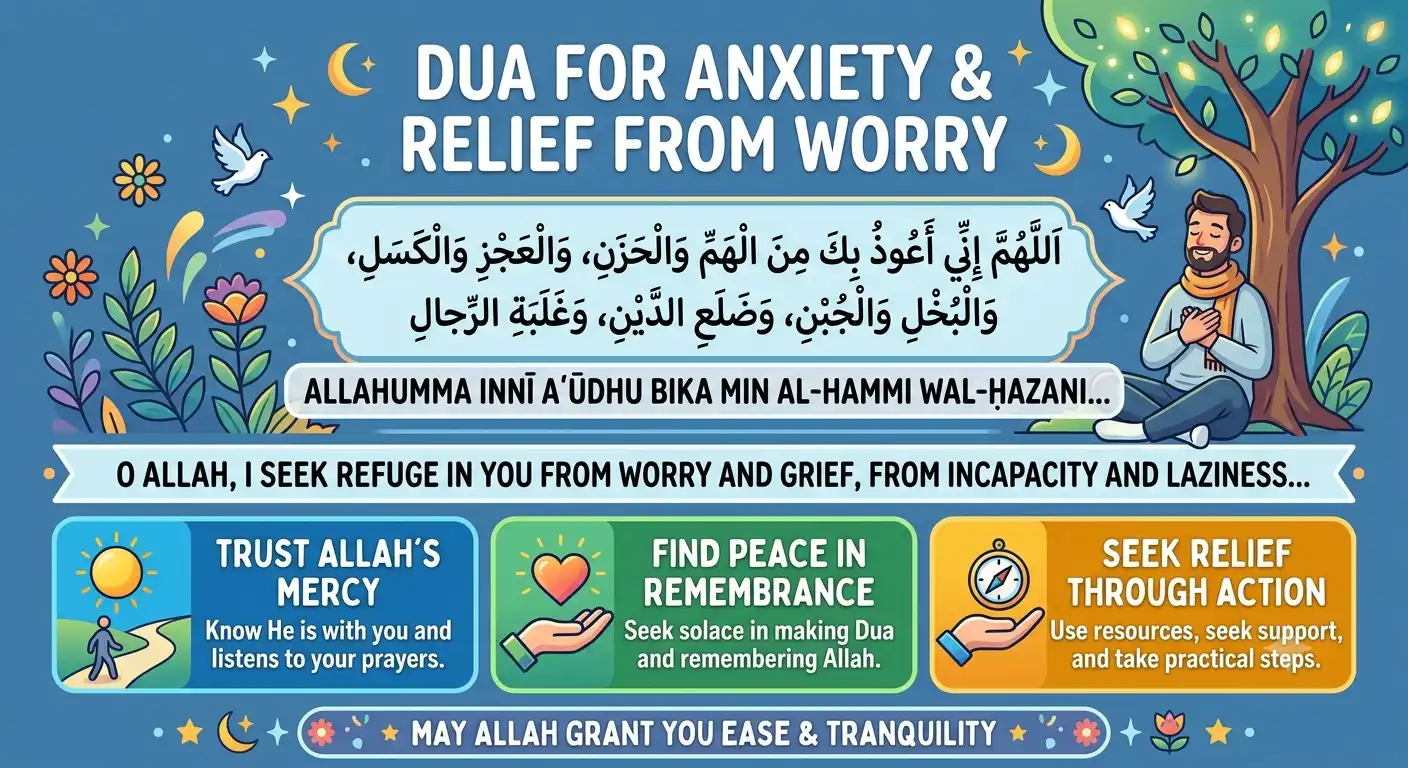
9. Dua Seeking Protection From Worry and Grief
This is one of the clearest Prophetic supplications for worry and grief because the wording directly asks Allah for protection from both.
Notice how comprehensive this dua is. It does not only mention emotional distress. It also asks Allah for protection from weakness, fear, debt, and circumstances in which a person feels overpowered.
10. A Personal Dua for Anxiety in English
In addition to learning established Quranic and Prophetic supplications, you can also ask Allah for help in your own words. If English is the language in which you can express your feelings most honestly, you may use a personal prayer such as this:
“O Allah, You know what I am carrying in my heart. You know the worries I cannot explain to anyone else. Give me strength to deal with what I can change and patience with what I cannot control. Replace my fear with trust in You, my confusion with clarity, and my sadness with hope. Help me take the right steps while leaving the outcome in Your hands. Forgive my mistakes, guide my heart, protect my family, and give me peace through Your remembrance. Ameen.”
A personal dua like this can be a meaningful supplement to the established supplications above. It allows you to speak honestly about your own situation while keeping the authentic Prophetic duas as part of your regular practice.
Can You Make Dua for Anxiety in English?
Yes. A Muslim can ask Allah in their own language when making personal supplication, especially when they are expressing their own needs and feelings. Allah knows what is hidden and what is spoken.
At the same time, when a supplication has a specific wording transmitted from the Prophet ﷺ, it is valuable to learn and preserve that wording in Arabic. Transliteration and English meaning can help you understand what you are saying while you gradually learn the Arabic.
The two approaches can work together: learn authentic duas in Arabic, understand their meaning, and also speak to Allah personally in the language you understand best.
When Should You Recite a Dua for Anxiety?
You do not have to wait for a particular clock time before turning to Allah. You can make dua whenever you need Him. However, some established supplications are connected to particular situations, such as bedtime or morning and evening remembrance.
- When you feel worried: turn to Allah immediately rather than waiting for the anxiety to become overwhelming.
- Before sleeping: use established bedtime remembrance such as the dua mentioned above.
- In the morning: build a consistent routine of Quranic duas and authentic adhkar.
- During a difficult situation: use supplications that express reliance, patience, and the request for ease.
- During sujood: use the opportunity to make sincere supplication in accordance with the guidance of the Sunnah.
Dua, Dhikr, and Practical Help Can Work Together
Making dua does not mean a person should ignore the practical causes of their difficulties. If anxiety is connected to financial problems, you can make a plan and seek trustworthy advice. If it is connected to family conflict, you can seek reconciliation or counseling. If it is affecting your health or daily functioning, professional care may be appropriate.
Spiritual practice can accompany these practical steps. The goal is not to choose between faith and responsible action, but to combine reliance on Allah with the means available to you.
Frequently Asked Questions About Dua for Anxiety
What is the best dua for anxiety in English?
Several authentic supplications are relevant to anxiety and distress. Among the most direct is the Prophetic dua asking Allah to make the Quran the spring of the heart and to remove sadness and worry. Another especially direct supplication is the dua beginning “Allahumma inni a’udhu bika minal-hammi wal-hazan,” which explicitly seeks protection from worry and grief.
Can I make dua for anxiety in English?
Yes. You can make personal supplication in English and express your worries and needs directly to Allah. For established duas from the Quran and Sunnah, learning the Arabic wording and understanding its meaning is beneficial.
What is a short dua for anxiety?
The dua of Prophet Yunus is particularly short: “La ilaha illa anta subhanaka inni kuntu minaz-zalimin.” It is found in Surah Al-Anbiya 21:87 and was made by Yunus during severe distress.
What is the dua for anxiety and fear?
“Hasbunallahu wa ni’mal wakeel” is a Quranic expression of reliance on Allah: “Allah is sufficient for us, and He is the best Disposer of affairs.” It appears in Quran 3:173 in the context of believers responding to a threat.
Is anxiety a sign of weak faith?
No. Experiencing fear, worry, sadness, or emotional difficulty does not automatically mean that a person has weak faith. Human beings experience difficult emotions. Islam provides spiritual practices such as dua, dhikr, prayer, patience, and reliance on Allah while also allowing people to seek appropriate practical and professional help.
How many times should I recite a dua for anxiety?
There is no single universal number prescribed for every anxiety-related dua. Where the Quran or authentic Sunnah specifies a number or time, follow that guidance. Otherwise, avoid presenting a particular repetition count as a required Sunnah without evidence.
Can I make dua when I am having anxiety at night?
Yes. You can turn to Allah at any time. The Sunnah also contains established bedtime supplications, including “Bismika Allahumma amutu wa ahya,” which the Prophet ﷺ said when going to sleep.
Should I seek professional help for severe anxiety?
Yes. If anxiety is persistent, severe, or interfering with sleep, work, relationships, worship, or everyday life, speaking with a qualified healthcare or mental-health professional is appropriate. Dua and professional care can be complementary rather than competing approaches.
Turn Your Worry Toward Allah
Anxiety can make you feel as though you have to solve everything at once. You do not. Take the next responsible step, make sincere dua, and place what you cannot control in Allah’s hands.
Learn one authentic dua. Understand its meaning. Repeat it with sincerity. Then keep going.

Asrar Ahmad is the founder of PrayersGuide.com and a professional SEO expert based in Pakistan. As a practicing Muslim with years of experience in digital content, He is dedicated to making authentic Quranic prayers/duas and Islamic prayers accessible to English-speaking Muslims worldwide. All content is carefully researched and sourced from the Quran and authentic Hadith only.