
Quranic Prayer for Forgiveness: 10 Powerful Duas for Allah’s Mercy
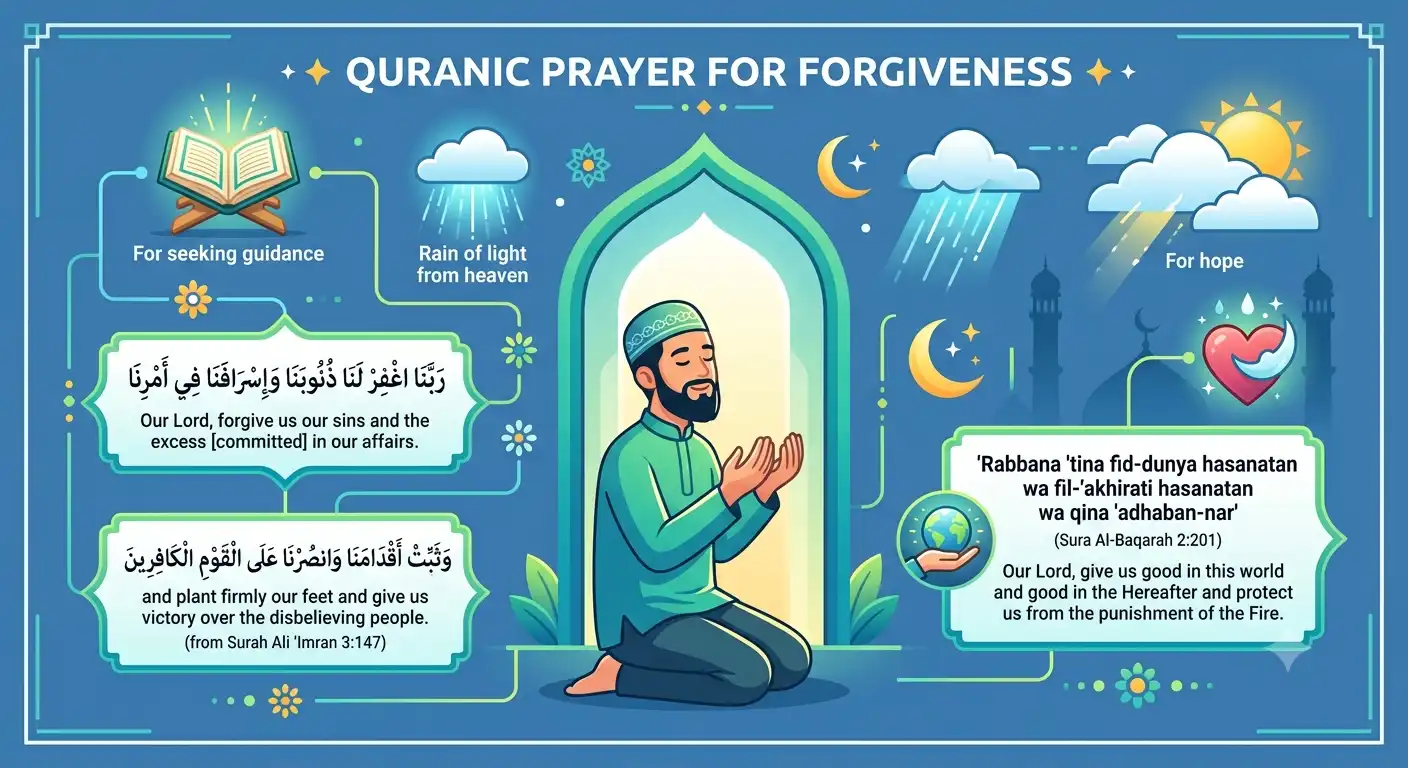
There are moments when a person carries the weight of a mistake so heavily that they do not know where to begin. You may have drifted away from Allah, committed a sin you deeply regret, or simply feel that your heart needs to return to its Creator.
In Islam, the door of repentance is always open. The Quran and authentic Sunnah give us beautiful prayers and words of repentance that help us turn back to Allah with humility, hope, and sincerity.
If you are searching for a Quranic prayer for forgiveness, this guide brings together Quranic duas, verses about Allah’s mercy, and authentic Prophetic supplications for seeking forgiveness.
— Surah Az-Zumar 39:53
This verse is one of the strongest reminders in the Quran that sincere repentance should be accompanied by hope rather than despair. Below are ten important prayers and passages to help you seek Allah’s forgiveness.
1. Quranic Prayer for Forgiveness — Dua of Adam and Hawwa (AS)
One of the most beautiful Quranic prayers for forgiveness is the dua attributed to Prophet Adam and his wife after their mistake. Their response teaches an important lesson: instead of making excuses, they acknowledged their wrongdoing and asked Allah for forgiveness and mercy.
This dua teaches us to recognize our mistakes, turn toward Allah, and ask for both forgiveness and mercy. It is especially meaningful when you are struggling with regret and want to make a sincere return to Allah.
2. Sayyid al-Istighfar — The Master Dua for Forgiveness
Sayyid al-Istighfar is one of the most comprehensive Prophetic duas for forgiveness. It is important to clarify that this is not a Quranic verse; it was taught by the Prophet Muhammad (PBUH) and is recorded in Sahih al-Bukhari.
The Prophet Muhammad (PBUH) described this as the master of seeking forgiveness. The hadith mentions its virtue when recited with conviction in the morning or evening.
3. Short Prayer for Forgiveness — Astaghfirullah
Sometimes you need a simple phrase that you can repeat throughout the day. Astaghfirullah means “I seek forgiveness from Allah” and is one of the simplest forms of istighfar.
The Prophet Muhammad (PBUH) regularly sought Allah’s forgiveness. You can make istighfar after salah, when remembering a mistake, during your morning or evening adhkar, or whenever you want to turn your heart back toward Allah.
4. Dua of Prophet Musa (AS) for Forgiveness
Prophet Musa (AS) made this concise prayer after acknowledging that he had wronged himself. It is a powerful example of immediately turning to Allah after making a mistake.
This short dua is particularly suitable when you recognize a personal mistake and want to respond with humility rather than delay repentance.
5. Quranic Prayer for Forgiveness of Sins — Surah Al-Imran
The Quran contains several supplications in which believers ask Allah to forgive their sins and shortcomings. One of them appears in Surah Al-Imran.
The dua combines a request for forgiveness with a request for steadfastness. This is a useful reminder that repentance is not only about looking backward at our mistakes; it is also about asking Allah to help us remain firm afterward.
6. Quranic Prayer of Prophet Ibrahim (AS) for Forgiveness
Prophet Ibrahim (AS) also prayed for forgiveness for himself, his parents, and the believers. This beautiful Quranic dua expands the meaning of seeking forgiveness beyond our own personal needs.
Including parents and fellow believers in your dua is a beautiful practice of remembering that our relationship with Allah is not only about ourselves.
7. Quranic Verse About Forgiveness After Major Sins
One of the most hopeful passages about repentance is found in Surah Az-Zumar. This is not technically a dua; it is a powerful Quranic declaration about Allah’s mercy.
The verse gives believers a powerful reason not to surrender to despair. At the same time, Islamic repentance involves sincerely turning back to Allah rather than simply assuming forgiveness without repentance.
8. Quranic Guidance for Seeking Forgiveness and Repentance
The Quran frequently connects istighfar, or seeking forgiveness, with tawbah, or repentance. One example appears in the words of Prophet Hud (AS).
This passage highlights an important distinction: asking Allah for forgiveness should be accompanied by sincere repentance and a genuine effort to leave the wrongdoing behind.
9. Prophetic Dua for Forgiveness During Night Prayer
The Sunnah also contains comprehensive supplications for forgiveness that the Prophet Muhammad (PBUH) made during his night prayer. This particular dua asks Allah to forgive both known and unknown shortcomings.
This is a reminder that sincere repentance can include shortcomings we recognize as well as those we may not fully understand.
10. A Simple Closing Dua for Tawbah
A believer can end the day by sincerely asking Allah for forgiveness and resolving to return to Him. The important element is sincerity rather than a particular formula or an invented fixed number.
You can use this simple wording whenever you sincerely want to turn back to Allah. There is no need to wait for a particular time or occasion to repent.
How to Make Sincere Tawbah to Allah
Seeking forgiveness is closely connected with sincere repentance. Classical Islamic scholarship commonly describes repentance as involving several important elements.
- Recognize the wrongdoing: Acknowledge the sin rather than making excuses for it.
- Feel genuine regret: Sincere remorse is an important part of repentance.
- Stop the wrongdoing: If the sin is ongoing, make a genuine effort to leave it.
- Resolve not to return: Intend sincerely not to repeat the wrongdoing.
- Restore people’s rights: If another person’s rights were violated, take appropriate steps to make amends.
When Is the Best Time to Ask Allah for Forgiveness?
You can seek Allah’s forgiveness at any time. There is no need to wait for a particular hour before making sincere tawbah.
The Quran and Sunnah also highlight certain times and practices associated with remembrance, prayer, and seeking forgiveness, including the quiet hours before dawn and the times when a believer is engaged in sincere worship.
If you are struggling with worry, guilt, or emotional distress while seeking forgiveness, you may also find our related guide useful:
Quranic Verses About Allah’s Forgiveness
The Quran repeatedly emphasizes Allah’s mercy and forgiveness. Some particularly relevant passages include:
- Surah Az-Zumar 39:53 — Do not despair of Allah’s mercy.
- Surah An-Nisa 4:110 — Whoever seeks Allah’s forgiveness will find Him Forgiving and Merciful.
- Surah Al-Furqan 25:70 — Allah mentions repentance, faith, and righteous action together.
- Surah Al-Baqarah 2:222 — Allah loves those who continually repent and purify themselves.
Conclusion: Never Despair of Allah’s Mercy
The Quranic prayer for forgiveness is ultimately about returning to Allah with humility and hope. The Quran gives us beautiful supplications, while the Sunnah preserves the words of the Prophet Muhammad (PBUH) for seeking forgiveness.
You may have made serious mistakes. You may have stayed away from prayer for a long time. You may feel ashamed of your past. None of these feelings should become a reason to abandon Allah’s mercy.
Instead, turn back. Say Astaghfirullah. Make sincere tawbah. Ask Allah to forgive you and help you change.
— Surah An-Nisa 4:110
The door of repentance is open. Take the step toward Allah with sincerity, and never allow despair to convince you that His mercy is beyond your reach.
Frequently Asked Questions
What is the most powerful Quranic prayer for forgiveness?
There is no need to declare one dua universally “the most powerful” in every situation. Among the most comprehensive supplications for forgiveness is Sayyid al-Istighfar, which was taught by the Prophet Muhammad (PBUH) and is recorded in Sahih al-Bukhari. For Quranic duas specifically, the prayer of Adam and Hawwa in Surah Al-A’raf 7:23 is one of the clearest examples of directly asking Allah for forgiveness and mercy.
How many times should I say Astaghfirullah?
The Prophet Muhammad (PBUH) frequently sought Allah’s forgiveness. Authentic narrations mention that he sought forgiveness many times each day. There is no need to invent a fixed number for every situation. Focus on sincerity, understanding, and consistency.
Can I make a forgiveness dua in English?
Yes. You can personally ask Allah for forgiveness in English or another language you understand. When reciting a specific Quranic or Prophetic supplication, learning the original Arabic and its meaning is beneficial. You can use transliteration as a bridge while learning.
Does Allah forgive major sins?
The Quran strongly emphasizes Allah’s vast mercy and calls people to repent rather than despair. Sincere repentance includes turning away from the wrongdoing and seeking Allah’s forgiveness. Muslims should never use the size of a past sin as a reason to abandon repentance.
What is the difference between Istighfar and Tawbah?
Istighfar means seeking Allah’s forgiveness. Tawbah means turning back to Allah in repentance. Sincere tawbah involves regret for wrongdoing, stopping the sin, and sincerely resolving not to return to it. If another person’s rights are involved, making appropriate amends is also important.

Asrar Ahmad is the founder of PrayersGuide.com and a professional SEO expert based in Pakistan. As a practicing Muslim with years of experience in digital content, He is dedicated to making authentic Quranic prayers/duas and Islamic prayers accessible to English-speaking Muslims worldwide. All content is carefully researched and sourced from the Quran and authentic Hadith only.

