Alhamdulillah Ala Kulli Haal: Meaning, Arabic & When to Say It
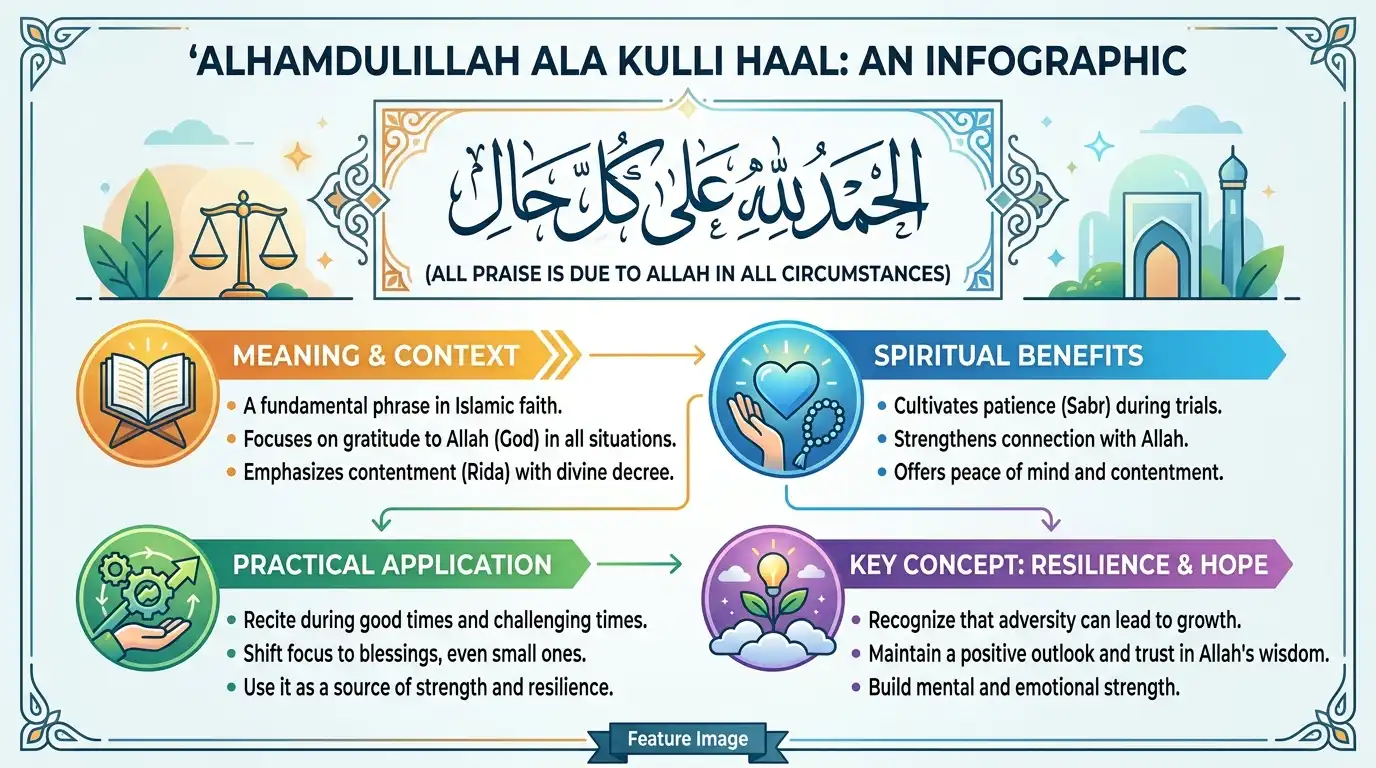
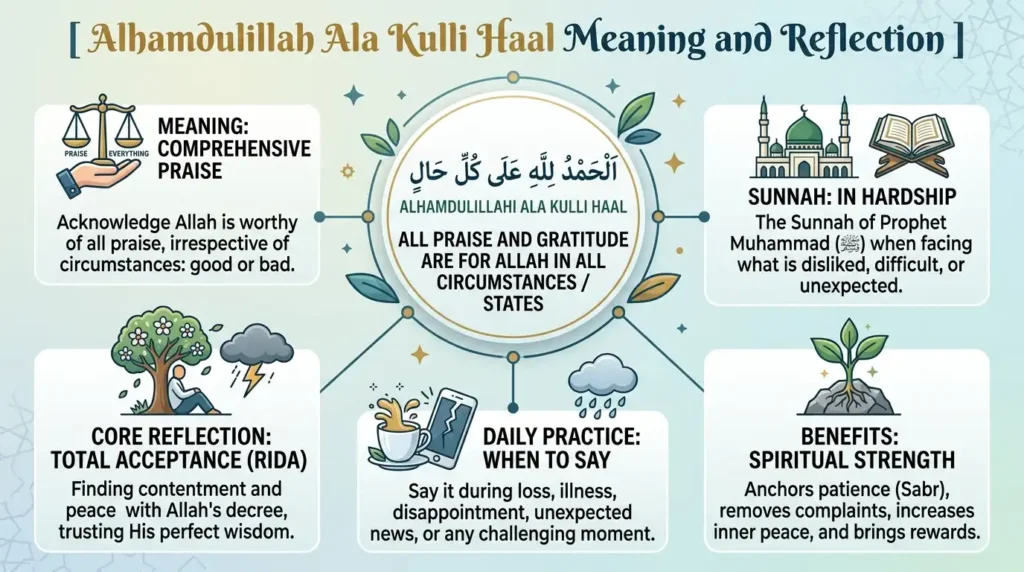
Alhamdulillah Ala Kulli Haal is an Arabic expression that means “All praise is for Allah in every circumstance” or “Praise be to Allah in every situation.” It is especially meaningful when life does not go according to plan because it reminds a Muslim to continue praising Allah while facing change, disappointment, difficulty, or uncertainty.
The phrase is often written online in several forms, including alhamdulillah ala kulli haal, alhamdulillah ala kulli hal, and alhamdulillah ‘ala kulli hal. These variations generally represent the same Arabic expression in different transliteration styles.
This guide explains its Arabic spelling, English and Urdu meanings, word-by-word translation, pronunciation, Islamic context, when to say it, and how it differs from Alhamdulillah for everything.
What Does Alhamdulillah Ala Kulli Haal Mean?
Alhamdulillah Ala Kulli Haal means:
“All praise is for Allah in every circumstance.”
It can also be translated naturally as:
“Praise be to Allah in every situation.”
The Arabic phrase is:
الْحَمْدُ لِلَّهِ عَلَى كُلِّ حَالٍ
Transliteration:
Alhamdulillahi ‘ala kulli haal
The expression combines the idea of praising Allah with the idea of doing so regardless of changing circumstances.
That makes it particularly relevant when something unexpected or unpleasant happens.
For example, someone might receive disappointing news, experience a setback at work, face financial difficulties, or deal with a personal loss. Saying Alhamdulillah ‘ala kulli hal does not mean the person has to describe the situation as pleasant. Instead, it expresses continued praise of Allah while facing the situation.
This distinction is important.
Alhamdulillah Ala Kulli Haal is not simply another way of saying “everything is good.” It is closer to saying that Allah remains worthy of praise in every circumstance.
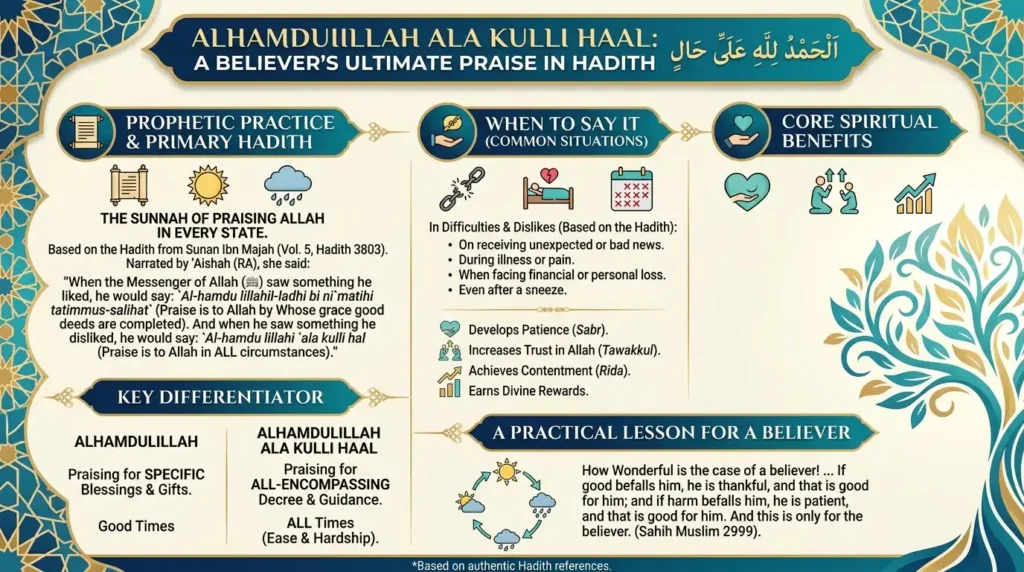
The phrase is also commonly associated with the narration recorded in Sunan Ibn Majah 3803, in which Aishah رضي الله عنها reported that when the Prophet Muhammad ﷺ saw something he disliked, he said “Al-hamdu lillahi ‘ala kulli hal.” (Sunnah)
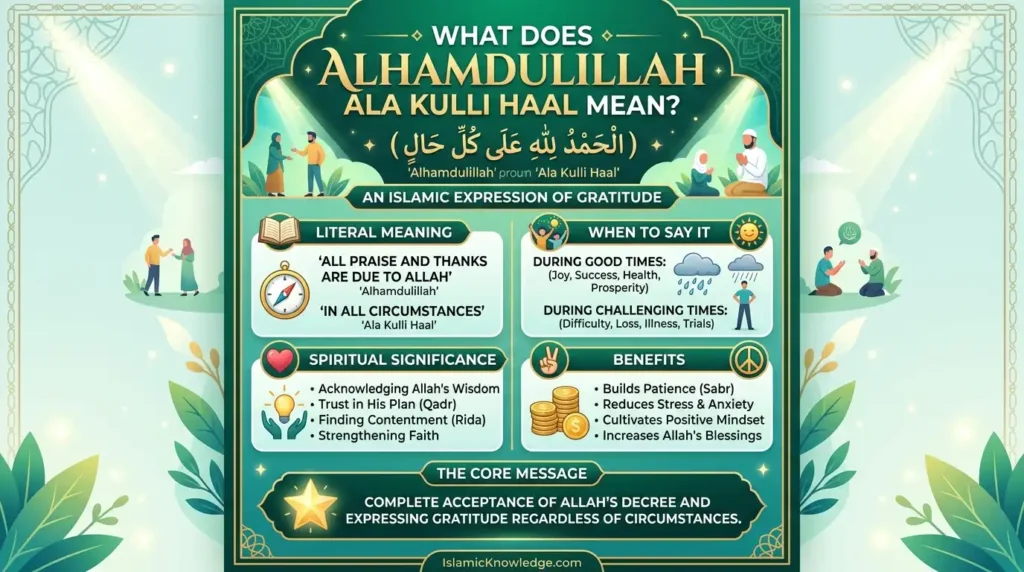
Image Placeholder — Image Title: What Does Alhamdulillah Ala Kulli Haal Mean
Alhamdulillah Ala Kulli Haal in Arabic
The complete Arabic spelling is:
الْحَمْدُ لِلَّهِ عَلَى كُلِّ حَالٍ
Without vowel marks, which is often more convenient for copying and pasting:
الحمد لله على كل حال
Transliteration:
Alhamdulillahi ‘ala kulli haal
You may also see:
- Alhamdulillah ala kulli haal
- Alhamdulillah ala kulli hal
- Alhamdulillah ‘ala kulli hal
- Alhamdulillah ala kullihal
- Alhamdulillah ala kulli haal
- Alhamdulillah 3ala kouli hal
These spellings are mostly differences in how Arabic sounds are represented using English letters. Arabic transliteration does not have one universally used spelling system, which is why the same phrase can appear differently in Google searches, social media posts, and Islamic websites.
Copy and Paste
Arabic:
الحمد لله على كل حال
English:
Alhamdulillah ‘ala kulli haal
Meaning:
All praise is for Allah in every circumstance.

Alhamdulillah Ala Kulli Haal Meaning in English
The closest straightforward English meaning of Alhamdulillah Ala Kulli Haal is:
“All praise is for Allah in every circumstance.”
Another natural translation is:
“Praise be to Allah in every situation.”
The word haal refers to a state, condition, or circumstance. Therefore, “every circumstance” communicates the idea more precisely than simply translating the phrase as “thank Allah for everything.”
There is also an important difference between praise and gratitude.
When someone says Alhamdulillah, they are not merely saying “thank you.” The phrase expresses hamd, which includes praise of Allah, while gratitude or shukr is closely related.
This is why translating Alhamdulillah simply as “thanks” can lose some of its meaning.
What Does “Ala Kulli” Mean?
‘Ala kulli can be understood as “in every” or “upon every,” depending on how the expression is translated.
Combined with haal, the phrase conveys:
“in every circumstance” or “in every state.”
That is why alhamdulillah ala kulli haal meaning in English is commonly given as:
All praise is for Allah in every circumstance.
Alhamdulillah Ala Kulli Haal Meaning in Urdu
For Urdu-speaking readers, Alhamdulillah Ala Kulli Haal can be written as:
الحمد للہ علی کل حال
A simple Urdu meaning is:
ہر حال میں اللہ کی حمد و تعریف ہے۔
Another natural explanation is:
ہر حالت میں اللہ کا شکر اور حمد کرنا۔
In simple Urdu, the idea is that a Muslim continues to praise Allah whether life is going according to expectations or a person is facing a difficult situation.
This is why searches such as alhamdulillah ala kulli haal maksud, maksud alhamdulillah ala kulli hal, and alhamdulillah kulli haal maksud generally point toward the same basic concept.
However, this article is written primarily for an English-speaking audience, including Muslims in the United States and United Kingdom, so the English explanation is the main focus.

Alhamdulillah Ala Kulli Haal Word-by-Word Meaning
Understanding each word makes the complete expression easier to remember.
| Arabic | Transliteration | Simple meaning |
| الْحَمْدُ | Al-hamdu | The praise |
| لِلَّهِ | Lillahi | Is for Allah |
| عَلَى | ‘Ala | In / upon |
| كُلِّ | Kulli | Every / all |
| حَالٍ | Haal | State / condition / circumstance |
Together:
الْحَمْدُ لِلَّهِ عَلَى كُلِّ حَالٍ
means:
“All praise is for Allah in every circumstance.”
Al-Hamdu
Al-hamdu refers to praise.
The phrase therefore begins by directing praise toward Allah.
Lillahi
Lillahi means “for Allah” or “belongs to Allah.”
Together, Al-hamdu lillahi means:
“All praise is for Allah.”
‘Ala
‘Ala is an Arabic preposition that can carry meanings such as “upon,” “on,” or, within this expression, “in.”
Kulli
Kulli means “every” or “all.”
Haal
Haal means state, condition, situation, or circumstance.
Therefore:
Kulli haal = every circumstance / every state.
This word-by-word structure explains why the phrase has a broader meaning than simply “Alhamdulillah for everything.”
Image Placeholder — Image Title: Alhamdulillah Ala Kulli Haal Word by Word Meaning
When Should You Say Alhamdulillah Ala Kulli Haal?
There is no need to restrict the expression to one particular type of event.
It is especially meaningful when something happens that a person dislikes or did not expect.
When You Receive Disappointing News
Suppose you apply for a job and do not get selected.
It is natural to feel disappointed. Saying:
Alhamdulillah ‘ala kulli haal
can remind you that disappointment does not end your relationship with Allah.
You can acknowledge the setback, improve your skills, apply elsewhere, and continue making dua.
During Financial Difficulties
Someone experiencing financial pressure may use the phrase as an expression of faith and continued praise.
However, saying Alhamdulillah should not replace practical action.
A person can:
- look for work
- reduce unnecessary expenses
- seek advice
- make dua
- help their family
- continue to trust Allah
while remaining grateful.
During Illness or Recovery
A person can say Alhamdulillah while also seeking appropriate medical treatment.
Gratitude does not mean refusing help or pretending that illness is easy.
Instead, it can remind a person that faith and responsible action can exist together.
After an Unexpected Change
Life can change quickly through:
- relocation
- job changes
- relationship difficulties
- academic setbacks
- financial changes
- family circumstances
In such moments, Alhamdulillah Ala Kulli Haal can serve as a short reminder to remain connected to Allah.

Alhamdulillah Ala Kulli Haal During Difficult Times
This is where the deeper meaning of the phrase becomes especially important.
A common misunderstanding is that saying Alhamdulillah Ala Kulli Haal means a Muslim should be happy about every hardship.
That is not necessary.
A person can be:
- sad and grateful
- worried and faithful
- disappointed and patient
- grieving and still connected to Allah
- struggling and still hopeful
The phrase is not about denying emotions.
Instead, it can represent the decision to continue recognizing Allah’s greatness while dealing with an unwanted circumstance.
Gratitude Does Not Mean Ignoring Problems
If someone loses their job, saying Alhamdulillah does not mean they should stop looking for employment.
Someone becomes ill, saying Alhamdulillah does not mean they should refuse treatment.
If someone experiences emotional distress, saying Alhamdulillah does not mean they should never seek support.
Faith, gratitude, patience, and practical action can work together.
Alhamdulillah in a Difficult Situation
Imagine a person in the UK who has just learned that their job contract will not be renewed.
They might say:
Alhamdulillah ‘ala kulli haal.
That statement does not mean:
“I am happy that I lost my job.”
It can instead mean:
“This is difficult, but Allah is still worthy of praise, and I will face this situation with faith while doing what I can.”
That is a much more useful way to understand the expression.
Is Alhamdulillah Ala Kulli Haal Mentioned in Hadith?
Yes, the phrase appears in a narration recorded in Sunan Ibn Majah 3803.
Aishah رضي الله عنها reported that when the Prophet Muhammad ﷺ saw something he liked, he would say:
“Al-hamdu lillahil-ladhi bi ni’matihi tatimmus-salihat.”
And when he saw something he disliked, he would say:
“Al-hamdu lillahi ‘ala kulli hal.”
The English translation given by Sunnah.com renders the latter as:
“Praise is to Allah in all circumstances.” (Sunnah)
What Is the Hadith Grade?
This is an area where an accurate article should avoid oversimplifying.
Sunnah.com currently displays the Darussalam grading of the Ibn Majah 3803 narration as Da’if. Another hadith reference, Alim, lists it as Hasan according to Al-Albani. (Sunnah)
Therefore, it is better to say that the phrase is recorded in Sunan Ibn Majah 3803 and that scholars have differed over the grading of this particular chain, rather than presenting it as an undisputedly sahih narration.
There are also other reports containing the phrase in different contexts, so readers should distinguish between the wording itself and the grading of a particular chain.
This kind of source transparency is especially important when publishing Islamic educational content.
Is Alhamdulillah Ala Kulli Haal in the Quran?
The exact phrase:
الْحَمْدُ لِلَّهِ عَلَى كُلِّ حَالٍ
is not a Quranic verse.
However, Alhamdulillah itself is prominently found in the Quran, including the opening of Surah Al-Fatihah:
الْحَمْدُ لِلَّهِ رَبِّ الْعَالَمِينَ
“All praise is for Allah, Lord of the worlds.”
So it is important not to describe Alhamdulillah Ala Kulli Haal as a Quran verse.
It is an Arabic expression associated with Islamic teachings and is recorded in hadith literature.
This distinction is worth making because many websites and social media posts sometimes label popular Islamic expressions as “Quranic verses” when they are actually from hadith or general Arabic usage.
Alhamdulillah Ala Kulli Haal vs Alhamdulillah for Everything
The two expressions are closely related, but they are not exact translations of one another.
| Phrase | Meaning |
| Alhamdulillah | All praise is for Allah |
| Alhamdulillah for everything | Praise and gratitude to Allah for everything |
| Alhamdulillah Ala Kulli Haal | All praise is for Allah in every circumstance |
| Alhamdulillah ‘ala kulli hal | Same phrase with a different transliteration |
| Alhamdulillah ‘ala kulli shay’ | Praise be to Allah for everything |
Which Phrase Should You Use?
If you want to express general gratitude for Allah’s blessings, Alhamdulillah is appropriate.
If you specifically want to express praise of Allah in every circumstance, particularly when circumstances are difficult or disappointing, Alhamdulillah ‘ala kulli hal conveys that idea more directly.
Neither expression requires a person to deny hardship.
Alhamdulillah Ala Kulli Haal Wa Ni’mah Meaning
You may also encounter searches for:
Alhamdulillah ala kulli haal wa ni’mah
This wording adds ni’mah, which refers to a blessing, favor, or grace.
It should not automatically be treated as though it is the exact wording of the hadith mentioned above.
When quoting Islamic sources, it is important to distinguish between:
- an established Arabic phrase,
- a commonly used supplication,
- a person’s own wording, and
- an exact quotation attributed to the Prophet ﷺ.
This prevents popular social media wording from being mistakenly presented as a hadith.
Alhamdulillah Ala Kulli Haal Quotes
The phrase is often used in inspirational captions, especially during periods of uncertainty.
Here are original English expressions that capture its meaning without falsely attributing them to the Quran or hadith.
Short Alhamdulillah Ala Kulli Haal Quotes
Alhamdulillah ‘ala kulli haal — praise Allah through every season of life.
When life changes unexpectedly, let faith remain steady: Alhamdulillah ‘ala kulli haal.
Not every circumstance is easy, but every circumstance can remind us to turn back to Allah.
Alhamdulillah in ease, Alhamdulillah in difficulty, and Alhamdulillah while waiting for what comes next.
Deep Quotes
Gratitude does not mean every chapter is easy. It means Allah remains worthy of praise while you walk through every chapter.
You may not understand why something happened today. You can still trust Allah while you search for the wisdom behind it.
Alhamdulillah ‘ala kulli haal is a reminder that circumstances change, but your connection with Allah does not have to.
Short Social Media Captions
- Alhamdulillah ‘ala kulli haal.
- Praise Allah in every circumstance.
- Through ease and difficulty: Alhamdulillah.
- Every season has a lesson. Alhamdulillah.
- Trust Allah. Keep going. Alhamdulillah.
- Whatever today brings, Alhamdulillah.

How to Pronounce Alhamdulillah Ala Kulli Haal
A simple English approximation is:
Al-ham-doo-lil-LAAH a-la KUL-lee HAAL
The exact pronunciation is better learned from a qualified Arabic or Quran teacher because some Arabic sounds do not have exact English equivalents.
The ‘ in ‘ala represents the Arabic letter ع (ayn). Similarly, haal contains the long ā sound.
You may therefore see the academic transliteration:
Al-ḥamdu lillāhi ʿalā kulli ḥāl
while a simpler English spelling is:
Alhamdulillah ala kulli haal
Both are attempts to represent the same Arabic expression.
Common Spelling Variations
Because people search for Arabic phrases using English letters, Google can receive many different versions of the same phrase.
Common variations include:
- alhamdulillah ala kulli haal
- alhamdulillah ala kulli hal
- alhamdulillah ‘ala kulli hal
- alhamdulillahi ala kulli hal
- alhamdulillah ala kulli haal meaning
- alhamdulillah kulli haal
- alhamdulillah kulli hal
- alhamdulillah ala kullihal
- alhamdulillah 3ala kouli hal
The spelling “haal” is often used to indicate the long vowel in the Arabic حَال.
The spelling “3ala” is common in informal Arabic transliteration systems where the number 3 represents the Arabic letter ع.
These differences do not necessarily represent different phrases.
Frequently Asked Questions
What does Alhamdulillah Ala Kulli Haal mean?
Alhamdulillah Ala Kulli Haal means “All praise is for Allah in every circumstance.” It expresses continued praise of Allah regardless of whether a person is experiencing ease, difficulty, success, disappointment, or another changing situation.
What is Alhamdulillah Ala Kulli Hal in Arabic?
It is written:
الْحَمْدُ لِلَّهِ عَلَى كُلِّ حَالٍ
Without vowel marks:
الحمد لله على كل حال
A common transliteration is Alhamdulillah ‘ala kulli haal.
What is the meaning of Alhamdulillah Ala Kulli Haal in English?
The most direct meaning is “All praise is for Allah in every circumstance.” Another natural English translation is “Praise be to Allah in every situation.”
What is the meaning of Alhamdulillah Ala Kulli Haal in Urdu?
A simple Urdu meaning is “ہر حال میں اللہ کی حمد و تعریف”, which can be explained as praising and thanking Allah in every circumstance.
When should you say Alhamdulillah Ala Kulli Haal?
It is especially associated with situations that a person dislikes or finds difficult. It can be used when receiving disappointing news, experiencing a setback, facing uncertainty, or simply reminding yourself to praise Allah regardless of changing circumstances.
Is Alhamdulillah Ala Kulli Haal a Quranic verse?
No. The exact phrase Alhamdulillah Ala Kulli Haal is not a Quranic verse. It appears in hadith literature, including Sunan Ibn Majah 3803. The Quran does, however, contain the phrase Alhamdulillah, including in Surah Al-Fatihah. (Sunnah)
Is Alhamdulillah Ala Kulli Haal an authentic hadith?
The wording is recorded in Sunan Ibn Majah 3803, narrated from Aishah رضي الله عنها. However, grading of that particular narration differs: Sunnah.com displays a Darussalam grading of Da’if, while Alim lists it as Hasan according to Al-Albani. It is therefore better to acknowledge the grading discussion rather than calling it unconditionally sahih. (Sunnah)
What is the difference between Alhamdulillah and Alhamdulillah Ala Kulli Haal?
Alhamdulillah means “All praise is for Allah.” Adding ‘ala kulli haal gives the idea of praising Allah in every circumstance or state. The second expression therefore emphasizes maintaining praise regardless of changing circumstances.
Final Thoughts
Alhamdulillah Ala Kulli Haal is a short phrase with a powerful message: circumstances change, but a Muslim’s relationship with Allah does not have to depend on whether the day is easy or difficult.
It can be easy to say Alhamdulillah after receiving good news. The deeper challenge is maintaining praise and faith when something does not happen as expected.
That does not mean denying sadness, ignoring problems, or refusing practical help. A person can acknowledge difficulty honestly while continuing to praise Allah, make dua, seek appropriate assistance, and take responsible action.
The Arabic phrase is:
الْحَمْدُ لِلَّهِ عَلَى كُلِّ حَالٍ
Alhamdulillahi ‘ala kulli haal
“All praise is for Allah in every circumstance.”
For anyone searching for alhamdulillah ala kulli haal meaning, alhamdulillah ala kulli hal meaning, or the Arabic spelling and pronunciation, this is the central idea to remember: praise of Allah is not limited to the circumstances we prefer.

Asrar Ahmad is the founder of PrayersGuide.com and a professional SEO expert based in Pakistan. As a practicing Muslim with years of experience in digital content, He is dedicated to making authentic Quranic prayers/duas and Islamic prayers accessible to English-speaking Muslims worldwide. All content is carefully researched and sourced from the Quran and authentic Hadith only.