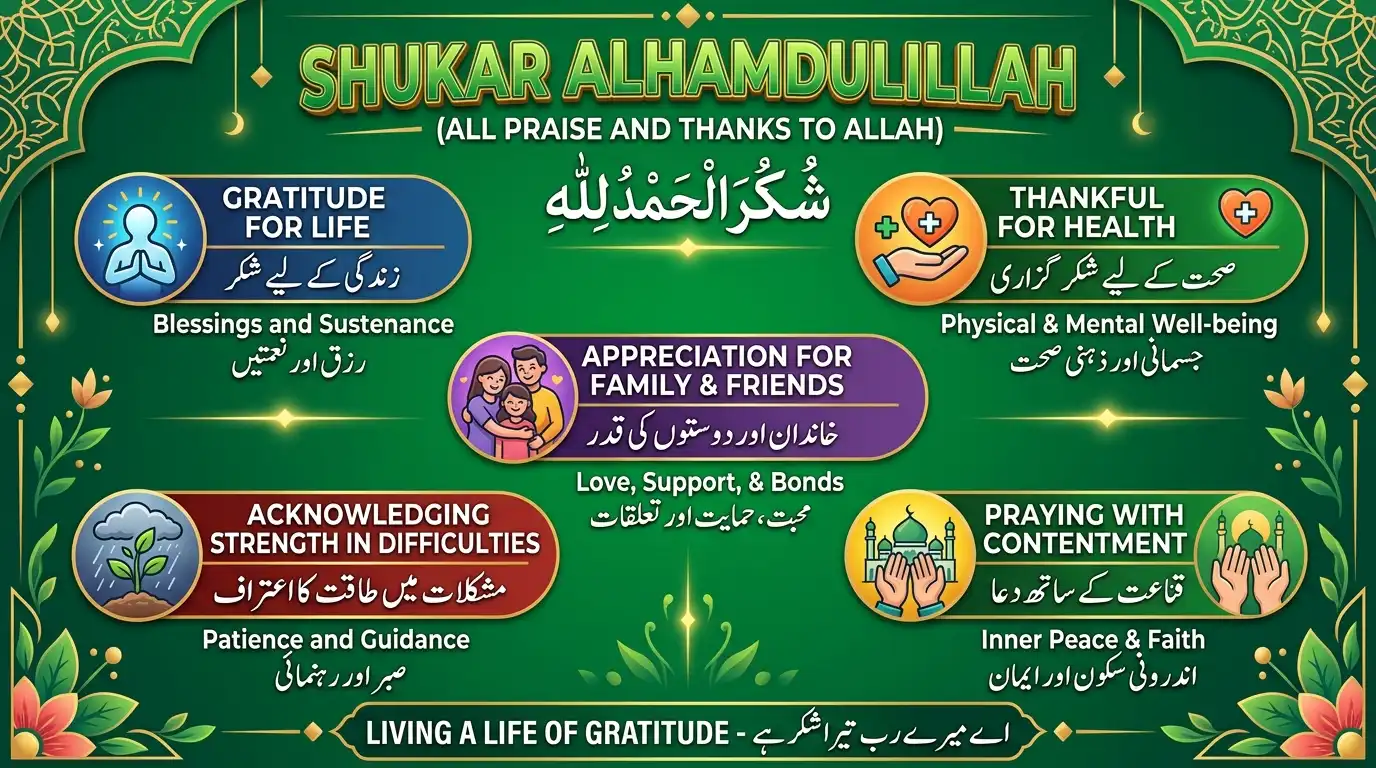
Shukar Alhamdulillah: Meaning, Difference & Usage
Shukar Alhamdulillah are closely connected ideas in Islamic life. Muslims use the word Alhamdulillah to praise Allah and acknowledge His blessings, while shukar refers more broadly to gratitude and thankfulness toward Allah. Understanding the difference helps explain why saying Alhamdulillah is more than simply saying “thank you.”
In this guide, we will explore shukar Alhamdulillah in Arabic, shukar Alhamdulillah in English, the difference between shukar and hamd, how Muslims express gratitude, and meaningful shukar Alhamdulillah quotes.
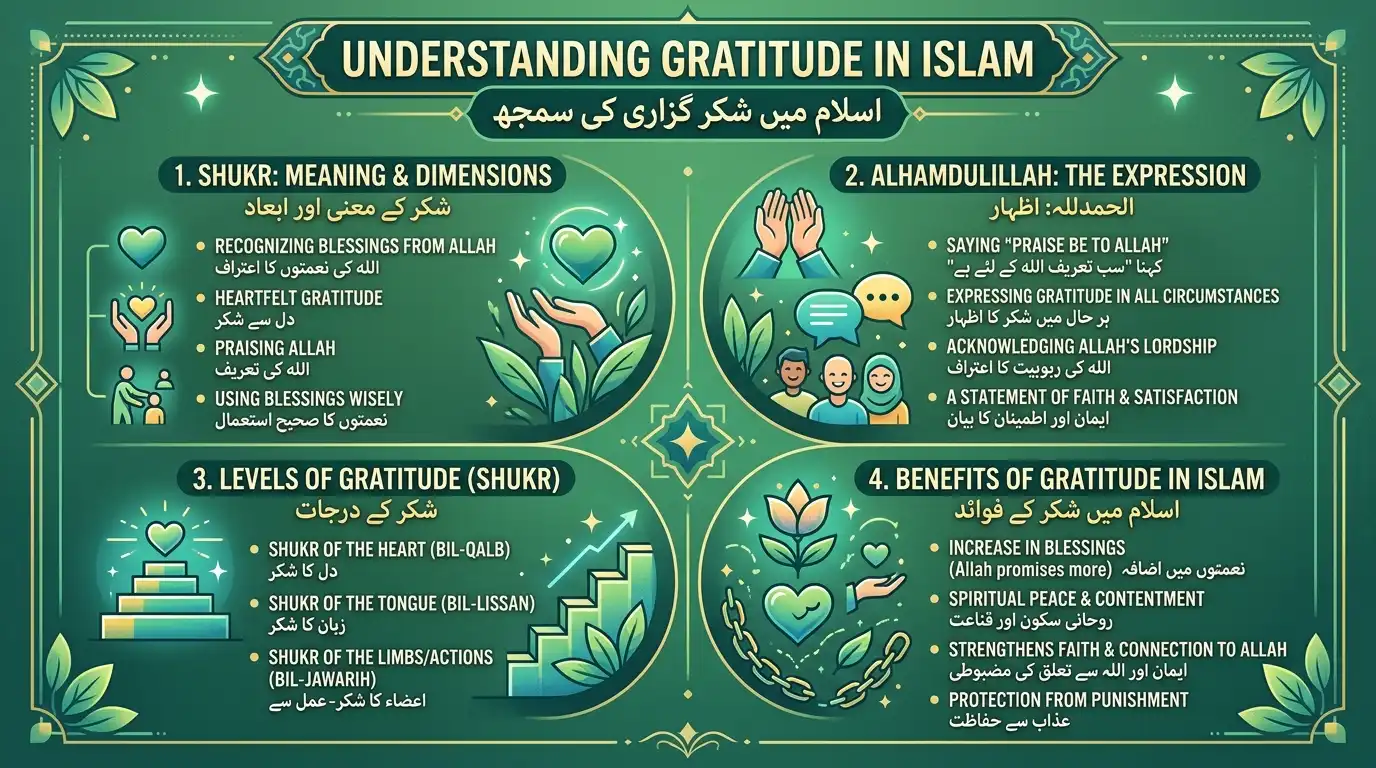
What Does Shukar Mean?
The Arabic word shukar (شُكْر) refers to gratitude, thankfulness, and recognizing a blessing. In an Islamic context, shukar means acknowledging Allah’s favors and responding to them with gratitude.
Shukr is not limited to words. A person can express gratitude through the heart, through speech, and through actions. Recognizing a blessing as coming from Allah and using that blessing responsibly are important dimensions of Islamic gratitude.
Shukar in Simple English
In simple English, shukr means gratitude to Allah. It is the attitude of recognizing blessings rather than taking them for granted. For example, good health, family, food, knowledge, safety, opportunities, and faith can all become reasons for gratitude.
Shukar in Everyday Life
Shukar can be expressed by appreciating what you have, speaking positively about Allah’s blessings, helping others with what you have been given, and avoiding the misuse of those blessings.
What Does Alhamdulillah Mean?
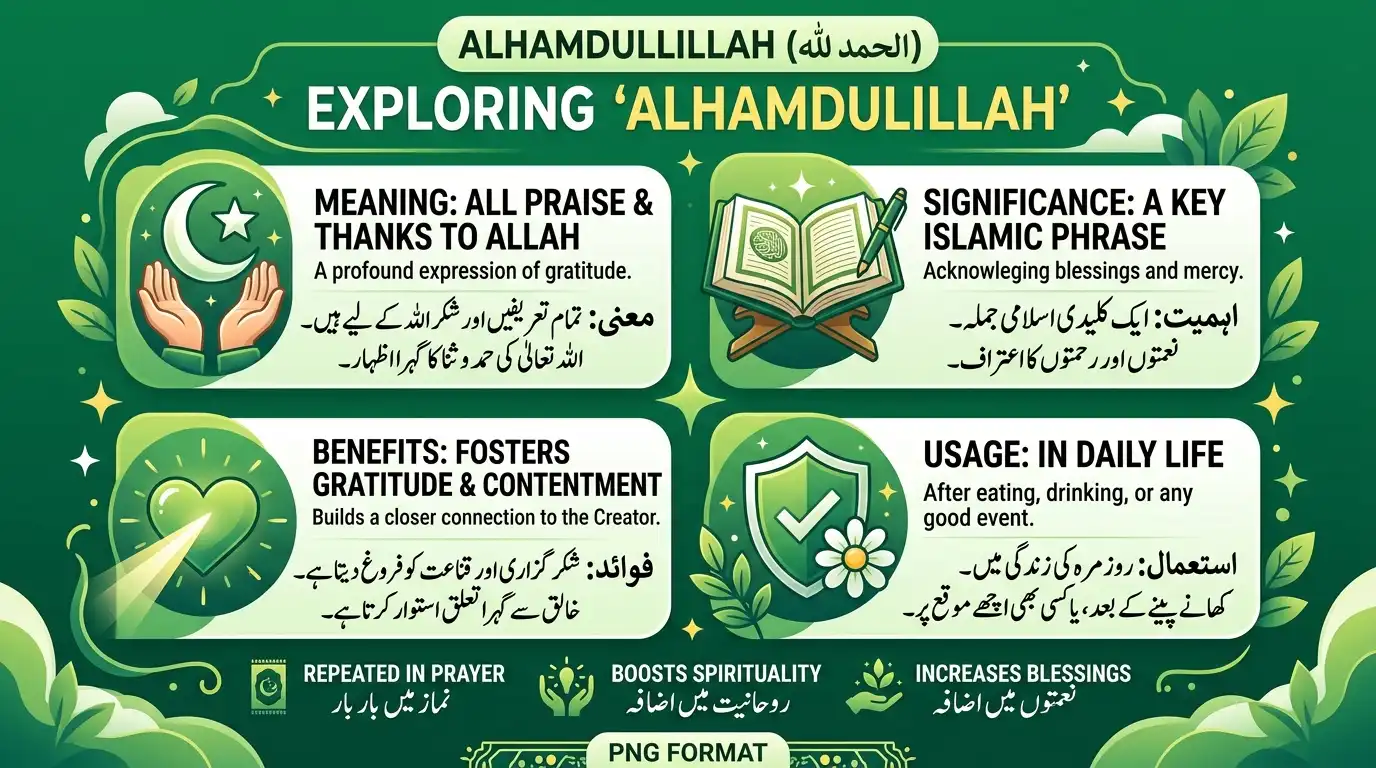
Alhamdulillah (الحمد لله) is an Arabic expression commonly translated as “Praise be to Allah” or “All praise is due to Allah.” It is an expression of praise directed toward Allah and is frequently used by Muslims when acknowledging blessings or responding to good news.
The word Alhamdulillah is therefore closely related to shukr, but the two terms are not simply interchangeable. Alhamdulillah is a specific expression of praise, while shukr describes the broader concept and practice of gratitude.
Shukar vs Hamd: What’s the Difference?
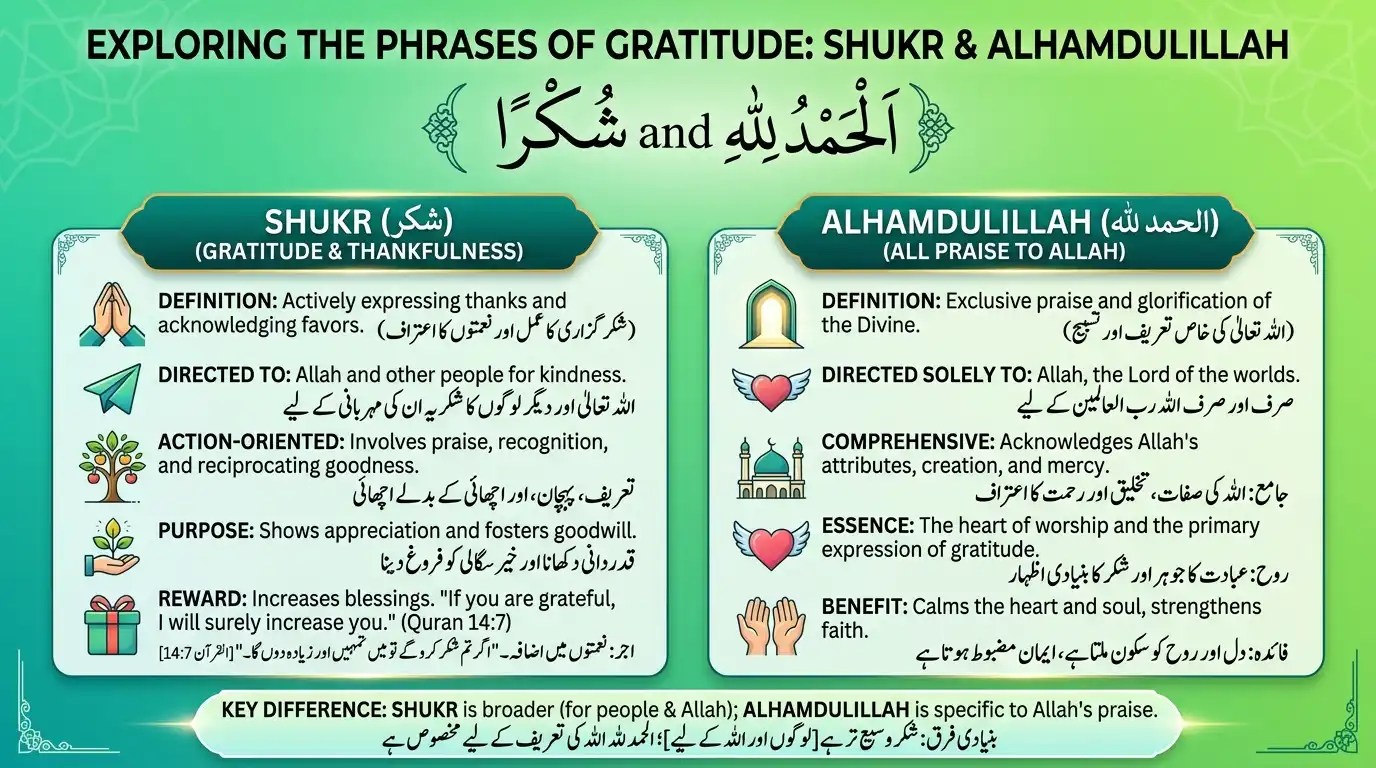
Shukar and hamd overlap, but classical Islamic discussions distinguish between them. Hamd is praise, while shukar is gratitude for a favor or blessing.
| Concept | Simple Meaning | Main Idea |
|---|---|---|
| Hamd | Praise | Praising Allah for His perfection and attributes |
| Shukr | Gratitude | Thankfulness for Allah’s blessings and favors |
| Alhamdulillah | Praise belongs to Allah | An expression of praise and acknowledgment directed to Allah |
This distinction explains why Alhamdulillah has a broader meaning than an ordinary expression of thanks. It can be said because Allah is worthy of praise, while shukr particularly emphasizes gratitude for blessings and favors.
Why Do Muslims Say Alhamdulillah?
Muslims say Alhamdulillah to praise Allah and acknowledge His blessings. It is commonly heard after receiving good news, when someone asks about one’s wellbeing, after enjoying a blessing, or while reflecting on Allah’s favors.
The phrase also appears prominently in the Qur’an. Surah Al-Fatihah begins with:
“Alhamdulillahi Rabbil ‘Alamin” means that all praise belongs to Allah, the Lord of the worlds. This opening establishes praise of Allah as a central part of Muslim worship.
Alhamdulillah After Good News
Someone who receives good news may say Alhamdulillah to acknowledge Allah while celebrating the blessing. For example, a person may say Alhamdulillah after passing an exam, receiving a new job, recovering from an illness, or welcoming a child.
Alhamdulillah During Difficult Times
Alhamdulillah can also be used while facing difficulty. This does not mean that Muslims must pretend pain does not exist. Rather, it can express continued trust in Allah and recognition that a person may still have blessings even during hardship.
Shukar Alhamdulillah in Arabic
The phrase shukr Alhamdulillah in Arabic can be expressed in several ways depending on the intended meaning. The most familiar expression is:
This means “Praise be to Allah” or “All praise is due to Allah.” For gratitude specifically, the Arabic word شُكْر means shukr or thankfulness.
Shukar Alhamdulillah Arabic Text
For a simple Arabic representation of the concepts, you may see:
The wording should be understood according to its grammatical context rather than treating every Romanized internet phrase as a fixed Arabic religious formula. For Islamic expressions, accurate Arabic wording is preferable to relying on informal transliterations.
Shukar Alhamdulillah Meaning in English
If you are searching for shukar Alhamdulillah in English, the simplest explanation is: gratitude and praise to Allah.
“Shukr” means gratitude or thankfulness, while “Alhamdulillah” means praise belongs to Allah. Together, the concepts describe a Muslim’s attitude of recognizing Allah’s blessings and praising Him for them.
Quick meaning:
Shukr = gratitude and thankfulness.
Alhamdulillah = praise belongs to Allah.
Islamic gratitude = recognizing blessings and responding to them appropriately.
Shukar Alhamdulillah Quotes
Shukar Alhamdulillah quotes can be used as reminders to appreciate blessings and maintain a grateful attitude. The following original lines are suitable for personal reflection, captions, or social media posts.
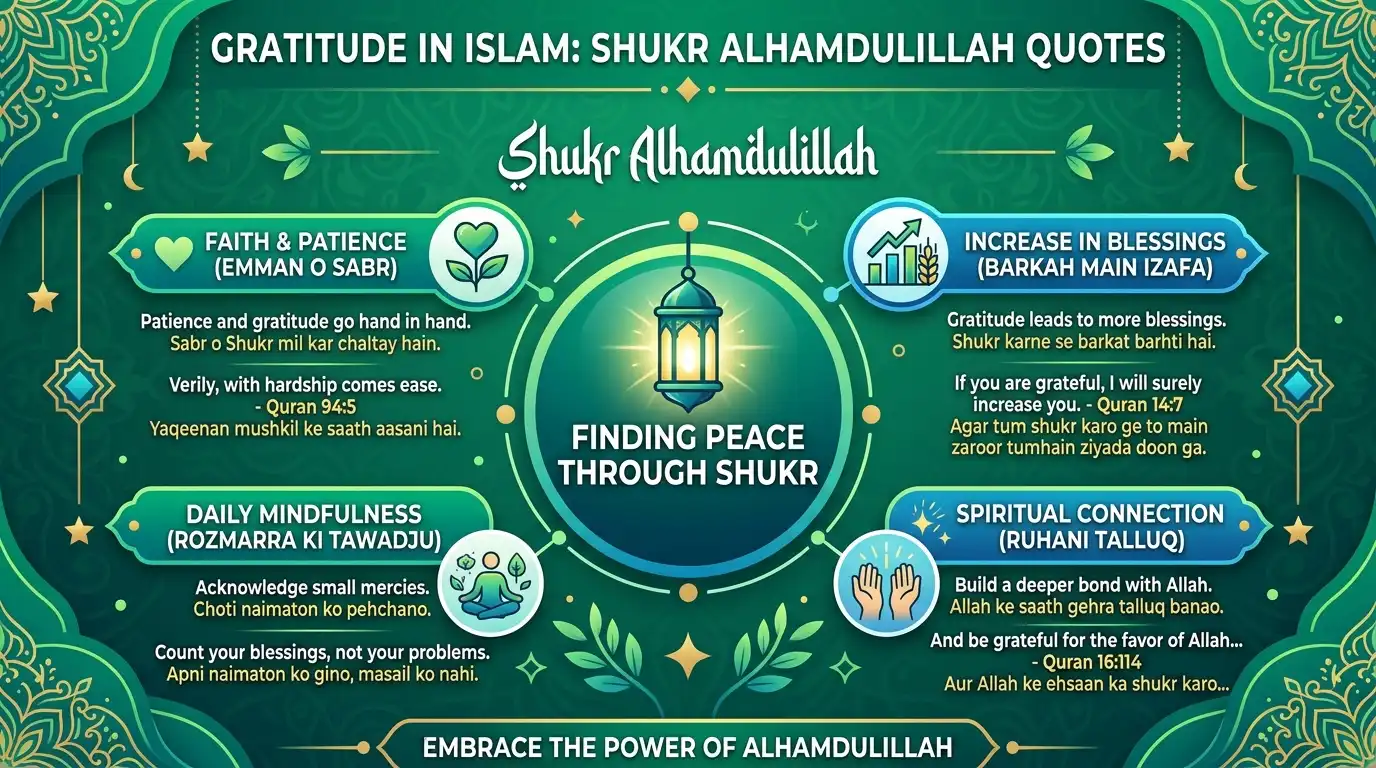
Alhamdulillah for All the Blessings
Alhamdulillah for all the blessings is a simple way of expressing gratitude for the many visible and unseen favors in life. Some blessings are obvious, such as health, food, family, shelter, and financial security. Others may be less noticeable, including time, knowledge, safety, opportunities, and the ability to worship.
Gratitude becomes more meaningful when it changes behavior. If someone is grateful for knowledge, they can use it beneficially. If they are grateful for wealth, they can spend responsibly and give to those in need. If they are grateful for health, they can take care of the body and use their strength for good.
Gratitude for Health
Good health is often taken for granted until it changes. Saying Alhamdulillah can help a person recognize health as a blessing rather than an entitlement.
Gratitude for Family
Family relationships can be a major source of support. Appreciating parents, spouses, children, relatives, and friends can turn gratitude into action.
Gratitude for Provision
Food, shelter, employment, income, and other forms of provision are frequently mentioned when Muslims reflect on Allah’s blessings. Shukr encourages a person to appreciate provision without becoming careless or wasteful.
Grateful Alhamdulillah Quotes
For those looking for grateful Alhamdulillah quotes, the best messages focus on genuine gratitude rather than simply repeating the phrase.
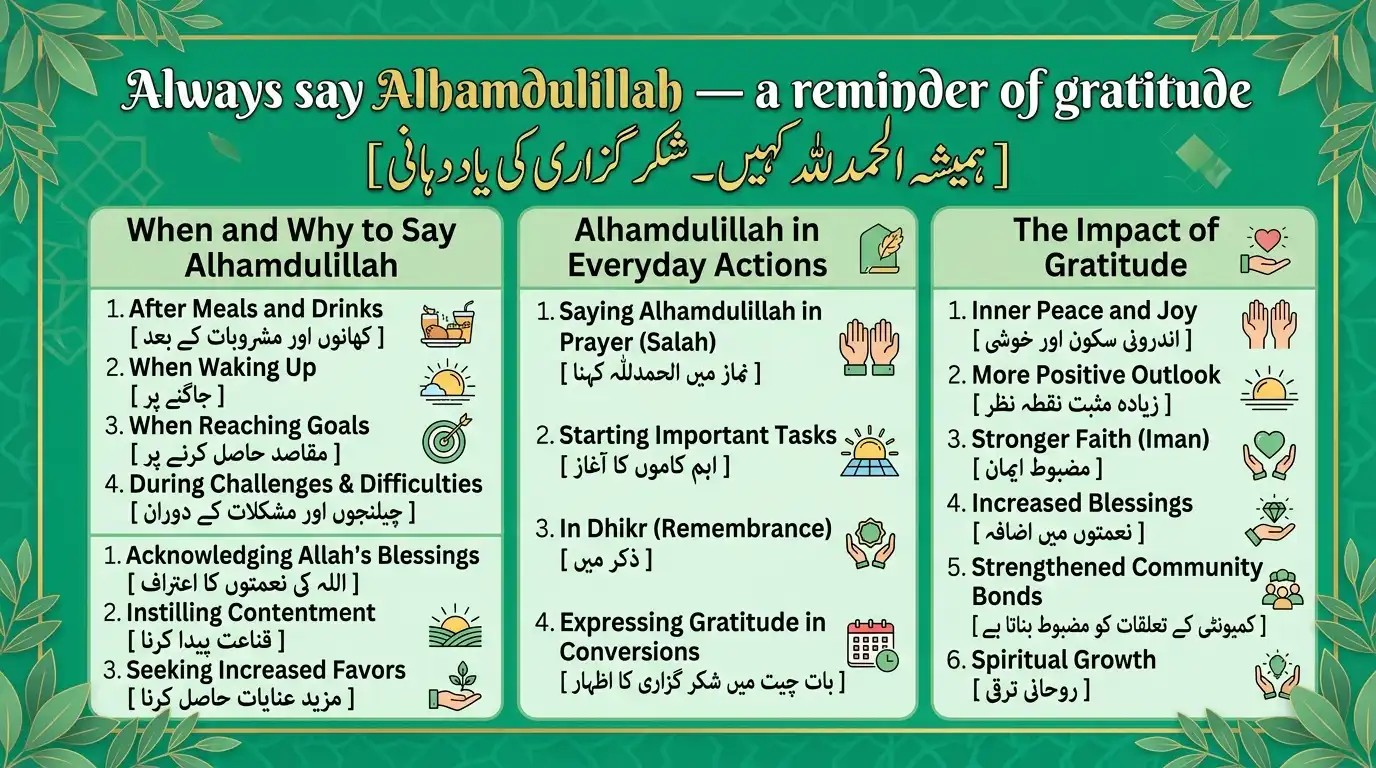
Always Say Alhamdulillah: What Does It Really Mean?
The phrase always say Alhamdulillah can be understood as a reminder to maintain gratitude and praise of Allah. It should not be interpreted as a requirement to ignore genuine problems or suppress legitimate emotions. A person can experience sadness, ask for help, seek treatment, solve a problem, and still remain grateful to Allah.
True gratitude is therefore more than a repeated phrase. It is an attitude that influences how a person thinks about blessings, how they respond to difficulties, and how they use what Allah has given them.
Shukar Through Words, Heart and Actions
Islamic gratitude is not limited to verbal expressions. A complete attitude of shukr can involve several dimensions.
Shukr of the Heart
A person recognizes that blessings ultimately come from Allah and develops an inward sense of appreciation.
Shukar of the Tongue
A person praises Allah and acknowledges His blessings through appropriate words such as Alhamdulillah.
Shukar Through Actions
A person uses blessings responsibly. Wealth can be used for good, knowledge can benefit others, and physical ability can be used in beneficial ways. This makes gratitude practical rather than merely verbal.
Shukar Alhamdulillah vs Ordinary Gratitude
There is an important difference between Islamic shukr and ordinary expressions of gratitude. A person can thank another human being for helping them, while shukr toward Allah recognizes Allah as the ultimate giver of blessings.
This does not mean Muslims should not thank people. In fact, appreciating people for their kindness is part of good character. The two forms of gratitude can exist together: thank people for what they do, while recognizing Allah for the blessings behind them.
Frequently Asked Questions
What does Shukar Alhamdulillah mean?
Shukr refers to gratitude and thankfulness, while Alhamdulillah means “Praise be to Allah” or “All praise is due to Allah.” Together, the concepts describe recognizing Allah’s blessings and expressing praise and gratitude for them.
How do you say Shukar Alhamdulillah in English?
A natural English explanation is “gratitude and praise to Allah.” Shukr means thankfulness or gratitude, while Alhamdulillah is an expression of praise directed toward Allah.
What is Shukar in Islam?
Shukr is gratitude toward Allah for His blessings and favors. It can involve recognizing blessings in the heart, praising Allah with the tongue, and using blessings responsibly through one’s actions.
Is Alhamdulillah a form of Shukar?
Yes. Saying Alhamdulillah can be an expression of shukr because it acknowledges Allah and praises Him. However, shukr is broader than simply saying a phrase; genuine gratitude can also be reflected in a person’s behavior and use of blessings.
What does Alhamdulillah for all the blessings mean?
It expresses gratitude to Allah for the blessings a person has received. These may include health, family, faith, food, shelter, knowledge, safety, opportunities, and many other visible or unseen favors.
What is the difference between Shukar and Hamd?
Hamd generally means praise, while shukar means gratitude or thankfulness. Hamd can be offered for Allah’s attributes and perfection, while shukr particularly emphasizes gratitude for blessings and favors.
Can I say Alhamdulillah during a difficult time?
Yes. Saying Alhamdulillah during hardship can express continued praise of Allah and trust in Him. It does not mean a person must deny pain, avoid seeking help, or pretend that a difficult situation is easy.
Final Thoughts
Shukr and Alhamdulillah are powerful reminders of gratitude in Islamic life. Shukr describes the broader attitude of thankfulness, while Alhamdulillah is one of the most familiar expressions through which Muslims praise Allah.
The deeper meaning of gratitude is not simply repeating words. It is recognizing blessings, appreciating the One who gave them, and using those blessings in ways that are beneficial and responsible.
Shukr — gratitude and thankfulness.
Alhamdulillah — all praise belongs to Allah.
الحمد لله — Praise be to Allah.

Asrar Ahmad is the founder of PrayersGuide.com and a professional SEO expert based in Pakistan. As a practicing Muslim with years of experience in digital content, He is dedicated to making authentic Quranic prayers/duas and Islamic prayers accessible to English-speaking Muslims worldwide. All content is carefully researched and sourced from the Quran and authentic Hadith only.