What Does Alhamdulillah Mean? Arabic, English & Urdu
If you have heard a Muslim say “Alhamdulillah” after good news, during a conversation, after a meal, or when talking about everyday life, you may wonder: what does Alhamdulillah mean?
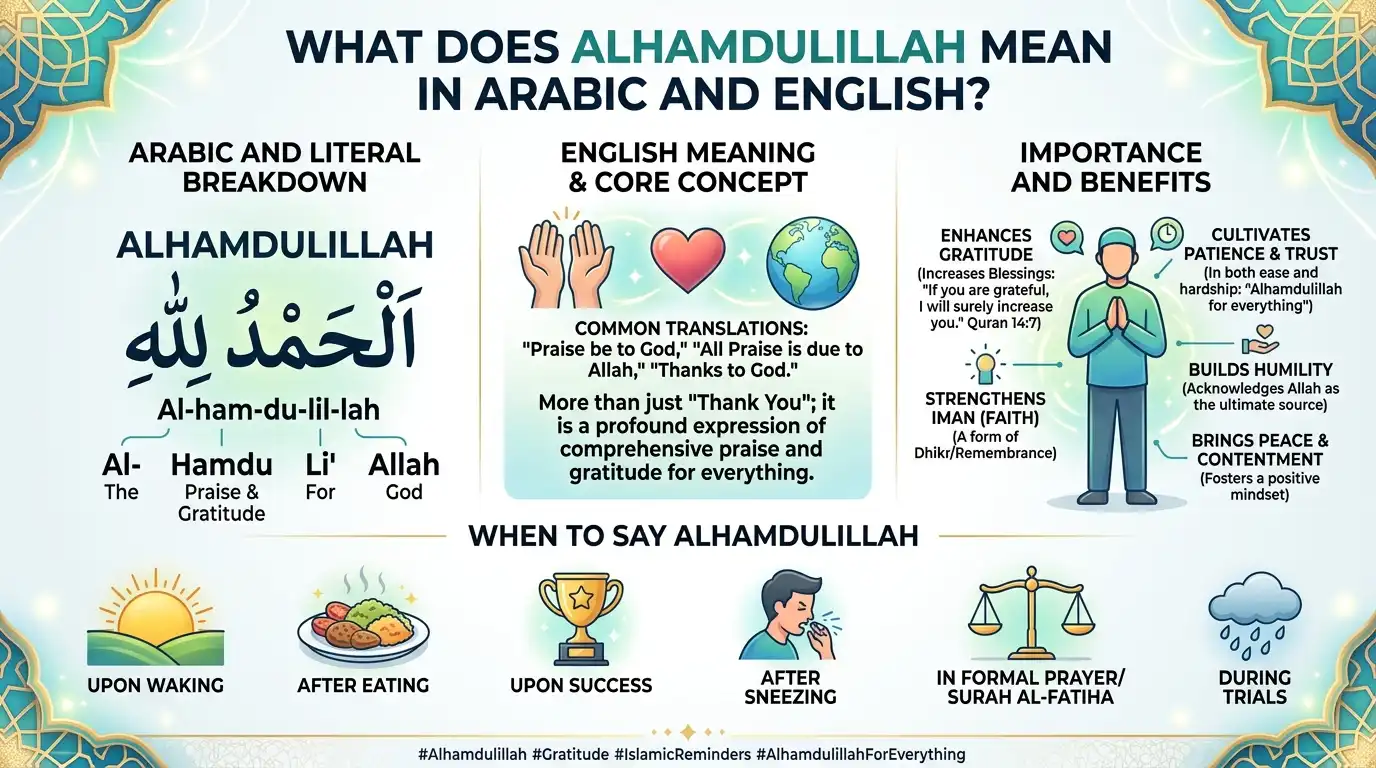
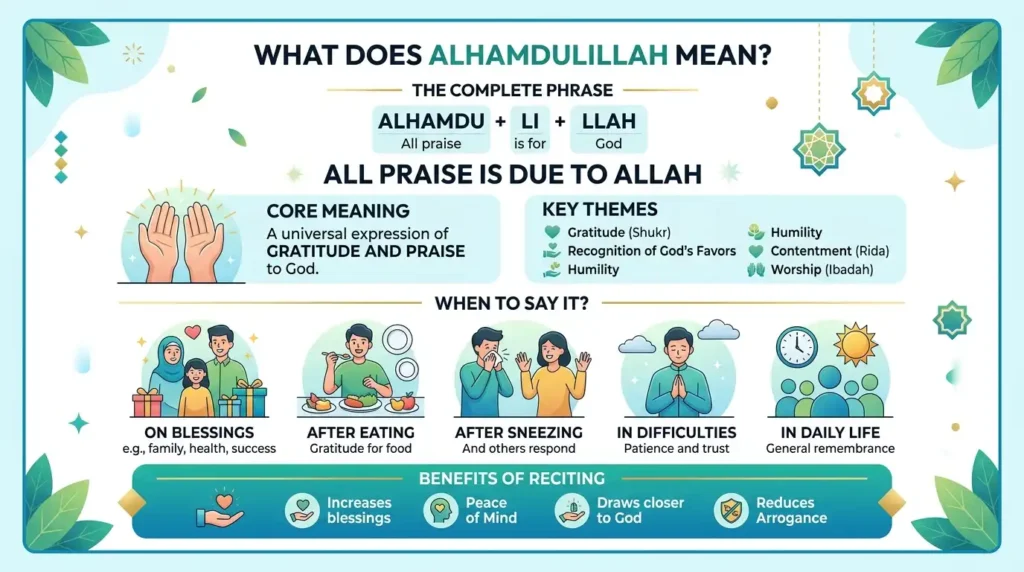
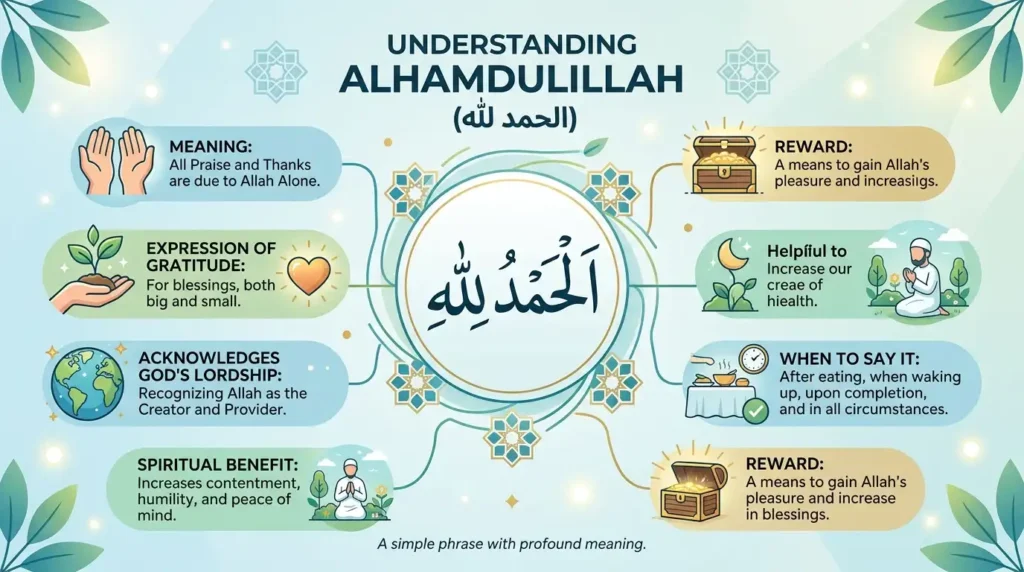
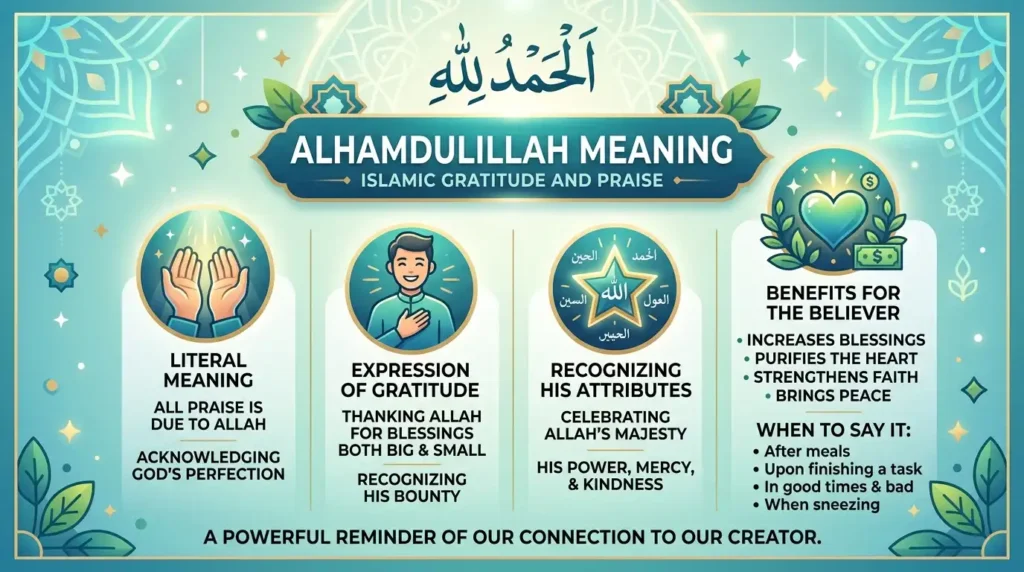
Alhamdulillah (ٱلْحَمْدُ لِلَّهِ) is an Arabic expression commonly translated as “All praise is due to Allah” or “Praise be to Allah.” It expresses praise of Allah and can also communicate gratitude for His blessings.
The phrase is not limited to one emotion or situation. Muslims may say it when something goes well, when acknowledging a blessing, when answering “How are you?”, and in formal worship. Its meaning becomes clearer when you look at the Arabic words hamd and lillah and see how the phrase is used in the Quran and everyday Muslim life.
What Does Alhamdulillah Mean?
Alhamdulillah is written in Arabic as:
ٱلْحَمْدُ لِلَّهِ
A common transliteration is:
Alhamdulillah
The simplest English translation is:
“All praise is due to Allah.”
Other translations include:
- “Praise be to Allah.”
- “All praise belongs to Allah.”
- “Praise and thanks be to Allah.”
The exact English wording varies because hamd has a broader meaning than the ordinary English word “thanks.”
Alhamdulillah is therefore more than a casual expression of appreciation. It is a statement that directs praise toward Allah.
In Islamic usage, the phrase can express gratitude for blessings while also praising Allah for who He is.
This is why translating it simply as “thank God” can be useful in some everyday contexts but does not communicate the entire meaning of the Arabic expression.
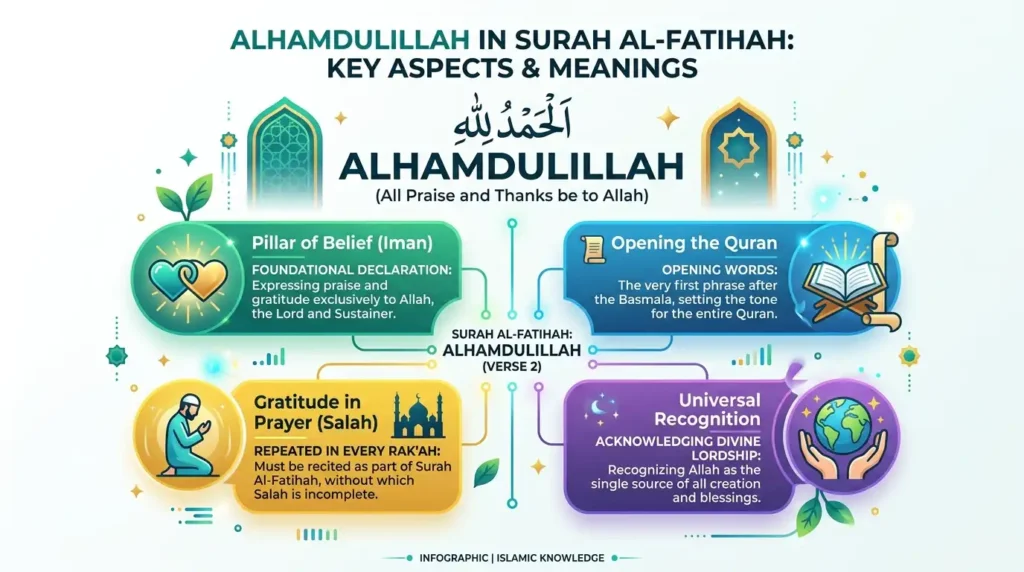
The phrase is also central to Islamic worship because Alhamdulillah appears at the beginning of Surah Al-Fatihah:
الْحَمْدُ لِلَّهِ رَبِّ الْعَالَمِينَ
Alhamdu lillahi Rabbil-‘alamin
The Quranic Arabic Corpus identifies ḥamd with the meaning of praise and shows the phrase’s grammatical components in the Quranic text. (Wikipedia)
Alhamdulillah Meaning in English
The most direct Alhamdulillah meaning in English is:
“All praise is due to Allah.”
For everyday readers, “Praise be to Allah” is another natural translation.
You may also encounter:
“All praise and thanks belong to Allah.”
This version attempts to communicate both the praise contained in hamd and the gratitude often expressed by Muslims when saying Alhamdulillah.
Is “Thank God” the Same as Alhamdulillah?
Not exactly.
In everyday English, someone might translate Alhamdulillah as “thank God.” That can communicate the general idea in a particular conversation, especially when someone is expressing relief.
But the Arabic phrase is more specific.
Alhamdulillah contains the concept of hamd, or praise, directed toward Allah. It is therefore not merely an expression of relief or gratitude for one particular event.
For example:
“Alhamdulillah, I passed my exam.”
can communicate both happiness about the result and recognition that the blessing ultimately comes from Allah.
Likewise:
“Alhamdulillah, I am doing well.”
can function as a grateful response when someone asks about your wellbeing.
Arabic-language learning resources also note that Alhamdulillah is used in ordinary conversation, including when answering questions about how someone is doing. (Mezzofanti Guild)
Alhamdulillah Meaning in Urdu
For readers searching Alhamdulillah ka meaning or Alhamdulillah ka matlab kya hota hai, the phrase can be explained in Urdu as:
الحمد للہ
تمام تعریفیں اللہ کے لیے ہیں۔
A simpler explanation is:
اللہ ہی کے لیے سب تعریفیں ہیں۔
In everyday Urdu, people may also explain the phrase through the idea of شکر (gratitude), particularly when discussing blessings.
However, Alhamdulillah should not be reduced to only “شکر” because hamd and shukr have related but distinct meanings.
Alhamdulillah Ka Matlab Kya Hota Hai?
In simple words:
Alhamdulillah ka matlab hai: “Allah ke liye tamam tareefain hain.”
In English:
“All praise is due to Allah.”
The phrase is commonly used by Urdu-speaking Muslims in Pakistan, India, the UK, the US, and communities around the world.

Alhamdulillah in Arabic
The standard Arabic form is:
ٱلْحَمْدُ لِلَّهِ
A version without vowel marks is:
الحمد لله
Transliteration:
Alhamdulillah
Pronunciation: approximately:
al-ham-doo-lil-LAH
The exact pronunciation is best learned from a qualified Arabic or Quran teacher because some Arabic sounds do not have exact equivalents in English.
Alhamdulillah Arabic Copy and Paste
If you simply need the Arabic text:
الحمد لله
If you want the fully vocalized Quranic-style form:
ٱلْحَمْدُ لِلَّهِ
The phrase is written using Arabic script even when it is used in English-language Muslim communities.
What Is the Literal Meaning of Alhamdulillah?
To understand the literal meaning of Alhamdulillah, it helps to break the expression into its Arabic components.
1. Al — الـ
Al is the Arabic definite article, similar to “the” in English.
2. Hamd — حمد
Hamd refers to praise, commendation, and the recognition of praiseworthy qualities.
It is related to the Arabic root Ḥ-M-D (ح م د).
This root appears in several Arabic names and words associated with praise.
3. Li-Allah — لله
Li is a preposition meaning something like “for,” “to,” or “belonging to.”
Allah is the Arabic proper name for God.
Together:
لِلَّهِ — lillah
can be understood as:
“for Allah” or “belonging to Allah.”
Therefore:
الْحَمْدُ لِلَّهِ
can be understood as:
“The praise belongs to Allah.”
Or more naturally in English:
“All praise is due to Allah.”
The linguistic structure is one reason the expression carries more meaning than a simple English equivalent such as “thanks.” (Wikipedia)
Hamd vs Shukr: What’s the Difference?
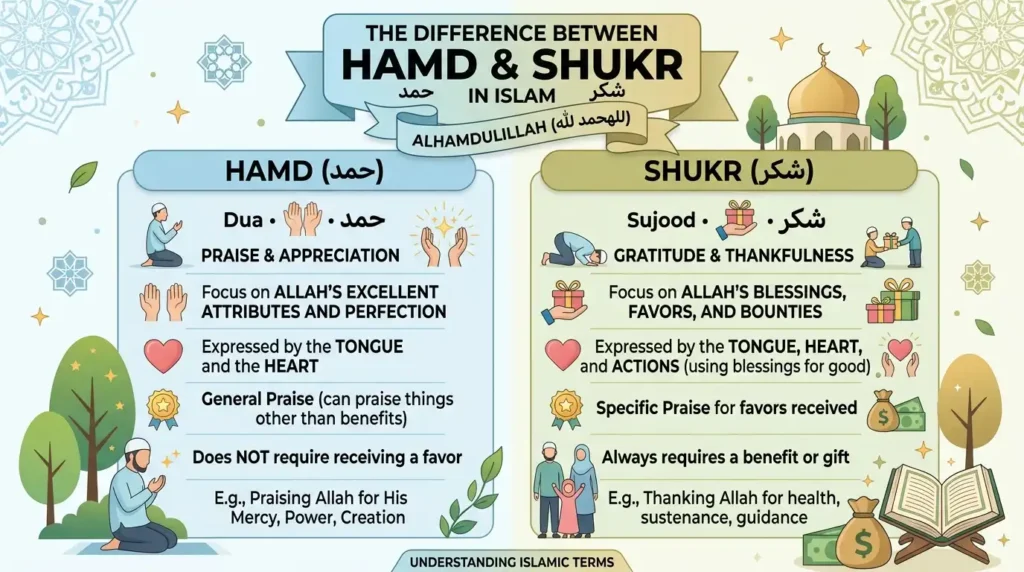
One of the most important linguistic points is the distinction between hamd and shukr.
Both concepts involve appreciation, but they are not identical.
What Is Hamd?
Hamd (حمد) is praise.
It involves recognizing and praising someone for qualities that deserve praise.
In the Islamic context, hamd is directed toward Allah.
What Is Shukr?
Shukr (شكر) is generally translated as gratitude or thankfulness.
It is particularly associated with recognizing and appreciating a favor or blessing received.
Hamd and Shukr Compared
| Term | Basic idea | Simple English |
| Hamd | Praise and commendation | Praise |
| Shukr | Gratitude for a favor or blessing | Thankfulness |
| Alhamdulillah | Praise directed to Allah | All praise is due to Allah |
This is why saying that Alhamdulillah simply means “thank you” is incomplete.
A person can praise Allah for His attributes and perfection, not only for a particular favor they have received.
At the same time, Alhamdulillah is frequently used as an expression of gratitude in everyday Muslim speech.
That combination is what makes the phrase so versatile.
Why Do Muslims Say Alhamdulillah?
Muslims say Alhamdulillah for several reasons, including praise, gratitude, remembrance of Allah, and acknowledgment of blessings.
It is deeply embedded in Islamic worship because the phrase appears in the Quran.
It also has a practical role in everyday conversation.
Alhamdulillah After Good News
Someone might say:
“Alhamdulillah, I got the job.”
The statement recognizes the successful outcome while attributing ultimate praise to Allah.
Alhamdulillah After Recovery
A person who has recovered from an illness may say:
“Alhamdulillah, I am feeling much better.”
The phrase expresses gratitude while acknowledging the improvement.
Alhamdulillah When Asked “How Are You?”
In many Muslim communities, it is common to answer:
“Alhamdulillah, I’m well.”
This does not necessarily mean that everything in the person’s life is perfect. It can simply express contentment and gratitude for their present condition.
Arabic-learning sources describe this as one of the common conversational uses of the phrase. (Mezzofanti Guild)
Alhamdulillah After Eating
Muslims may also say Alhamdulillah after eating as an expression of gratitude to Allah for food and provision.
The phrase therefore moves naturally between formal religious contexts and ordinary daily conversation.
When Is Alhamdulillah Used?
There is no single situation in which Alhamdulillah must be used.
Common contexts include:
After Receiving Good News
Examples include:
- passing an exam
- getting a job
- completing a degree
- receiving good family news
- achieving a personal goal
Example:
“Alhamdulillah, I passed my final exam.”
After Eating or Drinking
A Muslim may praise Allah after enjoying food or drink.
After Sneezing
In Islamic practice, a person who sneezes says Alhamdulillah.
A well-known hadith in Sahih al-Bukhari 6224 records the etiquette that when one of you sneezes and says Alhamdulillah, another Muslim responds with Yarhamuk Allah. (islamtics)
When Talking About Health
Someone may say:
“Alhamdulillah, my family is doing well.”
During Difficult Circumstances
Alhamdulillah can also be said during hardship.
This does not mean that Muslims are expected to pretend that pain, grief, or difficulty is pleasant.
A person can be sad and still praise Allah.
Person can be worried and still make dua.
A person can face a financial problem and still say Alhamdulillah while actively looking for a solution.
That distinction prevents the phrase from being misunderstood as a command to ignore real problems.

Alhamdulillah in the Quran
The phrase Alhamdulillah has a central place in the Quran.
The most familiar occurrence is at the beginning of Surah Al-Fatihah:
الْحَمْدُ لِلَّهِ رَبِّ الْعَالَمِينَ
Alhamdu lillahi Rabbil-‘alamin
“All praise is for Allah, Lord of the worlds.”
This is Quran 1:2.
The expression also appears elsewhere in the Quran. For example:
- Quran 6:1 begins with praise of Allah, the Creator of the heavens and earth.
- Quran 18:1 begins with praise of Allah for revealing the Book.
- Quran 34:1 begins with praise of Allah, to whom belongs what is in the heavens and earth.
- Quran 35:1 begins with praise of Allah, Creator of the heavens and earth.
The repeated Quranic use demonstrates that Alhamdulillah is not simply a modern phrase used in Muslim culture. It is part of Quranic language and Islamic worship.
The Quranic Arabic Corpus provides the Arabic text and grammatical information for the phrase in Al-Fatihah. (Wikipedia)
Why Is Alhamdulillah at the Beginning of Al-Fatihah?
Surah Al-Fatihah begins with praise before moving into the believer’s request for guidance.
The sequence is meaningful:
Praise → recognition of Allah → worship → seeking help → asking for guidance.
This gives Alhamdulillah a role beyond ordinary thankfulness. It establishes an attitude of recognizing Allah before asking Him for what we need.
Alhamdulillah vs Thank You
Although Alhamdulillah is often translated as “thank God”, the two expressions should not be treated as exact equivalents.
“Thank You”
In English, thank you normally expresses gratitude to another person for something they have done.
For example:
“Thank you for helping me.”
“Alhamdulillah”
Alhamdulillah praises Allah and can express gratitude at the same time.
For example:
“Alhamdulillah, my daughter is healthy.”
The speaker is not necessarily thanking another person. They are praising Allah and acknowledging a blessing.
Is Alhamdulillah the Same as “Thank God”?
Sometimes “thank God” works as an approximate translation, especially in casual English.
For example:
“Thank God, everyone arrived safely.”
This can convey a similar emotional idea.
But for a precise explanation of the Arabic phrase, “All praise is due to Allah” is more appropriate.
Alhamdulillah and Everyday Muslim Identity
For many Muslims living in the United States and United Kingdom, Alhamdulillah is part of both religious practice and everyday conversation.
You may hear it in:
- Muslim homes
- mosques
- Islamic schools
- university Muslim societies
- workplaces
- family conversations
- online Muslim communities
A British Muslim might say:
“Alhamdulillah, work is going well.”
An American Muslim might say:
“Alhamdulillah, we finally found a new home.”
The phrase does not require a formal religious setting.
Its meaning travels naturally between Arabic, English, and other languages because Muslim communities around the world use the original Arabic expression.
Common Misunderstandings About Alhamdulillah
“Alhamdulillah” Only Means “Everything Is Good”
Not necessarily.
It can express gratitude or praise without claiming that every part of life is perfect.
It Means “Thank You” and Nothing More
This is also incomplete.
The central concept is hamd, or praise, directed toward Allah.
Alhamdulillah Means Muslims Cannot Complain
A person can acknowledge difficulty without abandoning gratitude.
Saying Alhamdulillah does not require someone to deny genuine hardship or avoid seeking help.
Alhamdulillah Is Only for Muslims Who Speak Arabic
No.
Arabic is the language of the phrase, but Muslims across the world use it regardless of their native language.
You can hear Alhamdulillah from Muslims whose everyday languages include English, Urdu, Turkish, Malay, Bengali, French, and many others.
Frequently Asked Questions
What does Alhamdulillah mean?
Alhamdulillah (الحمد لله) means “All praise is due to Allah” or “Praise be to Allah.” It is an Arabic expression used by Muslims to praise Allah and commonly express gratitude for blessings and good circumstances.
What is the meaning of Alhamdulillah in English?
The most direct English translation is “All praise is due to Allah.” “Praise be to Allah” is another common translation. “Thank God” can communicate a similar idea in certain contexts but does not fully capture the meaning of hamd.
What is Alhamdulillah in Arabic?
Alhamdulillah is written:
ٱلْحَمْدُ لِلَّهِ
Without vowel marks:
الحمد لله
It is pronounced approximately al-ham-doo-lil-LAH.
What does Alhamdulillah mean in Urdu?
Alhamdulillah means “تمام تعریفیں اللہ کے لیے ہیں” in Urdu. It can also be explained as “اللہ ہی کے لیے سب تعریفیں ہیں.” The phrase is commonly used to express praise and gratitude to Allah.
What is the literal meaning of Alhamdulillah?
Literally, the phrase can be understood as “the praise is for Allah.” In natural English, it is usually translated as “All praise is due to Allah.” The expression consists of al, hamd, and lillah.
Is Alhamdulillah a Quranic phrase?
Yes. Alhamdulillah appears in the Quran, most famously in Surah Al-Fatihah 1:2: “Alhamdu lillahi Rabbil-‘alamin.” The phrase also occurs at the beginning of several other Quranic passages. (Wikipedia)
Is Alhamdulillah the same as Shukr?
They are closely related but not identical. Shukr generally refers to gratitude or thankfulness, while hamd refers to praise and commendation. Alhamdulillah can express gratitude, but its meaning extends beyond simply saying “thank you.”
Why do Muslims say Alhamdulillah?
Muslims say Alhamdulillah to praise Allah, express gratitude, acknowledge blessings, and remember Allah throughout daily life. It is also part of Quranic worship and appears in the opening of Surah Al-Fatihah.
Final Thoughts: What Does Alhamdulillah Mean?
So, what does Alhamdulillah mean?
At its simplest:
Alhamdulillah means “All praise is due to Allah.”
But the phrase carries more meaning than a single English translation can capture.
It can express praise, gratitude, recognition of blessings, contentment, and remembrance of Allah. Its linguistic foundation in hamd explains why translating it merely as “thanks” can be incomplete.
The Arabic is:
ٱلْحَمْدُ لِلَّهِ
Alhamdulillah
And the familiar Quranic expression is:
الْحَمْدُ لِلَّهِ رَبِّ الْعَالَمِينَ
Alhamdu lillahi Rabbil-‘alamin
“All praise is for Allah, Lord of the worlds.”
For Muslims, this is not simply a phrase to use when something goes well. It is a reminder to recognize Allah in ordinary moments, blessings, worship, and changing circumstances.
Understanding the phrase therefore starts with its translation but does not end there. Alhamdulillah is praise expressed through words, with gratitude and recognition behind those words.

Asrar Ahmad is the founder of PrayersGuide.com and a professional SEO expert based in Pakistan. As a practicing Muslim with years of experience in digital content, He is dedicated to making authentic Quranic prayers/duas and Islamic prayers accessible to English-speaking Muslims worldwide. All content is carefully researched and sourced from the Quran and authentic Hadith only.