
Alhamdulillah for Everything: Meaning, Arabic, Quotes & More

Alhamdulillah for everything is a phrase many Muslims use to express praise and gratitude to Allah in every circumstance. You may hear it after good news, during a difficult period, after recovering from illness, or simply when someone reflects on the blessings in their life.
But what does the phrase actually mean? Is it the same as Alhamdulillah Ala Kulli Haal? How is it written in Arabic? And does saying Alhamdulillah during hardship mean that a person should ignore pain or difficulty?
This guide explains the meaning, Arabic wording, everyday usage, Islamic context, and inspirational Alhamdulillah for everything quotes in clear English for readers in the United States, United Kingdom, and other English-speaking communities.
Alhamdulillah (الحمد لله) means “All praise is due to Allah.”

What Does Alhamdulillah Mean?
Alhamdulillah (الحمد لله) is an Arabic expression commonly translated as “All praise is due to Allah” or “Praise be to Allah.”
The phrase appears at the beginning of Surah Al-Fatihah:
الْحَمْدُ لِلَّهِ رَبِّ الْعَالَمِينَ
Alhamdu lillahi Rabbil-‘alamin
Meaning:
“All praise is for Allah, Lord of the worlds.”
Because Alhamdulillah is part of Surah Al-Fatihah, Muslims encounter this expression regularly in their daily prayers.
The phrase can express both praise and gratitude. For example, a Muslim might say Alhamdulillah after receiving good news, finishing an important task, recovering from an illness, enjoying a meal, or realizing how many blessings they have.
What Is the Meaning of Alhamdulillah in English?
The most common English translations are:
- All praise is due to Allah
- Praise be to Allah
- All praise belongs to Allah
- Thanks and praise be to Allah
“Thank God” is sometimes used as a conversational English equivalent, but it does not fully capture the religious meaning of Alhamdulillah. The Arabic expression specifically directs praise toward Allah.
Is Alhamdulillah Only Used When Something Good Happens?
No.
It is certainly common to say Alhamdulillah when something good happens, but the expression can also be used when facing difficulty.
This does not mean that Muslims must pretend hardship is pleasant. A person can be sad about losing a job, worried about an illness, or disappointed by an outcome while still praising Allah and asking Him for help.
That distinction is important when understanding Alhamdulillah for everything.

Alhamdulillah for Everything Meaning
The expression Alhamdulillah for everything communicates an attitude of praise and gratitude toward Allah regardless of the circumstances a person is experiencing.
In simple English, you can understand it as:
“I praise and thank Allah in every circumstance and for all the blessings He has given me.”
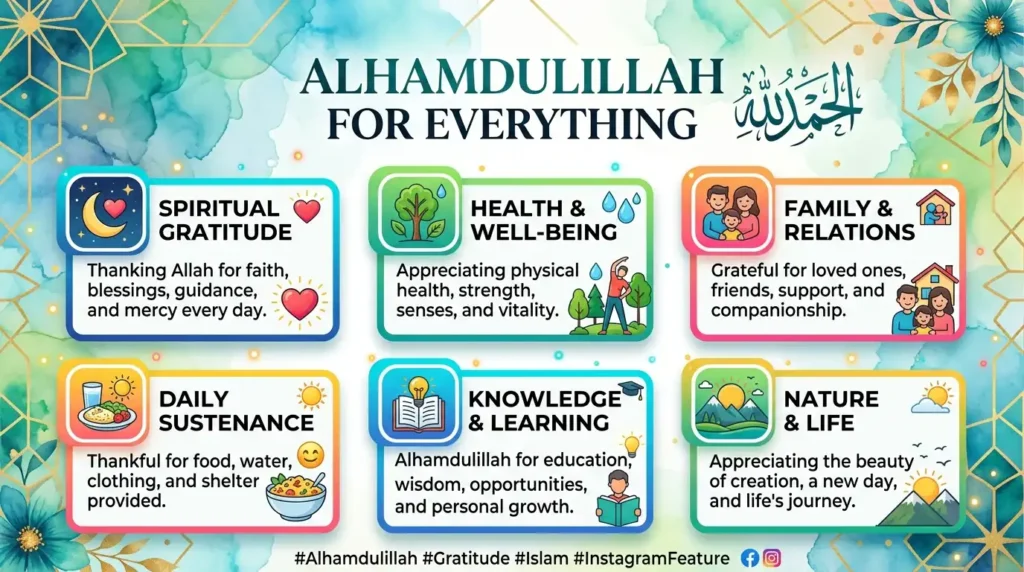
It is often used to express gratitude for things such as:
- health
- family
- faith
- food
- work
- education
- safety
- opportunities
- friendships
- everyday blessings
The expression can also carry a deeper meaning during difficult periods.
Alhamdulillah for Everything Does Not Mean Everything Is Easy
This is one of the most important points to understand.
Saying Alhamdulillah for everything does not mean that a Muslim believes every event is enjoyable or that suffering should be dismissed.
For example, someone who loses a job can say Alhamdulillah while still looking for another job. Someone who becomes sick can praise Allah while also seeking appropriate medical care. Someone experiencing grief can turn to Allah while acknowledging their sadness.
Gratitude does not require denying reality.
Instead, it can help a person maintain faith, patience, and perspective while dealing with reality.
The Quran emphasizes gratitude in several places. In Surah Ibrahim 14:7, Allah says that if people are grateful, He will increase them in favor. (Online Quran Zoom)
Why Do Muslims Say Alhamdulillah for Everything?
For many Muslims, the phrase is a reminder that blessings should not be taken for granted.
A person may focus heavily on what they want and overlook what they already have. Saying Alhamdulillah redirects attention toward gratitude.
It can therefore become part of a person’s daily remembrance of Allah rather than simply a phrase used for social media captions.
Alhamdulillah for Everything in Arabic
If you are looking for Alhamdulillah for everything in Arabic, there are related Arabic expressions that should be distinguished carefully.
الحمد لله
Alhamdulillah
Meaning:
“All praise is due to Allah.”
الحمد لله على كل حال
Alhamdulillah ‘ala kulli haal
Meaning:
“All praise is for Allah in every circumstance.”
الحمد لله على كل شيء
Alhamdulillah ‘ala kulli shay’
Meaning:
“Praise be to Allah for everything.”
These expressions are closely related, but they are not identical word-for-word translations.
If your goal is specifically to express the idea of praising Allah in every circumstance, الحمد لله على كل حال is particularly relevant.

What Does Alhamdulillah Ala Kulli Haal Mean?
Alhamdulillah Ala Kulli Haal is written in Arabic as:
الحمد لله على كل حال
A common transliteration is:
Alhamdulillah ‘ala kulli haal
Its basic meaning is:
“All praise is for Allah in every circumstance.”
The phrase is particularly meaningful when circumstances are not what a person hoped for.
A narration attributed to Aishah رضي الله عنها reports that when the Prophet Muhammad ﷺ saw something he liked, he would praise Allah, and when he saw something he disliked, he would say “Al-hamdu lillahi ‘ala kulli hal.” The narration is recorded in Sunan Ibn Majah 3803; the Sunnah.com listing notes a Darussalam grading of Da’if, so it is better to present this narration with that qualification rather than claiming it as an unquestionably authentic hadith. (Sunnah)
Alhamdulillah Ala Kulli Hal vs. Alhamdulillah for Everything
These expressions have similar ideas but slightly different wording.
| Expression | Meaning |
| Alhamdulillah | All praise is due to Allah |
| Alhamdulillah for everything | Praise and gratitude to Allah for everything |
| Alhamdulillah ‘ala kulli haal | Praise be to Allah in every circumstance |
| Alhamdulillah ‘ala kulli shay’ | Praise be to Allah for everything |
Understanding this difference is useful because English translations can sometimes make related Arabic phrases appear more interchangeable than they actually are.

When Should You Say Alhamdulillah?
There is no single situation in which Muslims are limited to saying Alhamdulillah.
It can be part of everyday speech and remembrance of Allah.
After Good News
You might say Alhamdulillah after:
- receiving a job offer
- passing an exam
- completing a project
- reaching a personal goal
- receiving good news about family
- recovering from an illness
The expression recognizes the blessing rather than treating success as entirely the result of personal effort.
After Eating
Alhamdulillah is also associated with praising Allah for food and provision.
Rather than viewing a meal as something ordinary that requires no thought, saying Alhamdulillah can remind a person that food, health, and the ability to enjoy it are blessings.
After Recovering From Illness
Someone who has recovered from illness may naturally say Alhamdulillah as an expression of gratitude for improved health.
That does not mean that seeking medical treatment conflicts with reliance upon Allah. Gratitude and practical action can exist together.
During Difficult Times
During hardship, expressions such as Alhamdulillah ‘ala kulli haal can remind a person to maintain faith and patience.
Again, this should not be interpreted as a command to suppress legitimate emotions.
A person can experience grief and still say Alhamdulillah.
Person can be worried and still make dua.
A person can face financial difficulty and still work toward improving their situation.

Alhamdulillah and Shukr
The concepts of Alhamdulillah and shukr are closely connected, but they are not exactly the same.
Shukr generally refers to gratitude or thankfulness. Hamd involves praise and commendation.
Therefore, saying Alhamdulillah can be an expression of shukr because it praises Allah and acknowledges His blessings.
Shukar Alhamdulillah in English
A simple way to express the idea in English is:
“Praise and thanks be to Allah.”
However, it is better not to assume that shukr and hamd are perfect synonyms.
Understanding this distinction makes the phrase more meaningful.
Alhamdulillah for All the Blessings
Some blessings are obvious:
- a healthy family
- food and water
- a safe home
- employment
- education
- physical abilities
- friends
- opportunities
Other blessings can become invisible because people become accustomed to them.
For example, waking up in the morning, being able to communicate with loved ones, having access to knowledge, or having another opportunity to improve can all become reasons for gratitude.
The Quran reminds believers that Allah’s favors cannot simply be counted. Surah An-Nahl 16:18 states that if people tried to count Allah’s blessings, they would not be able to enumerate them. (IslamKaZikr)
Alhamdulillah for Everything Quotes
The phrase has become particularly popular in English-language Islamic social media, including Instagram, Facebook, Pinterest, and WhatsApp.
However, not every quote circulating online should be presented as a Quranic verse or hadith. The safest approach is to clearly distinguish original inspirational wording from statements attributed to Islamic sources.
Here are original caption-style quotes that express the theme without falsely attributing them to a religious authority.
Alhamdulillah for Everything Quotes
Alhamdulillah for everything I understand, everything I am still learning, and every blessing I sometimes overlook.
Alhamdulillah for the doors that opened, the doors that closed, and the lessons I found along the way.
Some days bring ease, other days bring lessons. Alhamdulillah for every day Allah gives me.
Alhamdulillah for every blessing, every lesson, and every opportunity to begin again.
Deep Alhamdulillah Quotes
Alhamdulillah is not only for the moments when life goes according to plan; it can also be a reminder to keep faith when it does not.
A grateful heart does not claim that life is perfect. It remembers that Allah’s blessings remain present even during imperfect days.
Sometimes gratitude begins with understanding. Sometimes it begins with trusting Allah while you are still searching for the answer.
Alhamdulillah Quotes for Difficult Times
When the answer has not arrived yet, keep making dua and keep saying Alhamdulillah.
Hardship may change what you expected from life, but it does not remove Allah from your life. Alhamdulillah.
You can acknowledge the pain, ask for help, and still say Alhamdulillah.
Alhamdulillah Quotes for Success
Success feels different when you remember Who made the opportunity possible. Alhamdulillah.
Work hard, remain humble, and remember to say Alhamdulillah when the result finally arrives.
Alhamdulillah for every achievement, because effort is ours but blessings come from Allah.

Alhamdulillah for Everything for Instagram and Social Media
The phrase is also frequently used as a short caption for Instagram posts, Facebook updates, WhatsApp statuses, and personal bios.
For social media, short captions usually work better than long explanations.
Short Alhamdulillah Captions
- Alhamdulillah for everything.
- Alhamdulillah, always.
- Alhamdulillah for today.
- Blessed beyond words. Alhamdulillah.
- Every blessing deserves gratitude. Alhamdulillah.
- Through every season: Alhamdulillah.
- Alhamdulillah for what was, what is, and what Allah has planned.
These are useful as captions because they express the idea without making unsupported religious claims.
Alhamdulillah in Urdu
Although this guide is primarily written for English-speaking readers in the United States and United Kingdom, many English-speaking Muslims also search for the Urdu meaning of Alhamdulillah.
In Urdu, Alhamdulillah is written:
الحمدللہ
A simple Urdu meaning is:
تمام تعریفیں اللہ کے لیے ہیں۔
For Alhamdulillah for everything, a simple rendering is:
ہر چیز کے لیے اللہ کا شکر اور حمد ہے۔
Another natural explanation is:
ہر حال میں اللہ کی حمد و تعریف کرنا۔
The exact translation can vary depending on whether the focus is on hamd (praise), gratitude, or the broader spiritual meaning of the expression.
Alhamdulillah Quotes in Urdu
جو ملا اس پر الحمدللہ، جو نہیں ملا اس پر اللہ کی حکمت پر یقین۔
ہر نعمت پر الحمدللہ، ہر آزمائش میں صبر۔
زندگی کی ہر چھوٹی بڑی نعمت کو پہچاننا بھی شکر ہے۔ الحمدللہ۔

How to Practice Gratitude Through Alhamdulillah
Saying Alhamdulillah becomes more meaningful when it is connected to action.
1. Notice Specific Blessings
Instead of repeating the phrase mechanically, pause and identify something specific you are grateful for.
It could be your health, family, education, work, food, safety, or another blessing.
2. Say It During Both Ease and Difficulty
Gratitude is easy when everything is going well. Maintaining remembrance during difficult periods can require much more patience.
That does not mean pretending everything is fine. It means keeping your connection with Allah while dealing honestly with the situation.
3. Combine Gratitude With Action
If you are struggling financially, gratitude does not mean refusing to seek employment.
You are sick, gratitude does not mean avoiding medical care.
If you failed an exam, gratitude does not mean giving up.
You can say Alhamdulillah and still take the next responsible step.
4. Remember That Gratitude Is Not Just Words
A person can say Alhamdulillah while treating other people poorly or wasting blessings.
A stronger understanding of gratitude includes recognizing blessings and using them responsibly.
Is Alhamdulillah for Everything a Quranic Phrase?
Alhamdulillah itself is directly found in the Quran. It appears prominently in Surah Al-Fatihah as Alhamdulillahi Rabbil-‘alamin.
However, the exact English sentence “Alhamdulillah for everything” is not a Quranic verse.
Likewise, Alhamdulillah ‘ala kulli haal is an Arabic expression found in hadith literature rather than a Quranic verse. As noted above, the narration in Sunan Ibn Majah 3803 is recorded with a Da’if grading on Sunnah.com, so it should not be presented without qualification. (Sunnah)
This distinction matters because Islamic websites should avoid presenting popular quotations as Quran or hadith without checking their sources.
Frequently Asked Questions
What does Alhamdulillah for everything mean?
It expresses praise and gratitude to Allah in every circumstance, It can refer to obvious blessings as well as maintaining faith during difficult periods. It does not mean that every painful event is enjoyable or that a person should ignore problems. Gratitude can exist alongside sadness, dua, practical effort, and seeking help.
What does Alhamdulillah mean in English?
Alhamdulillah is commonly translated as “All praise is due to Allah” or “Praise be to Allah.” It is an Arabic expression of praise and gratitude to Allah and is found in the opening verse of Surah Al-Fatihah.
How do you write Alhamdulillah for everything in Arabic?
The idea can be expressed with الحمد لله على كل شيء (Alhamdulillah ‘ala kulli shay’) for “Praise be to Allah for everything.” A related expression, الحمد لله على كل حال (Alhamdulillah ‘ala kulli haal), means “All praise is for Allah in every circumstance.”
What does Alhamdulillah Ala Kulli Haal mean?
Alhamdulillah ‘ala kulli haal means “All praise is for Allah in every circumstance.” It is particularly relevant when discussing how a Muslim maintains praise of Allah during changing or difficult situations.
When should you say Alhamdulillah?
Muslims commonly say Alhamdulillah after receiving good news, enjoying a blessing, eating, recovering from illness, completing something important, or reflecting on Allah’s favors. It can also be used when acknowledging Allah during hardship.
Is Alhamdulillah the same as thank you?
Not exactly. “Thank you” generally expresses gratitude to another person, while Alhamdulillah specifically praises Allah. Although “thank God” can sometimes communicate a similar idea in casual English, it does not capture every aspect of the Arabic expression.
Can you say Alhamdulillah during a difficult time?
Yes. Saying Alhamdulillah during hardship does not require pretending that the hardship is easy. A Muslim can acknowledge pain, make dua, seek appropriate help, and work to improve the situation while continuing to praise Allah.
What is Alhamdulillah in Urdu?
Alhamdulillah is written الحمدللہ in Urdu. A simple meaning is “تمام تعریفیں اللہ کے لیے ہیں”, meaning “All praise is for Allah.” The phrase Alhamdulillah for everything explained as maintaining praise and gratitude toward Allah in every circumstance.
Final Thoughts on Alhamdulillah for Everything
Alhamdulillah for everything is more than a popular Islamic phrase or social media caption. It expresses a way of viewing blessings, challenges, success, disappointment, and everyday life through gratitude to Allah.
The phrase does not require a person to deny hardship. A Muslim can feel sadness, seek medical treatment, work toward a better future, ask for help, and make dua while still saying Alhamdulillah.
That balance is important.
When life brings something beautiful, Alhamdulillah can remind us to recognize the blessing.
When life becomes difficult, Alhamdulillah ‘ala kulli haal can serve as a reminder to maintain faith and praise while facing the situation.
And on ordinary days, simply noticing the blessings that have become easy to overlook can turn an everyday moment into an opportunity for gratitude.
Alhamdulillah for every blessing we notice, every lesson we learn, and every day Allah gives us.


Asrar Ahmad is the founder of PrayersGuide.com and a professional SEO expert based in Pakistan. As a practicing Muslim with years of experience in digital content, He is dedicated to making authentic Quranic prayers/duas and Islamic prayers accessible to English-speaking Muslims worldwide. All content is carefully researched and sourced from the Quran and authentic Hadith only.







One Comment