
Janazah Dua: The Last Gift You Give a Muslim
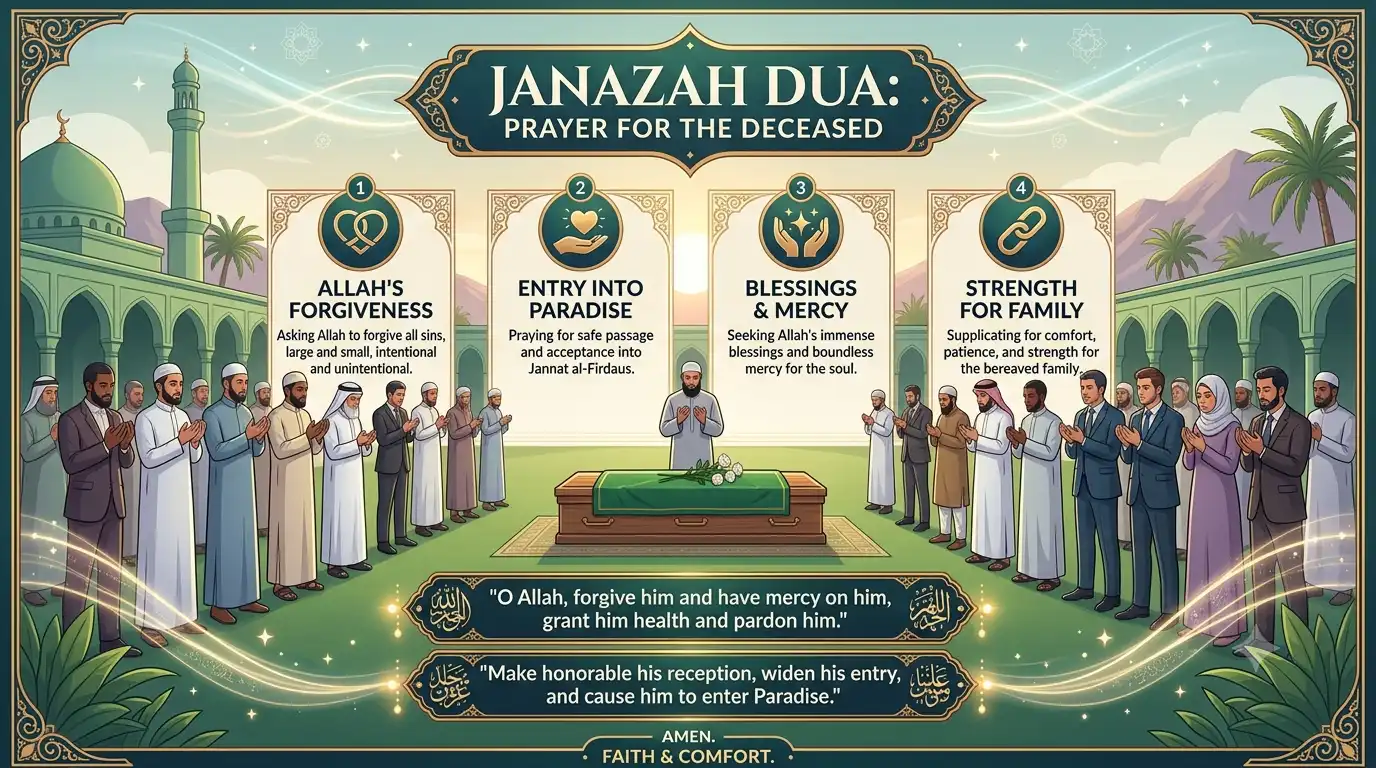
The most powerful thing you can do for someone who has left this world is stand before Allah and ask Him — with your whole heart — to forgive them.
Introduction: The Day Words Run Out
It was a Thursday afternoon in a small town in Punjab.
A man stood at his father’s janazah, rows of men behind him, all waiting. He had memorized everything — he thought. But the moment the imam said the first Allahu Akbar, his mind went blank. Tears blurred his vision. His lips moved, but nothing came.
Later, he said: “I felt like I had failed my father at the one moment he needed me most.”
If you have ever stood in a janazah prayer and felt that same fear — the panic of forgetting, the weight of the moment — this article is written for you.
The janazah dua is not a performance. It is not about reciting perfectly. It is the last act of love you offer a believer before they are lowered into the earth. And Allah, Who knows every trembling heart, receives it — even when your voice breaks.
What Is Janazah Dua — and Why It Carries So Much Weight
The janazah dua is the supplication recited during Salat al-Janazah — the Islamic funeral prayer — asking Allah to forgive, have mercy on, and honour the deceased.
Unlike other salah, there is no ruku. No sujood. Just four takbirs, standing before Allah, your hands raised and your heart open.
After the first takbir, you recite Surah Al-Fatiha. After the second, Durood Ibrahim, After the third comes the heart of the prayer — the dua for the deceased. And after the fourth, you make salam.
This prayer is fard kifayah — a communal obligation. If enough Muslims perform it, the rest are relieved. But the Prophet Hazrat MUHAMMAD ﷺ encouraged every Muslim who could attend to do so. He said:
“Whoever follows the funeral procession and offers the prayer will have a reward of one Qirat, and whoever follows it and stays until burial will have two Qirats — each Qirat like the size of Mount Uhud.” (Sahih al-Bukhari 1325)
This is not a small thing. Standing in janazah for your brother or sister in Islam is one of the most rewarded acts you can perform on an ordinary day.
And at the centre of it is the dua — the supplication that rises from the earth and reaches Allah on behalf of a soul that can no longer speak for itself.
The Main Janazah Dua — Full Arabic, Transliteration & Translation
This is the most comprehensive and widely narrated prophetic supplication for the deceased. The Prophet Hazrat Muhammad ﷺ was heard reciting it, and scholars across all four madhabs have considered it authentic and recommended.
Arabic:
اللَّهُمَّ اغْفِرْ لِحَيِّنَا وَمَيِّتِنَا، وَشَاهِدِنَا وَغَائِبِنَا، وَصَغِيرِنَا وَكَبِيرِنَا، وَذَكَرِنَا وَأُنْثَانَا، اللَّهُمَّ مَنْ أَحْيَيْتَهُ مِنَّا فَأَحْيِهِ عَلَى الْإِسْلَامِ، وَمَنْ تَوَفَّيْتَهُ مِنَّا فَتَوَفَّهُ عَلَى الْإِيمَانِ، اللَّهُمَّ لَا تَحْرِمْنَا أَجْرَهُ وَلَا تُضِلَّنَا بَعْدَهُ
Transliteration:
Allāhumma-ghfir li-ḥayyinā wa mayyitinā, wa shāhidinā wa ghā’ibinā, wa ṣaghīrinā wa kabīrinā, wa dhakārinā wa unthānā. Allāhumma man aḥyaytahu minnā fa-aḥyihi ‘alal-Islām, wa man tawaffaytahu minnā fa-tawaffahu ‘alal-īmān. Allāhumma lā taḥrimnā ajrahu wa lā tuḍillanā ba’dah.
English Translation:
“O Allah, forgive our living and our dead, our present and our absent, our young and our old, our males and our females. O Allah, whoever among us You keep alive, keep him alive upon Islam; and whoever among us You cause to die, let him die upon faith. O Allah, do not deprive us of his reward, and do not let us go astray after him.”
📖 Source: Sunan Abu Dawud 3201, Sunan al-Tirmidhi 1024, Musnad Ahmad 22619 — narrated by Hazrat Abu Hurayrah (رضي الله عنه). Al-Hakim declared this hadith sahih by the criteria of both Bukhari and Muslim.
Why This Dua Is Unlike Any Other
Notice what the Prophet Hazrat Muhammad ﷺ asked for.
He did not only ask for the deceased. He asked for all of us — the living and the dead together, the young and the old, men and women, He asked that those still living be kept upon Islam, He asked that no one be left to go astray after the loss.
A janazah is not just a farewell. It is a mirror. Standing over the dead, we see our own destination. And this dua — composed by the Prophet Hazrat MUHAMMAD ﷺ himself — holds both truths at once: mercy for the one who has gone, and guidance for the ones left behind.
The Detailed Janazah Dua — From Imam Shafi’i (Combining Prophetic Hadith)
This longer supplication was compiled by Imam al-Shafi’i (rahimahullah) from multiple authentic hadith narrations. It is widely used across the world and is especially recommended for those who wish to offer a more complete intercession for the deceased.
Arabic:
اللَّهُمَّ هَذَا عَبْدُكَ وَابْنُ عَبْدَيْكَ، خَرَجَ مِنْ رَوْحِ الدُّنْيَا وَسِعَتِهَا وَمَحْبُوبِهَا وَأَحِبَّاؤُهُ فِيهَا، إِلَى ظُلْمَةِ الْقَبْرِ وَمَا هُوَ لَاقِيهِ، كَانَ يَشْهَدُ أَنْ لَا إِلَهَ إِلَّا أَنْتَ وَأَنَّ مُحَمَّدًا عَبْدُكَ وَرَسُولُكَ، وَأَنْتَ أَعْلَمُ بِهِ، اللَّهُمَّ نَزَلَ بِكَ وَأَنْتَ خَيْرُ مَنْزُولٍ بِهِ، وَأَصْبَحَ فَقِيرًا إِلَى رَحْمَتِكَ وَأَنْتَ غَنِيٌّ عَنْ عَذَابِهِ، اللَّهُمَّ إِنْ كَانَ مُحْسِنًا فَزِدْ فِي إِحْسَانِهِ، وَإِنْ كَانَ مُسِيئًا فَتَجَاوَزْ عَنْهُ، وَلَقِّهِ بِرَحْمَتِكَ رِضَاكَ، وَقِهِ فِتْنَةَ الْقَبْرِ وَعَذَابَهُ، وَافْسَحْ لَهُ فِي قَبْرِهِ، وَجَافِ الْأَرْضَ عَنْ جَنْبَيْهِ، وَلَقِّهِ بِرَحْمَتِكَ الْأَمْنَ مِنْ عَذَابِكَ حَتَّى تَبْعَثَهُ إِلَى جَنَّتِكَ يَا أَرْحَمَ الرَّاحِمِينَ
Transliteration:
Allāhumma hādhā ‘abduka wabnu ‘abdayk, kharaja min rawḥid-dunyā wa si’atihā wa maḥbūbihā wa aḥibbā’uhu fīhā, ilā ẓulmatil-qabri wa mā huwa lāqīh. Kāna yashhadu an lā ilāha illā anta wa anna Muḥammadan ‘abduka wa rasūluk, wa anta a’lamu bih. Allāhumma nazala bika wa anta khayru manzūlin bih, wa aṣbaḥa faqīran ilā raḥmatika wa anta ghaniyyun ‘an ‘adhābih. Allāhumma in kāna muḥsinan fa-zid fī iḥsānih, wa in kāna musī’an fa-tajāwaz ‘anh, wa laqqihi bi-raḥmatika riḍāk, wa qihi fitnatil-qabri wa ‘adhābah, wafsakhlahu fī qabrihi, wa jāfil-arḍa ‘an janbayh, wa laqqihi bi-raḥmatikāl-amna min ‘adhābika ḥattā tab’athahu ilā jannatika yā arḥamar-rāḥimīn.
English Translation:
“O Allah, this is Your servant and the son of Your two servants. He has departed from the comfort, expanse, and pleasures of this world — and from those who loved him in it — toward the darkness of the grave and what he is about to encounter. He used to testify that there is no god but You and that Muhammad is Your servant and messenger, and You know him best. O Allah, he has come to rest with You, and You are the best of hosts. He has become utterly dependent on Your mercy, and You have no need of his punishment. O Allah, if he was a doer of good, increase him in his goodness; and if he was a wrongdoer, overlook his sins. Grant him Your pleasure through Your mercy, protect him from the trial and punishment of the grave, expand his grave for him, distance the earth from his sides, and through Your mercy grant him security from Your punishment — until You resurrect him to Your Paradise, O Most Merciful of the merciful.”
📖 Source: Compiled by Imam al-Shafi’i from narrations in Sunan Abu Dawud, Sunan al-Tirmidhi, and Sunan al-Bayhaqi.
Janazah Dua for Specific Cases
For a Deceased Woman
The same main dua is used, with the pronouns changed from masculine to feminine:
Arabic (key phrases changed): اللَّهُمَّ اغْفِرْ لَهَا وَارْحَمْهَا وَعَافِهَا وَاعْفُ عَنْهَا
Transliteration: Allāhumma-ghfir lahā warḥamhā wa ‘āfihā wa’fu ‘anhā.
Translation: “O Allah, forgive her, have mercy on her, grant her well-being, and pardon her.”
📖 Source: Sahih Muslim 963
The change is simple: lahu (for him) becomes lahā (for her). Hu endings become hā. This is the only adjustment needed.
For a Deceased Child
The Prophet Hazrat Muhammad ﷺ taught a specific supplication for a child who has died:
Arabic: اللَّهُمَّ اجْعَلْهُ فَرَطًا لِأَبَوَيْهِ وَسَلَفًا وَذُخْرًا وَعِظَةً وَاعْتِبَارًا وَشَفِيعًا وَثَقِّلْ بِهِ مَوَازِينَهُمَا وَأَفْرِغِ الصَّبْرَ عَلَى قُلُوبِهِمَا
Transliteration: Allāhumma-j’alhu faraṭan li-abawayhi wa salafan wa dhukhran wa ‘iẓatan wa’tibāran wa shafī’an, wa thaqqil bihi mawāzīnahumā, wa afrigh aṣ-ṣabra ‘alā qulūbihimā.
Translation: “O Allah, make him a predecessor, a provision stored ahead, and an intercessor for his parents. Make him a lesson and a cause for reflection. Add his weight to their scales of good deeds, and pour patience over their hearts.”
📖 Source: Musnad Ahmad, narrated from Hazrat Abu Musa al-Ash’ari (رضي الله عنه); classified as hasan by scholars of hadith.
Short Dua When You Forget — An Emergency Backup
The Prophet Hazrat MUHAMMAD ﷺ also used the simplest of words. If you are overwhelmed, afraid, or have forgotten — this is enough:
Arabic: اللَّهُمَّ اغْفِرْ لَهُ وَارْحَمْهُ
Transliteration: Allāhumma-ghfir lahu warḥamh.
Translation: “O Allah, forgive him and have mercy on him.”
Do not let the fear of forgetting prevent you from standing. Allah receives a broken supplication offered with a sincere heart over a polished recitation offered with an absent one.
The Dua After the Fourth Takbir
After the fourth and final Allahu Akbar, before the salam, the following supplication is recommended:
Arabic: اللَّهُمَّ لَا تَحْرِمْنَا أَجْرَهُ وَلَا تَفْتِنَّا بَعْدَهُ وَاغْفِرْ لَنَا وَلَهُ
Transliteration: Allāhumma lā taḥrimnā ajrahu wa lā taftinnā ba’dahu wa-ghfir lanā wa lah.
Translation: “O Allah, do not deprive us of his reward, do not put us to trial after him, and forgive us and him.”
📖 Source: Narrated by Hazrat Abdullah ibn Abi Awfa (رضي الله عنه); referenced in Sunan Ibn Majah 1498 and authenticated by al-Hakim.
Dua at the Graveside — After Burial
The janazah does not end when the prayer ends. The Prophet Hazrat MUHAMMAD ﷺ would stand at the graveside after burial and make dua for the deceased. He instructed his companions:
“Seek forgiveness for your brother and ask Allah to make him firm, for he is being questioned right now.” (Sunan Abu Dawud 3221)
Arabic (Dua at the Grave): اللَّهُمَّ اغْفِرْ لَهُ، اللَّهُمَّ ثَبِّتْهُ
Transliteration: Allāhumma-ghfir lah, Allāhumma thabbitah.
Translation: “O Allah, forgive him. O Allah, make him firm.”
These words — short, direct, sincere — are recited at the graveside as the soil is placed. They are among the most important words you will ever say for another person.
What Quran Says About Death and the Soul
The Quran does not shy away from death. It speaks of it clearly, tenderly, and with purpose — reminding the believer that every soul returns to its Creator.
Surah Al-Baqarah 2:156:
إِنَّا لِلَّهِ وَإِنَّآ إِلَيْهِ رَٰجِعُونَ
Innā lillāhi wa innā ilayhi rāji’ūn.
“Indeed, we belong to Allah, and indeed to Him we shall return.”
This verse — known as al-Istirja — is recited upon hearing of any death. It is not grief alone. It is a theological statement: that the soul was always His, and returning to Him is not loss but completion.
Surah Aal-e-Imran 3:185:
كُلُّ نَفْسٍ ذَآئِقَةُ ٱلْمَوْتِ
Kullu nafsin dhā’iqatul-mawt.
“Every soul will taste death.”
Every soul. Not some. Not the unprepared. Every single one. The janazah prayer is our reminder that our turn is coming — and our preparation for it begins now.
The Complete Step-by-Step Structure of Janazah Prayer
Many Muslims know the dua but feel uncertain about the full structure of the prayer. Here is the complete order:
Step 1 — First Takbir: Say Allahu Akbar, raise hands to shoulders or earlobes, then fold. Recite Surah Al-Fatiha silently.
Step 2 — Second Takbir: Say Allahu Akbar without raising hands. Recite Durood Ibrahim (the same salawat recited in tashahhud).
Step 3 — Third Takbir: Say Allahu Akbar without raising hands. Recite the janazah dua for the deceased. This is the heart of the prayer.
Step 4 — Fourth Takbir: Say Allahu Akbar without raising hands. Recite the short closing dua: “Allāhumma lā taḥrimnā ajrahu…” or simply make personal dua silently.
Step 5 — Salam: Give salam to the right (Assalamu alaykum wa rahmatullah) and then to the left.
The entire prayer is performed standing. No ruku, no sujood, no sitting. Hands remain folded between takbirs. The imam leads aloud in takbir only — everything else is silent.
Common Mistakes in Janazah Prayer That Many Muslims Make
Competitors rarely address this section. But it is what people search for most.
Raising hands at every takbir: According to the majority of scholars (Hanafi, Maliki, Shafi’i), hands are raised only at the first takbir. The subsequent three takbirs are said without raising the hands. This is the more common and widely narrated position.
Thinking the dua must be long to be accepted: The Prophet Hazrat MUHAMMAD ﷺ sometimes recited the longest dua and sometimes just Allāhumma-ghfir lahu. Sincerity carries more weight than length.
Leaving immediately after the prayer: The Prophet Hazrat MUHAMMAD ﷺ encouraged following the janazah all the way to the grave and making dua there. The graveside dua is not optional — it is Sunnah and deeply important for the deceased at the moment of the first questioning.
Reciting the same pronoun for all deceased: Remember — lahu is for a man, lahā is for a woman. Adjust the dua accordingly. This single change is the difference between praying for him and praying for her.
Standing too far back to hear the imam: In janazah, the imam’s takbir must be heard or seen for the salah to be valid. Stand close enough to follow correctly.
What Happens to the Soul After Janazah
This is what every person standing in a janazah is quietly thinking — even if they say nothing.
The Prophet Hazrat MUHAMMAD ﷺ told us. After the body is buried and the footsteps of the people fade away, two angels — Munkar and Nakir — come to the deceased. They ask three questions: Who is your Lord? What is your religion? Who is your Prophet?
The Prophet Hazrat MUHAMMAD ﷺ said the believers will answer with clarity and calm. Their grave will be expanded for them, filled with light, and they will sleep in peace until the Day of Rising.
For this reason, the janazah dua asks specifically: “Protect him from the trial and punishment of the grave.” It is not metaphor. It is intercession at the most critical moment.
Your dua in janazah may be the last prayer made specifically for that soul before they face what comes next. Say it. Mean it. Stand.
Frequently Asked Questions About Janazah Dua
Q: Can I recite the janazah dua in Urdu or English if I don’t know the Arabic?
Scholars differ on this. The majority position (Hanafi, Shafi’i) is that the dua should be in Arabic since it is part of salah. However, if someone genuinely does not know the Arabic and cannot learn it in time, making sincere dua in their own language — while working toward learning the Arabic — is better than standing silent. Begin with the shortest authentic dua (Allāhumma-ghfir lahu) and build from there.
Q: Is janazah prayer valid if performed without the dua for the deceased?
According to the Hanafi madhab, the minimum for janazah is the four takbirs. However, omitting the dua entirely reduces the prayer from its full prophetic form. Some scholars consider the dua a condition for validity. It is safest and most Sunnah-aligned to always include it.
Q: Can women perform the janazah prayer?
Yes. Women may pray janazah. There is no prohibition. They may do so in congregation with the main prayer, or separately. The Prophet Hazrat MUHAMMAD ﷺ had women pray janazah, and this is established Sunnah.
Q: How many times can janazah prayer be performed for the same person?
Once is the Sunnah. If someone missed the janazah prayer before burial, they may pray it at the grave within approximately three days according to scholarly consensus. After that, the time has passed, and one makes general dua for the deceased instead.
Q: What if I forget the janazah dua completely during the prayer?
Say Allāhumma-ghfir lahu — “O Allah, forgive him.” Three words. They are authentic, prophetic, and sufficient. Allah does not reject a prayer offered in fear and sincerity. Complete your salam and learn the full dua before the next janazah.
Q: Is it Sunnah to raise hands during the janazah dua after the third takbir?
Most scholars say no — the hands remain folded in their position throughout, as there is no specific narration for raising them at that point. The first takbir is the one where hands are raised. Follow your local imam and madhab on this.
Conclusion: The Last Gift You Give a Muslim
The janazah dua has not recited for the living. It sent upward — carried on your breath, offered through your standing body — directly to Allah, on behalf of a soul that has left this world and can no longer speak for itself.
Every time you stand in a janazah, you are fulfilling a right. A right the deceased has over the community, A right established by the Prophet Hazrat MUHAMMAD ﷺ. A right that Allah rewards with the equivalent of mountains.
The Quran says:
وَلَا تَحْسَبَنَّ الَّذِينَ قُتِلُوا فِي سَبِيلِ اللَّهِ أَمْوَاتًا ۚ بَلْ أَحْيَاءٌ عِندَ رَبِّهِمْ يُرْزَقُونَ
Wa lā taḥsabanna-lladhīna qutilū fī sabīlillāhi amwātā, bal aḥyā’un ‘inda Rabbihim yurzaqūn.
“And do not think of those who have been killed in the cause of Allah as dead — rather, they are alive with their Lord, being provided for.” (Quran 3:169)
The believing soul does not disappear. It goes home.
Your dua reaches them, Your standing in rows for them reaches them. Your tears — even the silent ones — reach them.
Learn the janazah dua. Not because you will need it soon. Because someone you love will need you to know it — and on that day, you will want to give them everything.
All supplications in this article sourced from authenticated hadith: Sahih al-Bukhari, Sahih Muslim, Sunan Abu Dawud, Sunan al-Tirmidhi, Sunan Ibn Majah, Musnad Ahmad, and the compiled works of Imam al-Shafi’i. Every Arabic text, transliteration, and translation has been cross-referenced with primary hadith collections.

Asrar Ahmad is the founder of PrayersGuide.com and a professional SEO expert based in Pakistan. As a practicing Muslim with years of experience in digital content, He is dedicated to making authentic Quranic prayers/duas and Islamic prayers accessible to English-speaking Muslims worldwide. All content is carefully researched and sourced from the Quran and authentic Hadith only.

One Comment