40 Rabbana Dua in English 

The most beloved words you can say to Allah begin with “Rabbana” — because they are the words He taught you Himself.

Introduction to Rabbana Dua in English

My aunt used to say the Rabbana duas after every salah. Not rushing. Not from memory alone — from her heart. She would raise her hands, close her eyes, and whisper each one like she was having a private conversation with Allah that no one else was invited to.

I asked her once why she always used the Quranic duas rather than making up her own.

She smiled and said — “Because when I use the words Allah taught me, I know He recognizes them. They came from Him. They go back to Him.”

If you are searching for Rabbana dua in English, this guide is written for you. For the believer who wants to understand what they are asking, For the new Muslim learning Arabic. For the soul who wants the power of Quranic supplication in a language their heart can fully follow.

These are not ordinary prayers. They are divine words chosen by Allah and placed in the Quran — taught to humanity through His final Messenger ﷺ, preserved perfectly for over fourteen centuries.

As THE PROPHET HAZRAT MUHAMMAD ﷺ said:

الدعاء هو العبادة

“Ad-du’a huwal-ibadah” 

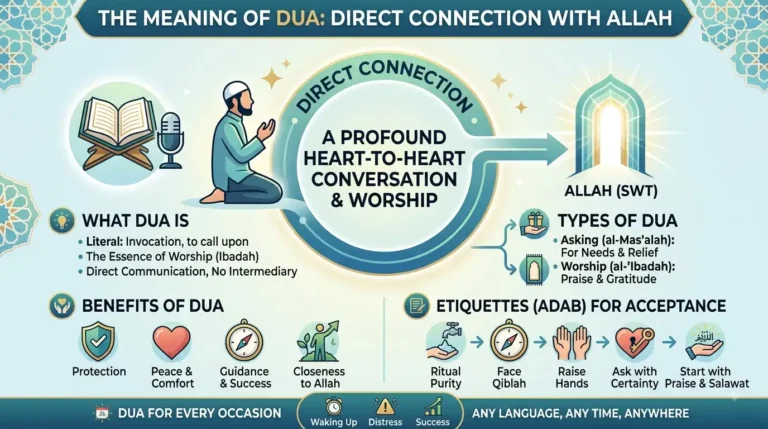
“Dua is worship itself.” — Tirmidhi

Dua is not a last resort. It is the most direct connection between a servant and their Lord. And Rabbana duas are its purest form.


What Are Rabbana Duas in English?

The word “Rabbana” means “Our Lord” in Arabic. Every dua in the Quran that begins with this word is a direct supplication taught by Allah to His servants — placed in the Quran as a gift, a guide, and a guarantee.

These are not duas that scholars invented or that believers improvised. They are divine supplications, directly revealed, preserved in the Quran word for word. When you say a Rabbana dua, you are using the exact words that Allah chose to teach humanity how to speak to Him.

There are over 40 Rabbana duas in the Quran — spanning every human need. Guidance. Forgiveness. Protection from hellfire. Mercy for parents. Strength in difficulty. Goodness in this life and the next. Steadfastness on the straight path. Allah covered everything.

Understanding them in English does not diminish their power — it deepens your connection to what you are saying. Many Muslims recite these duas in Arabic without fully grasping their meaning. When you understand each word, the dua moves from the tongue into the heart. And that is where Allah listens most.

These supplications are also theologically perfect. They ask for what truly matters, They are free from the mistakes human beings make when they do not know what to ask for. They are proofs that Allah knew every need you would ever have — before you were born — and He answered them in advance in His Book.


20 Rabbana Duas in English by Purpose

For Forgiveness, Mercy, and Spiritual Healing

(Emotions: confession, grief, hope, surrender, healing)

Confession

Arabic: رَبَّنَا ظَلَمْنَا أَنفُسَنَا وَإِن لَّمْ تَغْفِرْ لَنَا وَتَرْحَمْنَا لَنَكُونَنَّ مِنَ الْخَاسِرِينَ 

Roman: Rabbana zalamna anfusana wa il-lam taghfir lana wa tarhamna lanakunanna minal-khasirin 

English: “Our Lord, we have wronged ourselves, and if You do not forgive us and have mercy upon us, we will surely be among the losers.” — Surah Al-A’raf 7:23

Ya Allah, I come to You with this dua of our parents Adam and Hawa — because it is mine too. I have wronged myself. I have fallen short in ways I can name and in ways I cannot, I have no defense except Your mercy. And Your mercy, I know, is greater than every sin I have ever committed.

Grief

Arabic: رَبَّنَا لَا تُزِغْ قُلُوبَنَا بَعْدَ إِذْ هَدَيْتَنَا وَهَبْ لَنَا مِن لَّدُنكَ رَحْمَةً 

Roman: Rabbana la tuzigh qulubana ba’da idh hadaytana wa hab lana milladunka rahmah 

English: “Our Lord, do not let our hearts deviate after You have guided us, and grant us from Yourself mercy.” — Surah Ali ‘Imran 3:8

There is grief in realizing how easily the heart can drift, Ya Rabb. I have felt it — the spiritual distance that crept in quietly during a difficult season. I am saying this dua today not as a formality but as a desperate plea: do not let my heart turn away from You. Hold it. Keep it close.

Hope

Arabic: رَبَّنَا إِنَّكَ جَامِعُ النَّاسِ لِيَوْمٍ لَّا رَيْبَ فِيهِ ۚ إِنَّ اللَّهَ لَا يُخْلِفُ الْمِيعَادَ 

Roman: Rabbana innaka jami’un-nasi li-yawmil la rayba fih, innallaha la yukhlifu mee’ad 

English: “Our Lord, surely You will gather the people for a Day about which there is no doubt. Indeed, Allah does not fail in His promise.” — Surah Ali ‘Imran 3:9

This dua fills me with hope, Ya Allah — because it reminds me that justice is coming. Every tear that went unwitnessed. Every wrong that went uncorrected. You are gathering all of it for a Day of complete accounting. And You never break Your promise. That is enough to keep me going.

Surrender

Arabic: رَبَّنَا آمَنَّا فَاغْفِرْ لَنَا وَارْحَمْنَا وَأَنتَ خَيْرُ الرَّاحِمِينَ 

Roman: Rabbana amanna faghfir lana warhamna wa anta khayrur-rahimin

English: “Our Lord, we have believed, so forgive us and have mercy upon us, and You are the best of the merciful.” — Surah Al-Mu’minun 23:109

Ya Rabb, I surrender everything to that one fact — You are the best of those who show mercy. Not just merciful. The best of the merciful. I place my sins, my struggles, my entire spiritual state in the hands of that mercy today. I have nothing else to offer except iman and this dua.

Healing

Arabic: رَبَّنَا اصْرِفْ عَنَّا عَذَابَ جَهَنَّمَ ۖ إِنَّ عَذَابَهَا كَانَ غَرَامًا 

Roman: Rabbanas-rif ‘anna ‘adhaba jahannama inna ‘adhabaha kana gharama English: “Our Lord, avert from us the punishment of Hell. Indeed, its punishment is ever adhering.” — Surah Al-Furqan 25:65

The fear of the Fire is not morbid — it is a healer of the soul, Ya Allah. This dua heals complacency. It heals spiritual laziness. When I say it with sincerity, it wakes something in me that needs waking. Protect me from the Fire — and let that protection begin by making me someone who fears You enough to live accordingly.


For Goodness in This World and the Next

(Emotions: gratitude, awe, wonder, trust, longing)

Gratitude

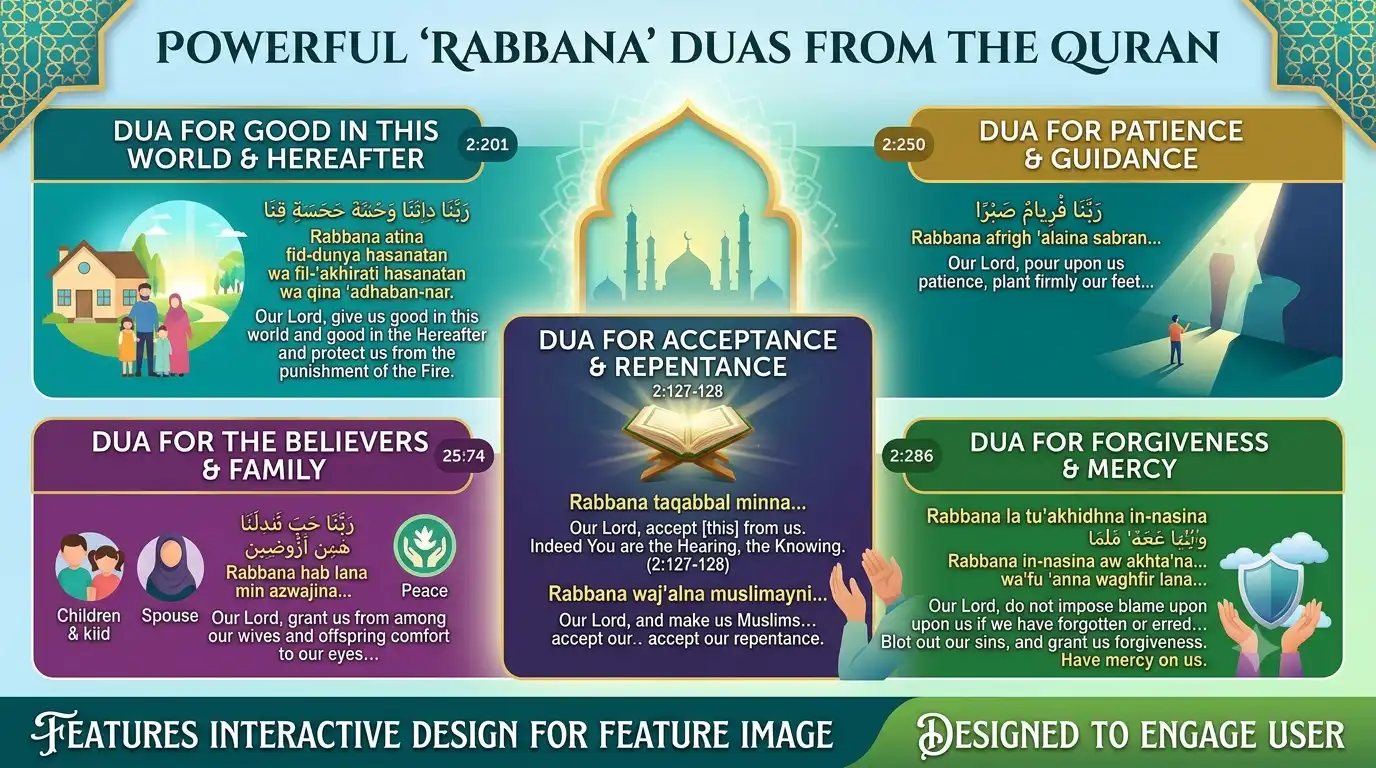
Arabic: رَبَّنَا آتِنَا فِي الدُّنْيَا حَسَنَةً وَفِي الْآخِرَةِ حَسَنَةً وَقِنَا عَذَابَ النَّارِ 

Roman: Rabbana atina fid-dunya hasanatan wa fil-akhirati hasanatan wa qina ‘adhaban-nar 

English: “Our Lord, give us good in this world and good in the Hereafter, and protect us from the punishment of the Fire.” — Surah Al-Baqarah 2:201

This is the dua that THE PROPHET HAZRAT MUHAMMAD ﷺ made most frequently. And when I say it, I feel grateful — because in three sentences, everything I could ever want is already covered. Good health, Good relationships. Good provision. A good death. A good ending. And protection from the worst of ends. Thank You, Ya Allah, for teaching us to ask for everything in so few words.

Awe

Arabic: رَبَّنَا مَا خَلَقْتَ هَٰذَا بَاطِلًا سُبْحَانَكَ فَقِنَا عَذَابَ النَّارِ 

Roman: Rabbana ma khalaqta hadha batila subhanaka faqina ‘adhaban-nar

English: “Our Lord, You did not create this in vain. Glory be to You! So protect us from the punishment of the Fire.” — Surah Ali ‘Imran 3:191

I am in awe when I say this dua — because it forces me to look at the universe and see it clearly. Not as random. Not as purposeless. As perfectly, intentionally created by a God who does nothing in vain. That awareness changes how I walk through my day. Everything has meaning when its Creator does nothing without purpose.

Wonder

Arabic: رَبَّنَا وَسِعْتَ كُلَّ شَيْءٍ رَّحْمَةً وَعِلْمًا فَاغْفِرْ لِلَّذِينَ تَابُوا وَاتَّبَعُوا سَبِيلَكَ 

Roman: Rabbana wasi’ta kulla shay’ir rahmatan wa ‘ilman faghfir lilladhina tabu wattaba’u sabilak 

English: “Our Lord, You encompass all things in mercy and knowledge, so forgive those who have repented and followed Your way.” — Surah Ghafir 40:7

The angels say this dua for us, Ya Allah — and that fills me with wonder. Beings of pure light, who have never sinned, are raising their hands for me. For us. Because You encompass everything in mercy and knowledge, they trust that You will forgive. Let me have even a fraction of the certainty in Your mercy that Your angels have.

Trust

Arabic: رَبَّنَا عَلَيْكَ تَوَكَّلْنَا وَإِلَيْكَ أَنَبْنَا وَإِلَيْكَ الْمَصِيرُ 

Roman: Rabbana ‘alayka tawakkalna wa ilayka anabna wa ilaykal-masir 

English: “Our Lord, upon You we have relied, and to You we have returned, and to You is the final destination.” — Surah Al-Mumtahanah 60:4

This dua is complete tawakkul in three phrases. I place my trust in You, Ya Allah — not in my planning, not in my connections, not in my savings account, I return to You. I am going to You eventually. That knowledge makes every difficulty smaller and every provision more precious. You are the destination. Everything else is just the journey.

Longing

Arabic: رَبَّنَا هَبْ لَنَا مِنْ أَزْوَاجِنَا وَذُرِّيَّاتِنَا قُرَّةَ أَعْيُنٍ وَاجْعَلْنَا لِلْمُتَّقِينَ إِمَامًا 

Roman: Rabbana hab lana min azwajina wa dhurriyyatina qurrata a’yunin waj’alna lil-muttaqina imama 

English: “Our Lord, grant us from among our wives and offspring comfort to our eyes and make us a leader for the righteous.” — Surah Al-Furqan 25:74

Ya Allah, the longing in this dua reaches the deepest part of me. I do not just want a family — I want a righteous family, I want children whose iman makes my eyes cool with joy. I want a home where salah is heard and the Quran is loved. And beyond my home — I want to be someone whose example points others toward You.


For Strength, Steadfastness, and Facing Difficulty

(Emotions: courage, desperation, boldness, intercession, peace)

Courage

Arabic: رَبَّنَا أَفْرِغْ عَلَيْنَا صَبْرًا وَثَبِّتْ أَقْدَامَنَا وَانصُرْنَا عَلَى الْقَوْمِ الْكَافِرِينَ 

Roman: Rabbana afrigh ‘alayna sabran wa thabbit aqdamana wansurna ‘alal-qawmil kafirin 

English: “Our Lord, pour upon us patience and plant firmly our feet and give us victory over the disbelieving people.” — Surah Al-Baqarah 2:250

The soldiers of Talut said this dua before a battle they were vastly outnumbered in — and they won. Ya Allah, I face battles too. Not always physical. Sometimes the hardest fights are inside me — against despair, against self-doubt, against giving up on what is right. Pour patience on me. Plant my feet. Give me victory.

Desperation

Arabic: رَبَّنَا لَا تَجْعَلْنَا مَعَ الْقَوْمِ الظَّالِمِينَ 

Roman: Rabbana la taj’alna ma’al-qawmiz-zalimin 

English: “Our Lord, do not place us with the wrongdoing people.” — Surah Al-A’raf 7:47

Ya Rabb, I say this dua with desperation — because I have seen what happens when a person is surrounded by the wrong people in the wrong environment. Protect me from that proximity. Protect my children from it. Let neither my company nor my community pull me toward what You have forbidden. This is not a small ask. It is everything.

Boldness

Arabic: رَبَّنَا لَا تُؤَاخِذْنَا إِن نَّسِينَا أَوْ أَخْطَأْنَا 

Roman: Rabbana la tu’akhidhna in nasina aw akhta’na 

English: “Our Lord, do not punish us if we forget or make mistakes.” — Surah Al-Baqarah 2:286

I love the boldness of this dua — because it asks Allah directly: forgive our forgetfulness and our errors. And do You know what Allah said when this verse was revealed? He said: “I have done so.” — Sahih Muslim. Ya Allah, knowing that You already said yes to this dua makes me bold enough to say it with everything I have.

Intercession

Arabic: رَبَّنَا اغْفِرْ لِي وَلِوَالِدَيَّ وَلِلْمُؤْمِنِينَ يَوْمَ يَقُومُ الْحِسَابُ 

Roman: Rabbana-ghfir li wa li-walidayya wa lil-mu’minina yawma yaqumul-hisab

English: “Our Lord, forgive me and my parents and the believers the Day the account is established.” — Surah Ibrahim 14:41

This is the dua of Ibrahim ﷺ — and when I say it, I feel the weight of intercession. Not just for myself but for my mother and father, for every believer who has ever lived. Ya Allah, on the Day when accounts are opened, let mercy cover us all. Let this dua reach every parent, every believer, across every generation.

Peace

Arabic: رَبَّنَا آتِنَا مِن لَّدُنكَ رَحْمَةً وَهَيِّئْ لَنَا مِنْ أَمْرِنَا رَشَدًا 

Roman: Rabbana atina milladunka rahmatan wa hayyi’ lana min amrina rashada

English: “Our Lord, grant us from Yourself mercy and prepare for us from our affair right guidance.” — Surah Al-Kahf 18:10

The people of the Cave said this dua before they slept — not knowing they would be protected for 309 years. Ya Allah, when I do not know what is coming, when the future is unclear and the present is confusing — give me mercy from Yourself and guide my situation toward what is right. That peace is enough. It always has been.


For Parents, Family, and Future Generations

(Emotions: longing for legacy, awe at parenthood, trust in Allah’s plan, wonder at His decree)

Longing for legacy

Arabic: رَبِّ اجْعَلْنِي مُقِيمَ الصَّلَاةِ وَمِن ذُرِّيَّتِي ۚ رَبَّنَا وَتَقَبَّلْ دُعَاءِ 

Roman: Rabbi-j’alni muqimas-salati wa min dhurriyyati, Rabbana wa taqabbal du’a

English: “My Lord, make me an establisher of prayer, and [many] from my descendants. Our Lord, and accept my supplication.” — Surah Ibrahim 14:40

Ya Allah, the deepest longing of my heart is to leave behind children who pray. Not children who are successful by the world’s measure — children who stand before You in salah every day of their lives. Make that my legacy. Make it their identity. Accept this dua — the dua of Ibrahim, the dua of every Muslim parent since.

Awe at parenthood

Arabic: رَبِّ أَوْزِعْنِي أَنْ أَشْكُرَ نِعْمَتَكَ الَّتِي أَنْعَمْتَ عَلَيَّ وَعَلَىٰ وَالِدَيَّ 

Roman: Rabbi awzi’ni an ashkura ni’matakal-lati an’amta ‘alayya wa ‘ala walidayya English: “My Lord, enable me to be grateful for Your favor which You have bestowed upon me and upon my parents.” — Surah Al-Ahqaf 46:15

When I became a parent, Ya Allah, I finally understood this dua. The moment I held my child, I felt awe — genuine, overwhelming awe — at what You gave me. And I thought of my own parents. The sacrifices I never fully counted. This dua is how I honor all of it — by asking You to make me a person capable of true, continuous gratitude for what I have been given.

Trust in Allah’s plan

Arabic: رَبَّنَا وَأَدْخِلْهُمْ جَنَّاتِ عَدْنٍ الَّتِي وَعَدتَّهُمْ 

Roman: Rabbana wa adkhilhum jannati ‘adninilati wa’adtahum 

English: “Our Lord, and admit them to gardens of perpetual residence which You have promised them.” — Surah Ghafir 40:8

The angels make this dua for the believers and their righteous families, Ya Allah. I am asking the same — for my parents, my children, my spouse, every person I love. Admit them to Jannah, Ya Rabb. Not because any of us earned it — but because You promised it to those who believed and did right. We are trying. Accept the trying.

Wonder at His decree

Arabic: رَبَّنَا لَا تَجْعَلْ فِي قُلُوبِنَا غِلًّا لِّلَّذِينَ آمَنُوا 

Roman: Rabbana la taj’al fi qulubina ghillan lilladhina amanu 

English: “Our Lord, do not put in our hearts [any] resentment toward those who have believed.” — Surah Al-Hashr 59:10

Ya Allah, the wonder of this dua is that it asks You to purify something invisible — the heart. Not just actions. Not just words. The heart itself. Remove every trace of resentment, jealousy, and hidden bitterness from within me toward my brothers and sisters in Islam. Make my heart clean for the believers the way You made it for You.


Why Rabbana Duas in English Transform Your Relationship With Allah

A sister I know used to recite Rabbana duas after every salah — in Arabic — for years. She was consistent, punctual, and sincere.

Then she started learning what they meant in English. Really understanding each word.

She told me — “It was like the dua finally moved from my lips into my chest. I had been saying the words for years. I was finally saying the meaning.”

That is the transformation these duas offer. Not a new practice — a deeper level of the one you already have.

THE PROPHET HAZRAT MUHAMMAD ﷺ said:

“ادْعُوا اللَّهَ وَأَنتُمْ مُوقِنُونَ بِالإِجَابَةِ” 

“Ud’ullaha wa antum muqinuna bil-ijaba” 

“Call upon Allah while being certain of His response.” — Tirmidhi

Certainty in response comes from understanding what you are asking. When you know the meaning of every word in a Rabbana dua, certainty becomes natural. You are not reciting — you are conversing with your Lord.


15 Powerful Rabbana Dua Points for Daily Strength

One dua need — one line — for every situation:

  • 🤲 When you have sinned and feel distant — “Rabbana zalamna anfusana — acknowledge the wrong and ask for mercy immediately.”
  • 💪 When facing an overwhelming task — “Rabbana afrigh ‘alayna sabran — ask for patience poured upon you like rain.”
  • 🏠 For a righteous family — “Rabbana hab lana min azwajina — ask for the coolness of your eyes in your spouse and children.”
  • 🌍 For balance between dunya and akhirah — “Rabbana atina fid-dunya hasanatan — the most comprehensive dua ever taught.”
  • 😔 When the heart feels spiritually dry — “Rabbana la tuzigh qulubana — beg Allah not to let your heart deviate.”
  • ⚔️ When facing injustice or oppression — “Rabbana la taj’alna ma’al-qawmiz-zalimin — ask to never be placed among the wrongdoers.”
  • 👨‍👩‍👧 For deceased parents — “Rabbana-ghfir li wa li-walidayya — make this dua after every salah for them.”
  • 🔄 When seeking forgiveness for mistakes — “Rabbana la tu’akhidhna in nasina aw akhta’na — Allah already promised to accept this.”
  • 🌙 Before sleep or a new beginning — “Rabbana atina milladunka rahmatan — ask for mercy and right guidance from Allah alone.”
  • 📖 For children who will pray — “Rabbani-j’alni muqimas-salati — make it your legacy dua for your family.”
  • 🕊️ For peace among believers — “Rabbana la taj’al fi qulubina ghillan — ask for a heart free of resentment.”
  • 💸 When in financial difficulty — “Rabbana atina fid-dunya hasanatan — ask for hasanah in all its forms.”
  • 🏥 For healing and health — “Rabbanas-rif ‘anna ‘adhaba jahannam — spiritual protection protects the whole person.”
  • 🎯 For purpose and direction — “Rabbana wa hayyi’ lana min amrina rashada — ask for right guidance in your affairs.”
  • ❤️ Every single day — “Rabbana amanna faghfir lana warhamna — three words of iman and two requests. That is enough.”

Rabbana Duas in English for Protection and Peace

Protection Duas

1. Ya Allah, I am saying Rabbana la tuzigh qulubana today as a shield — not just a request but a daily spiritual protection over my heart. The heart that goes crooked destroys everything else with it. Keep mine straight, Keep it yours. Keep it from every deviation, every distraction, every pull toward what is not You.

2. Rabbana la taj’alna ma’al-qawmiz-zalimin — Ya Allah, I am praying this dua for protection from harmful environments, harmful companions, and harmful influences. Protect me from proximity to oppression and corruption. Let the people around me be those who bring me closer to You, not further away. That protection is worth more than any worldly security I could build for myself.

3. Ya Rabb, I am saying the dua of the Ashab al-Kahf — Rabbana atina milladunka rahmatan — because they were young people who needed protection from a society that wanted to destroy their faith. Cover me and every young Muslim with the same mercy You covered them with. Let us find our cave of protection in tawakkul on You.

4. Rabbana-ghfir lana dhunubana wa israfana fi amrina — Ya Allah, protect me from the consequences of my own excess and wrongdoing. I have been careless with my time, my words, my choices. That carelessness has consequences. Forgive it. And protect me from the full weight of what I would deserve without Your mercy covering me.


Peace Duas

1. When anxiety visits and the night is long, Ya Allah, I return to Rabbana atina fid-dunya hasanatan. In six words, everything I am anxious about is addressed — this life and the next, covered and protected. That dua does not just ask for peace. It is peace. Let it settle into me every time I say it.

2. Ya Rabb, the peace I am asking for through these Rabbana duas is not the absence of hardship. It is the presence of You in every hardship. Rabbana la tuzigh qulubana — keep my heart steady. Let the storms come, but let my heart remain anchored to You. That is the only peace that actually holds.

3. Rabbana hab lana min azwajina wa dhurriyyatina qurrata a’yunin — Ya Allah, the greatest peace I could experience on earth is a home filled with people whose righteousness makes my heart cool. Build that for me. Let my family be my peace, not my war. Let the people I love most be the ones who bring me closest to You.


Rabbana Duas in English for Specific Situations

💼 For Career, Livelihood, and Worldly Success

Ya Allah, I am saying Rabbana atina fid-dunya hasanatan over my work today — because hasanah in dunya covers everything good in this life. Good income, Good relationships with colleagues. Good reputation. Work that is halal and beneficial. Protect my career from what is haram. Open doors of provision I have not knocked on yet. Give me the ability to earn with dignity and to give with gratitude. Let my work be ‘ibadah — an act of worship done with excellence and sincere intention.


💔 For a Broken Heart or Difficult Relationship

Rabbana hab lana min azwajina qurrata a’yunin — Ya Allah, I am saying this dua through grief today. The relationship I had hoped for has brought me pain instead of peace. Heal what is broken in my heart. If this person is not right for me, release both of us with gentleness. If there is repair possible, guide us toward it with Your wisdom. Give me the kind of love that cools my eyes — not the kind that keeps them red from crying.


🏥 For Illness and Physical Healing

Ya Allah, I am raising my hands today with Rabbana atina fid-dunya hasanatan — because good health is the greatest hasanah of dunya. Heal what is sick in my body. Give wisdom to my doctors. Let my recovery be swift or my endurance be complete — whichever serves Your plan for me best. Protect me from despair during illness. Let every day of difficulty in sickness be an expiation of sins and a raising of ranks. You are As-Shafi — the Healer. I call on that name today with everything I have.


👨‍👩‍👧 For Children and Their Future

Rabbani-j’alni muqimas-salati wa min dhurriyyati — Ya Allah, this is the dua I carry for my children every single day. Make them people who pray. Not people who are forced to pray — people who love it. People who feel incomplete without it. Plant that love in their hearts so early and so deep that the world cannot pull it out. Let the legacy of this family be prayer — generation after generation, long after I am gone.


📖 For Spiritual Growth and Closeness to Allah

Rabbana la tuzigh qulubana ba’da idh hadaytana wa hab lana milladunka rahmatan — Ya Allah, I am asking for the most important thing a believer can ask for: to stay guided. Guidance is not a one-time gift. It is a daily renewal. I am renewing my request today. Do not let my heart drift. Do not let success make me arrogant or failure make me hopeless. Keep me close. That is all I truly need.


What Changes When Rabbana Duas Become Your Daily Practice

For the first week, you might read them from a screen. You say the Arabic. You read the English. It feels like learning rather than living.

But then something happens around week two.

You are in the middle of a difficult conversation and Rabbana la tuzigh qulubana surfaces in your mind — unprompted. You are stressed about money and Rabbana atina fid-dunya hasanatan rises naturally in your heart, You have made a mistake and Rabbana zalamna anfusana is already on your lips before you consciously decided to pray.

That is when you know the duas have moved from your memory into your marrow.

THE PROPHET HAZRAT MUHAMMAD ﷺ said:

“مَا مِنْ مُسْلِمٍ يَدْعُو اللَّهَ بِدُعَاءٍ لَيْسَ فِيهِ إِثْمٌ وَلَا قَطِيعَةُ رَحِمٍ إِلَّا أَعْطَاهُ اللَّهُ إِحْدَى ثَلَاثٍ”

 “Ma min Muslimin yad’ullaha bi-du’ain laysa fihi ithmun wa la qati’atu rahimin illa a’tahu Allahu ihda thalath” 

“There is no Muslim who calls upon Allah with a dua containing no sin and no cutting of ties of kinship, except that Allah gives him one of three things.” — Ahmad

A du’a answered. A reward stored. A harm removed. Every single time. That is what consistent Rabbana dua practice guarantees — not always what you asked for, but always something better than having not asked.


How to Make Rabbana Duas a Daily Habit — 10 Steps

  1. Learn one Rabbana dua per week — start with Al-Baqarah 2:201. Master the Arabic, memorize the meaning, understand the context. One dua deeply understood beats ten duas barely known.
  2. Say three Rabbana duas after every salah — rotate through them. This turns five daily prayers into fifteen daily encounters with Quranic supplication.
  3. Understand the context of each dua — who said it in the Quran, in what situation. That context makes the dua alive, not mechanical.
  4. Keep a Rabbana dua card on your prayer mat — written in Arabic with English meaning beside it. Your eyes will absorb it even before you consciously read it.
  5. Choose one dua as your personal anchor dua — the one that speaks to your current life situation most directly. Say it morning and evening.
  6. Teach one Rabbana dua to your children every month — children who learn these duas young carry them for life.
  7. Use the English meanings for deep reflection on Fridays — read each Rabbana dua slowly in English as a spiritual meditation before Jumu’ah.
  8. Say Ameen with full conviction after each dua — Ameen is not a formality. It is a declaration that you believe Allah will respond.
  9. Track answered duas — keep a simple notebook. When a Rabbana dua is answered, write it down. This record becomes your strongest faith fuel.
  10. End every night with Rabbana atina fid-dunya hasanatan — let the last words on your lips before sleep be a request for goodness in both worlds. It is how many of the salaf ended every day.

Iman Declarations to Strengthen Your Dua Practice

  1. I am a servant whose Lord taught him how to ask — the Rabbana duas are my divine gift.
  2. I have direct access to Allah through dua — no intermediary, no appointment, no rejection.
  3. Allah is Al-Mujeeb — the One who responds — and every Rabbana dua I make is heard.
  4. I am saying the same words that the Prophets said — and Allah responded to them.
  5. I have certainty that my dua is never wasted — it is answered, stored, or exchanged for something better.
  6. Allah is closer to me than my jugular vein — and the Rabbana duas are how I acknowledge that closeness.
  7. I am building a relationship with Allah through these Quranic supplications — word by word, day by day.
  8. I have the best words ever spoken — the words of the Quran — as my daily conversation with my Creator.
  9. Allah is not burdened by my repeated requests — He loves that I keep asking.
  10. I am a person of dua — and that single practice protects, guides, and transforms everything else in my life.

Quotes to Carry Into Every Dua

  1. “When you say Rabbana, you are calling on the same Lord that Ibrahim called on — and He still answers.”
  2. “The dua Allah put in His Book is the dua He already wanted you to make.”
  3. “Understanding what you are asking doubles the certainty with which you ask it.”
  4. “Rabbana duas are not just prayers — they are the Quran speaking for you when your own words run out.”
  5. “Allah taught you how to ask for everything. The only question is whether you will ask.”
  6. “A Rabbana dua said with understanding reaches a place that the same words said without it cannot.”
  7. “The angels are making dua for you right now — match their effort with your own.”
  8. “Every Rabbana dua in the Quran was preserved for the generation that needed it most — and that is every generation.”
  9. “You are not begging when you make dua — you are claiming what your Lord invited you to receive.”
  10. “The servant who says Rabbana with a full heart will never feel abandoned — because a Lord being called is a Lord who is present.”

Common Questions About Rabbana Duas in English Answered

How many Rabbana duas are in the Quran? There are approximately 40 Rabbana duas in the Quran — spread across multiple surahs, addressing every human need from forgiveness to family, from protection to provision. Scholars have collected and categorized them, and memorizing even ten of them gives a Muslim a comprehensive arsenal of divine supplication for daily life.

Can I make Rabbana duas in English if my Arabic is weak? Yes — and understanding the meaning in English is actually encouraged to deepen your khushu (concentration) in dua. However, memorizing even the short Arabic forms is highly recommended as the Prophet ﷺ and the Sahaba used these in Arabic. The ideal is Arabic pronunciation plus English comprehension — both together.

Is there a specific time to say Rabbana duas? The best times for any dua are the last third of the night, between adhan and iqamah, after fardh prayers, during sujood, on Fridays, and when fasting. Rabbana duas can and should be said at all of these times.

THE PROPHET HAZRAT MUHAMMAD ﷺ said:

“أَقْرَبُ مَا يَكُونُ الْعَبْدُ مِنْ رَبِّهِ وَهُوَ سَاجِدٌ” 

“Aqrabu ma yakunu al-‘abdu min Rabbihi wa huwa sajid” 

“The closest a servant is to his Lord is when he is in prostration.” — Muslim

So the Rabbana duas said in sujood carry extraordinary weight.

Why do Rabbana duas feel more powerful than personal duas? Because they are divinely author. When you make a personal dua, you are asking in your own words — which is beautiful and encouraged. When you make a Rabbana dua, you are asking in the words Allah chose for you. There is a completeness to them, a theological precision, and a spiritual authority that personal duas often lack simply because human beings do not always know what to ask for.

Do I need wudu to say Rabbana duas? Wudu is not require for dua — you can make dua at any time, in any state, in any direction. However, being in a state of purity, facing the qiblah, and raising your hands adds to the adab (etiquette) of dua and generally deepens its quality.


Final Thoughts on Rabbana Dua in English

You have just read through some of the most powerful words ever spoken in human history — words not composed by scholars, not invented by saints, but revealed by Allah Himself and placed in His final Book.

Every Rabbana dua in English you have read today was first said by a Prophet, a believer, or an angel — in moments of need, moments of gratitude, moments of fear and moments of love. And they preserved for you. For this exact moment. For whatever you are going through right now.

Do not let them sit on a screen. Take one. Say it today, Say it tomorrow. Say it after Fajr when the world is quiet and your Lord is near.

THE PROPHET HAZRAT MUHAMMAD ﷺ told us:

“إِنَّ اللَّهَ يُحِبُّ الْمُلِحِّينَ فِي الدُّعَاءِ”

 “Innallaha yuhibbu al-mulihina fid-du’a”

 “Indeed, Allah loves those who are persistent in dua.” — Ibn Hibban

Be persistent. Be specific. Be certain.

Because the Lord who taught you how to ask has never once failed to hear.

Leave a Comment